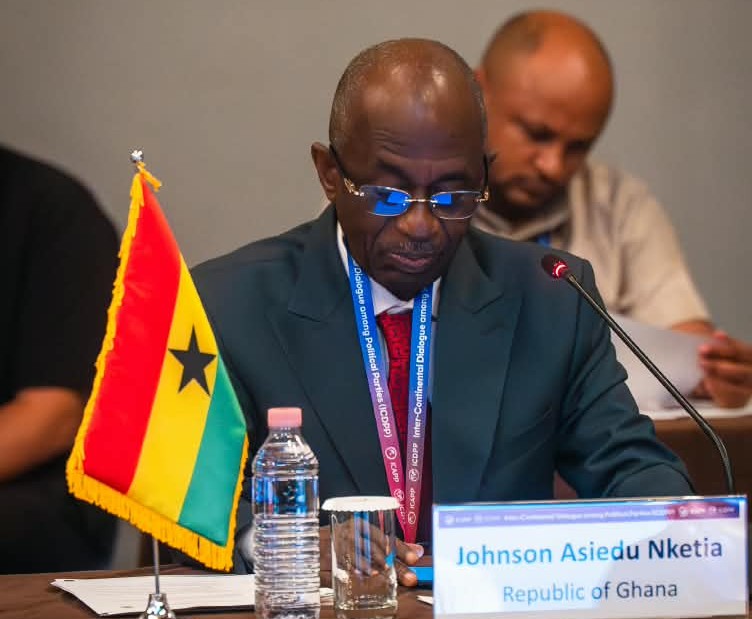

National Chairman of the National Democratic Congress (NDC) Johnson Asiedu Nketiah, has been elected as the inaugural Chairman of the African Political Parties Initiative (APPI).
He accepted the responsibility on Saturday, November 7, at the African Political Parties Summit 2026 in Addis Ababa, Ethiopia, on behalf of the inaugural leadership of the Initiative.
“On behalf of the inaugural leadership of the African Political Parties Initiative, I accept the responsibility of serving as Chair with gratitude to the participating political parties and with great respect for the colleagues with whom I will serve,” he said.
He acknowledged the Africa Governance Centre for establishing APPI and for bringing political parties from across the continent into a common forum.
“The consensus has been reached, the leadership has been constituted, and our attention now turns to the work,” he said.
Parties Are Where Future Governments Are Formed
Mr Asiedu Nketiah said he comes to the responsibility as National Chairman of the NDC, noting that the party supported APPI from its early stages and will continue to support its work.
He argued that political parties must take a longer view of their responsibility, because power changes hands more quickly than nations change.
“Those who govern today may sit in opposition tomorrow, and those in opposition may later inherit the institutions they once criticised,” he said.
“A political party is not merely an organisation for winning elections. It is one of the places in which future government is formed. Long before a minister takes an oath, people have already learnt how power is exercised, whether evidence matters, whether competence is respected and whether institutions are taken seriously. What happens inside political parties eventually enters the state.”
*A Different Africa in 15 Years*
The new APPI Chair warned that the Africa political parties will govern over the next fifteen years will be very different from the Africa in which many present political institutions were formed.
He cited the continent’s population, which has passed 1.5 billion and is projected to approach 2.5 billion by 2050; between 10 and 12 million young Africans entering the labour market each year while only around 3 million formal jobs are created; hundreds of millions still lacking access to electricity; and Africa accounting for only about 2 per cent of global manufacturing value added.
At the same time, he said, artificial intelligence is changing production and work, energy systems are being rebuilt, strategic minerals have acquired greater geopolitical importance, and countries are competing more aggressively for technology, capital, industry, supply chains and skilled people.
“African politics cannot prepare for that world with assumptions inherited from another age,” he said.
Capability, Not Just Resources
While Africa enters the period with considerable advantages — a young population, substantial natural resources, growing markets and an increasingly important place in the world economy — Mr Asiedu Nketiah said numbers alone do not create power.
“Resources alone do not create prosperity. A large market does not create industry merely because it exists. Countries become stronger when they acquire the capability to produce, to finance, to innovate, to organise and to sustain national purpose over time,” he said.
“Our minerals must support African industry. Our agricultural wealth must support processing and productive enterprise. Our markets must provide scale for African businesses. Our young people must become scientists, engineers, entrepreneurs, skilled workers and institution builders.”
He said political parties seeking responsibility for the state must know the country they propose to govern, understand the economy, the institutions they will inherit and the choices they will face when demands exceed available resources.
Parties, he said, need people who have studied industry, agriculture, trade, energy, technology, public finance and the machinery of government, and policy institutions capable of retaining knowledge beyond individual leaders.
“Electoral victory gives authority. The ability to govern well has to be built before victory comes.”
Development Takes Longer Than Political Terms
Mr Asiedu Nketiah also cautioned against the cycle of abandoning national progress with every change of government.
“Development takes longer than political terms. Industrial capacity, energy systems, transport networks, universities, productive agriculture and strong public institutions are built over years,” he said.
“New governments have every right to change policies they believe have failed, but countries pay a heavy price when each political transition also disperses useful expertise, weakens functioning institutions or abandons investments that continue to serve the national interest.”
“Political maturity includes the ability to know what must change and what must be preserved. There is no virtue in wasting what works.”
APPI Agenda 2040
It is against this background, he said, that APPI Agenda 2040 must be developed.
The Agenda, he explained, will be shaped by African political parties themselves and will provide a common horizon for considering the institutions parties need, the capabilities they must develop and the leadership Africa will require in the years ahead.
“By 2040, many of the people who will occupy the highest political offices on this continent will be men and women who are already active within our parties today. Their political formation is taking place now,” he said.
“The standards we set, the knowledge we value and the responsibilities we entrust to them will influence the governments they eventually lead.”
For that reason, he called for party schools, policy institutes, research institutions and systems for preserving institutional memory to be given a more important place in African political life.
He also said women and young people must move beyond structures created principally for mobilisation and into the places where policy is developed, resources are allocated and political authority is exercised.
“The continent cannot afford to leave large reserves of talent outside the rooms in which its future is decided.”
Collective Leadership
Mr Asiedu Nketiah said the leadership of APPI will carry the work forward collectively, relying on Presidents, Chairpersons and Secretaries-General of participating parties, Regional Vice-Chairs, the leadership of the Africa Governance Centre and the Secretariat as consultations on Agenda 2040 proceed across the continent.
He said APPI will continue engagement with political parties and political institutions beyond Africa, while noting that Africa enters those conversations with experience of its own.
“Our political parties have led liberation movements, governed newly independent states, negotiated democratic transitions, managed conflict and reconstruction, and governed through economic crises and constitutional change. That history has produced knowledge that belongs in the global political conversation,” he said.
Closing his address, he said the balance of the world is changing, and Africa’s demographic, economic and strategic weight will grow with it.
“The question is whether that weight will become productive power, prosperity and influence. That will depend in part on the quality of the political institutions we build now,” he said.
“By 2040, Africa will be larger, more urban, more connected and more exposed to the consequences of decisions taken elsewhere in the world. Its citizens will expect more from government, and they will have every right to do so.”
“APPI Agenda 2040 must therefore look beyond the next election and ask what kind of political institutions can carry Africa confidently into that future. The generation that will lead that Africa is already among us. Our responsibility is to ensure that when its moment comes, it inherits institutions equal to the demands it will face,” he said.