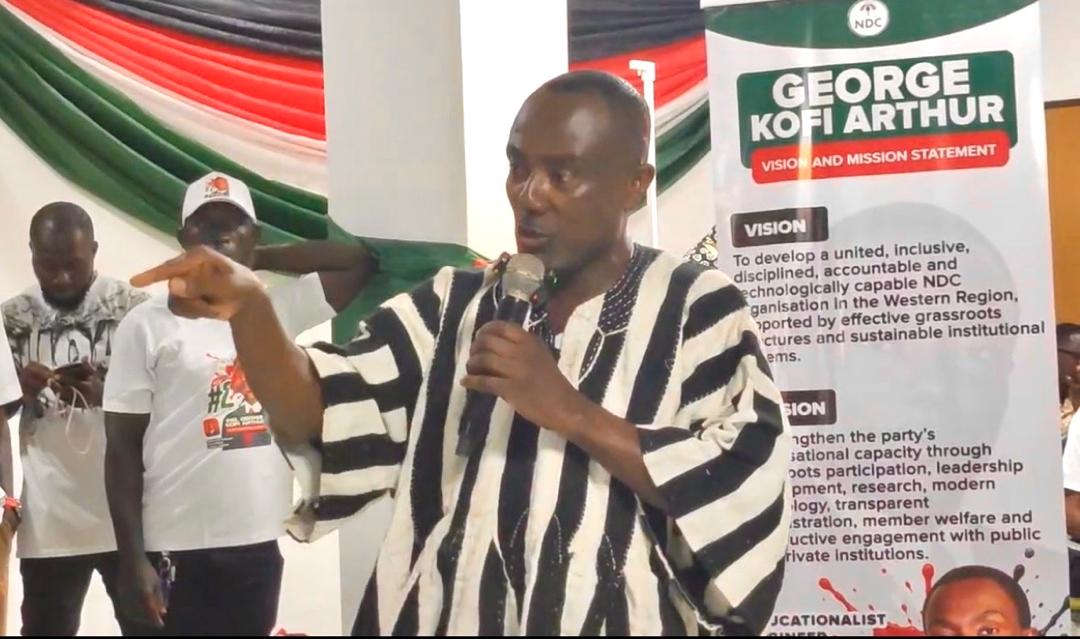

Former three-term Member of Parliament for Amenfi Central, George Kofi Arthur, has outlined a vision of financial independence, institutional strengthening and economic empowerment for the National Democratic Congress (NDC) in the Western Region.
He argued that the party must move beyond a culture of financial dependency towards a sustainable system capable of supporting its structures and members.
Mr Arthur, who is seeking to become the next Western Regional Chairman, believes the party’s branches, constituencies and regional administration must be equipped with the financial and organisational capacity to sustain their activities without constantly depending on external financial assistance.
He stated that a sustainable party organisation must be built around innovative revenue-generation initiatives, strategic partnerships and programmes that create economic opportunities for members while strengthening the party’s institutional structures.
“With me, the era where the party goes begging before anything could be done is going to be over. All it takes is a leader who will be able to implement programmes that will earn the party the necessary funds.”
He believes that the persistent disconnect between the various levels of party organisation has limited the ability of the NDC to harness its collective resources and respond effectively to the needs of its members.
“My proposed approach would prioritise stronger coordination, recognition of members’ contributions and an organisational environment that encourages participation and innovation.”
George Arthur’s proposition draws on twelve years of parliamentary experience, during which he represented Amenfi Central from 2005 to 2017, serving three consecutive terms in Ghana’s Fourth, Fifth and Sixth Parliaments.
A significant part of his parliamentary career was his chairmanship of the Select Committee on Defence and Interior, a position that exposed him to national security policy, institutional administration, budgetary scrutiny and the operational requirements of key state security agencies.
His involvement extended to the Committee on Poverty Reduction Strategy, which he chaired during parliamentary discussions with the National Development Planning Commission in March 2016 on Ghana’s Shared Growth and Development Agenda.
These responsibilities, he argues, provide relevant experience in institutional coordination, financial oversight, development planning and resource management.
“It is these experiences that I intend to bring into the administration of the party, particularly in developing sustainable funding mechanisms and improving the operational capacity of its structures. My professional background in engineering and construction further informs my development outlook. With my involvement in infrastructure projects across parts of the Western and Western North regions, I understand the importance of connecting economic opportunities with practical development planning.”
Beyond the internal affairs of the NDC, he says his ambition extends to unlocking the Western Region’s economic potential, arguing that the region must move from repeatedly highlighting its natural-resource endowment to developing practical initiatives that translate those resources into jobs, investment and improved livelihoods.
He identifies the region’s strategic seaport, extensive coastline, agricultural potential, mineral resources, industrial establishments and growing tertiary education sector as opportunities that could support a more diversified regional economy.
Among the possibilities he identifies is the development of targeted agricultural cooperative schemes, designed around the specific agricultural characteristics and production capacities of individual districts.
“Such arrangements, I believe, could improve access to inputs, technical support, markets and financing while strengthening the economic position of farmers.”
He also sees opportunities in partnerships with universities and other tertiary institutions to address infrastructure and service gaps, including student accommodation, while creating avenues for local businesses to participate in the expanding education economy.
“All these will open up many opportunities that the teeming youth in the party can take up and invariably address the growing frustrations of no jobs. This is what my leadership will be about.”
He insists that his proposed relationship between party organisation and regional development is interconnected.
“A party whose members have access to economic opportunities, professional development and sustainable welfare arrangements would be better positioned to maintain active grassroots structures and participate meaningfully in its organisational activities.”
He says his business experience, parliamentary background and exposure to development planning would inform his efforts to identify opportunities, build partnerships and mobilise resources for the benefit of party structures and members.
His broader proposition is that the Western Region’s development conversation must increasingly focus on identifying opportunities, developing workable partnerships and translating existing economic advantages into tangible outcomes.