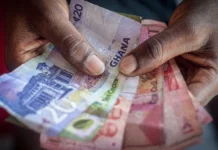
The National Tripartite Committee (NTC) has announced a new National Daily Minimum Wage (NDMW) for 2027 and 2028, in a move away from annual negotiations to a multi-year framework.
In a communique issued in Accra on Monday, November 10, 2026, the Committee — comprising Government, Employers and Organised Labour — said it had unanimously agreed on the new rates after extensive consultations.
Year | National Daily Minimum Wage | Effective Date
2027 | GH¢25.04 | 1 January 2027
2028 | GH¢28.79 | 1 January 2028
All establishments, institutions or organisations whose daily minimum wages are below the new NDMW are required to adjust accordingly, effective 1 January 2027.
The communique was jointly issued and signed by the Minister for Labour, Jobs and Employment, Hon. Emmanuel Kwadwo Agyekum (MP) for Government; the Deputy Minister for Finance, Hon. Thomas Nyarko Ampem (MP) for Government; Nana Dr. Emmanuel Adu-Sarkodee Afriyie, President of the Ghana Employers’ Association (GEA) for Employers; and Mr. Joshua Ansah, Secretary-General of the Trades Union Congress (TUC), Ghana, for Organised Labour.
A Shift to Multi-Year Bargaining
The Committee said the partners have agreed to adopt a multi-year negotiation framework to promote predictability in wage determination, facilitate medium-term planning and budgeting, protect workers’ incomes and sustain industrial harmony.
However, the deal is not locked in stone. The partners agreed that where there are material changes in key economic indicators, including inflation, exchange rates and economic growth, the Committee shall reconvene to review the agreed NDMW as circumstances may require. Any adjustment will be undertaken through tripartite consultations, guided by credible economic data and determined by consensus.
The Committee also commended all parties for the cooperation and understanding demonstrated throughout the negotiations and called on employers to comply fully with the agreed NDMW. It further urged government to make the NDMW tax exempt.
Background: What This Means in Context
The new rates represent a significant jump from the current wage.
Ghana’s national daily minimum wage for 2026 is GH¢21.77, following a 9 percent increase approved by the NTC from GH¢19.97 in 2025, effective January 1 to December 31, 2026.
Against that 2026 base:
– The 2027 rate of *GH¢25.04 is about 15% higher* than GH¢21.77
– The 2028 rate of *GH¢28.79 is about 15% higher* than the 2027 rate
In monthly terms, at 27 working days, the 2027 rate translates to roughly GH¢676 per month, compared to roughly GH¢588 per month on the 2026 rate. At 26 working days, it is roughly GH¢651 per month in 2027 and GH¢748 per month in 2028.
The increase comes against a long-running debate in Ghana about whether the minimum wage is a liveable wage. The TUC in 2025 called for a shift from the current minimum wage approach toward a living wage framework that considers essential needs such as housing, healthcare, education and transportation. 584a
It also comes months after President John Dramani Mahama assented to the Income Tax (Amendment) Act, 2026, on August 26, 2026, which exempts people who earn the national minimum wage or below from paying income tax. The Committee’s fresh call for the NDMW to be made tax exempt aligns with that law, and will be watched closely by workers to see whether the exemption is applied to the new, higher rates in 2027 and 2028. f8c1
The Tripartite Partners reaffirmed their commitment to improving workers’ living standards, promoting productivity, protecting employment, sustaining business competitiveness and strengthening industrial harmony.