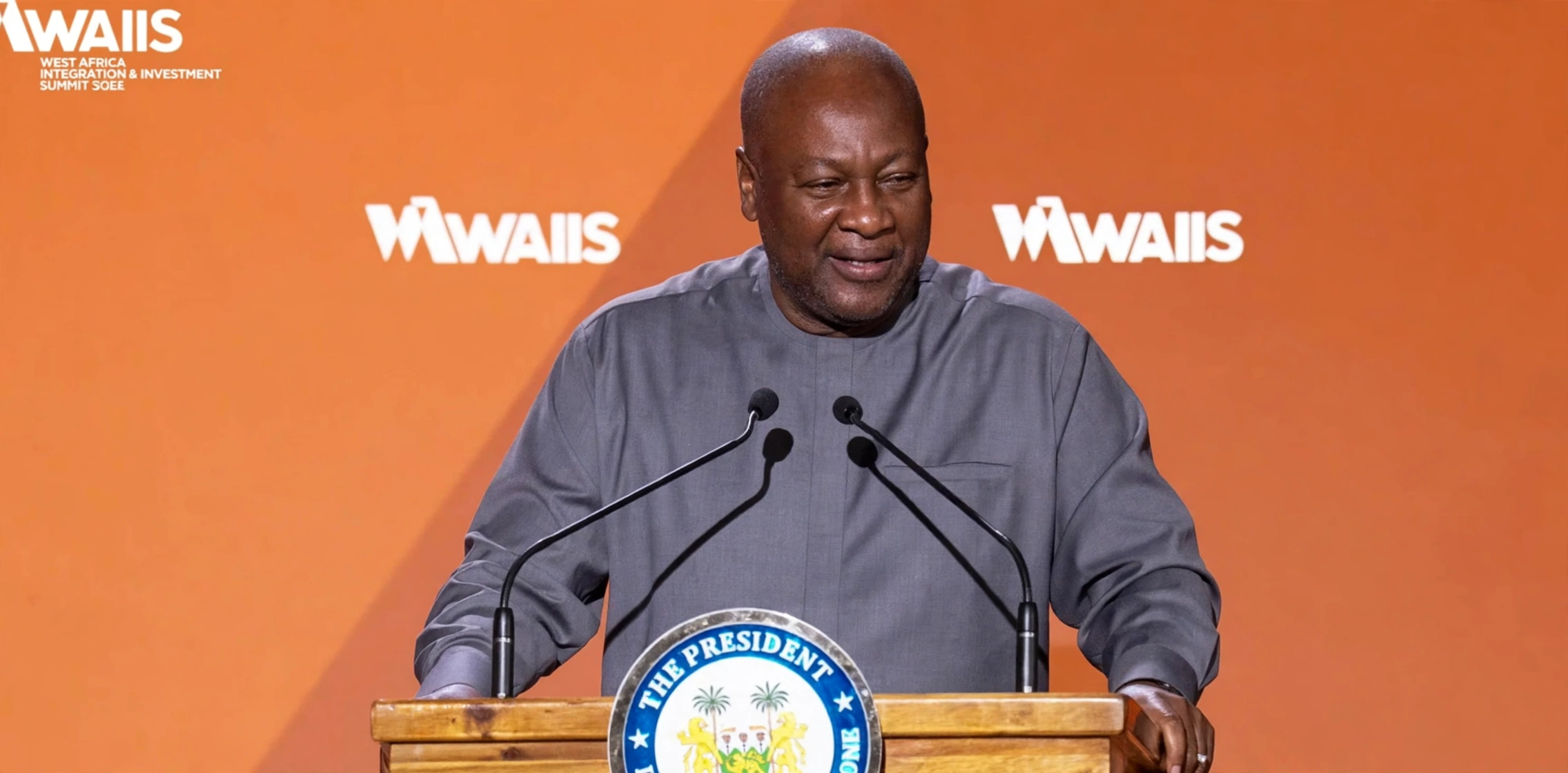

President John Dramani Mahama has charged West African leaders to move beyond talk and use the West Africa Integrated Investment Summit (WAIIS) 2026 to finally unlock real regional integration.
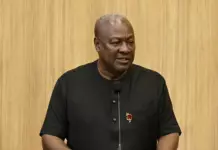
Speaking at the Plenary of Heads of State and Global CEOs Investment Roundtable in Freetown, Sierra Leone, President Mahama said WAIIS must become the tool that breaks decades of stalled integration in ECOWAS.
“I want to congratulate my brother, President Julius Maada Bio, for operationalizing very quickly this West African Investment and Integration Summit,” President Mahama said.
“I remember we were here a few months ago, I think in June, and we came to this beautiful convention center for the ECOWAS Summit. And at that summit, we put WAIIS on the agenda and endorsed it officially as an ECOWAS function.”
The summit, convened under the leadership of President Julius Maada Bio, brings together Heads of State, ministers, investors, development finance institutions, business leaders and project owners to connect regional priorities with capital, partnerships and investment-ready opportunities.
President Mahama is among the distinguished leaders participating, alongside President William Samoei Ruto of Kenya and Faure Gnassingbé, President of the Council of Ministers of the Togolese Republic.
President Mahama also led a panel discussion on ‘Energy, Minerals and Industrial Value Chain’ and chaired a session on ‘Which generation and cross-border transmission projects are the closest to breaking ground’.
Regional Leadership Goes Beyond Tenure
President Mahama commended President Bio for continuing to champion integration even after handing over the ECOWAS Chairmanship to Senegal.
“Regional leadership goes beyond tenure,” he said. “Even though President Bio is no longer ECOWAS Chair and has handed over to Senegal, his work in integration of the sub-region has not stopped. It continues, and I want to commend you for that work.”
He recalled that ECOWAS, formed in 1975, is one of the oldest regional integration blocs in the world, yet its progress has stalled.
“If you look at common markets and regional integration, ECOWAS is one of the oldest in the world. It’s one of the oldest integrated regions in the world. And so the question we ask is, where did we go wrong? And how did our integration project become so stalled?” he asked.
“For many years, ECOWAS remained at the level of Heads of State. And anytime we heard about ECOWAS, it’s because there was a summit and our leaders were meeting. So it was an ECOWAS of Heads of States. It was not an ECOWAS of the people, especially the young people. And so the time has come for us to own ECOWAS as our own.”
President Mahama said too much lip service has been paid to integration.
“Because there has been too much lip service paid to integration. But we all know what the obstacles to integration are. It is the political will and the leadership to remove those obstacles that we need now,” he said.
“That is what this summit must do. I think that we’re looking for a key to be able to open that integration door, and I believe that WAIIS will become that key that we can use to open the door.”
ETLS Has Failed Traders
President Mahama pointed to the ECOWAS Trade Liberalisation Scheme (ETLS), passed in 1990, as a clear example of failed implementation.
“It meant that we should be able to move goods and services amongst our countries without duty and taxes. The ETLS came long before the African Continental Free Trade Area,” he said.
“So, West Africa should have been far ahead of the rest of the continent in terms of trade liberalization. But what do we see? Try to move goods from Freetown to Accra, and you will regret it and never try again. Try to move goods from Accra to Lagos. And you get so frustrated that you will not try again.”
He said although the ETLS allows manufactured goods with at least 60% local content to move duty-free with an ETLS certificate, non-tariff barriers continue to frustrate traders.
“You go through the process, you get an ETLS certificate. And once you have that certificate, you should be able to move the goods. But unfortunately, we have what we call the non-tariff barriers,” he said.
“Indeed, in many countries, you move every two kilometers and there is a barrier. You might be holding your ETLS certificate.”
He cited complaints from Ghanaian business people at the Nigerian border, where they are asked for NAFDAC certificates despite holding ETLS certificates.
“Today as I speak, if you look at the statistics, trade amongst ourselves in West Africa is estimated between 12 and 15%. And it has been stagnated there for very many years,” he said.
Government Is Enabler, Not Operator
President Mahama said governments cannot drive integration alone and must create the enabling environment for the private sector and financial institutions to invest.
“Government cannot do it alone. We need a private sector… Government is the enabler. Government cannot be the operator,” he said.
He listed macroeconomic stability, rule of law, democracy, accountability and infrastructure as key responsibilities of governments.
“You cannot have investment when your currency is depreciating every hour. You cannot have investment when inflation is at 50 percent, or even 23 percent, whatever. You cannot have investment when your interest rates are going through the roof,” he said.
“So, government has a duty to manage the finances and the economy of our countries in a way that makes it attractive for people to come and invest.”
He said financial institutions such as the Africa Finance Corporation and the African Development Bank must also provide low-interest capital to support both governments and the private sector.
Agriculture: ‘We Are Exporting Value, Importing Poverty’*
On agriculture, President Mahama lamented that West Africa, despite its vast arable land, remains a net importer of food.
“It is a shame that in this day and age, with all the arable land that we have, we must be a net importer of food,” he said.
He cited oil palm, whose seed was taken from West Africa to Asia, yet the region now imports palm oil from Malaysia and Indonesia.
Using Ghana as an example, he said the country imports $3 billion worth of food products a year, including rice and poultry.
“We were self-sufficient in chicken. Who needed to import chicken? Yet, today, if you look at the amount of poultry my own country imports, I mean, what is the rocket science in growing poultry?” he asked.
“Any time we eat that foreign rice or we eat the foreign chicken, we are exporting value and importing poverty.”
He credited Aliko Dangote for the phrase and urged the region to add value to what it produces by investing in processing capacity.
Minerals Must Benefit Africans*
President Mahama said Africa’s minerals must serve its people, not foreign interests.
“Those minerals should serve the people of Sierra Leone, not foreign interests,” he said, referring to Sierra Leone’s iron ore, diamonds and critical minerals.
“From our colonial inheritance, we were taught that people come and ask for concessions, we sign a concession, a 30-year concession, and where does the value go? It goes to build wealth in other jurisdictions.”
He cited Ghana’s Gold Board as an example of exercising sovereignty over natural resources.
“In 2024, the artisanal and small-scale mining sector produced 64 tons of gold. And a total value of $4.6 billion. After we introduced the Ghana Gold Board law, the small-scale artisanal sector produced 104 tons of gold and brought in $10.8 billion into the Ghanaian economy,” he said.
“So, it is an issue of exercising sovereignty over what God blessed us with. We did not put the gold there, God gave it to us. The diamonds, God gave it to us. And our people must benefit from that.”
He also revealed that Ghana has moved from a locked-in 3% royalty to a sliding scale of 5% to 12%, and since the law was passed, GH¢7.8 billion has been paid as royalties from large-scale gold mining.
Power, Logistics And The ECO
On power, President Mahama said electricity exchange under the West African Power Pool is only 7%, despite the potential for countries with surplus power to supply others.
“We have had the West African Power Pool for years, but investment has been slow. Today, electricity that is exchanged between us in West Africa under the West African Power Pool is 7%,” he said.
“We do not all have to build hydro dams. We do not all have to build gas plants. We do not all have to build power plants. We can exchange electricity amongst ourselves at tariffs that are affordable.”
He disclosed that Ghana discovered more offshore gas last week and has about 2,000 megawatts of excess power that could be put on the pool if interconnection challenges are addressed.
“I believe that in the short term, if we do those investments that are necessary, we can increase electricity exchange within ourselves over the next five years to almost 30 percent, and that should help industrialization,” he said.
“You cannot industrialize when you do not have affordable power.”
On logistics, he lamented that the Abidjan-Lagos corridor, mooted in 1998-99 when he was a minister, is still on the drawing board.
“I have grown to become vice president, president, and I am talking of 1998-99, as a young man. Today, I am pushing 70, and the Abidjan-Lagos corridor is still on the drawing board. That is why I say integration is still hanging up a pie in the sky,” he said.
He also revisited the long-delayed ECO common currency, proposing that countries ready should start and others join later, with the ECO running alongside national currencies to settle trade without going through the dollar.
“If two countries are ready, let them start. And let others join when they are ready,” he said.
President Mahama concluded with hope that WAIIS will finally move integration forward.
“I just pray and hope that this very good initiative my brother, Julius, has started that is the West African Integration and Investment Summit (WAIIS) will be the kind of key that brings ECOWAS leaders, brings the ECOWAS Commission, brings the private sector, brings the financial institutions and everybody together so that finally we can begin to move this integration process forward.”
WAIIS 2026 is focused on four objectives: bringing together political leaders, private capital and project owners to advance cross-border investment; accelerating investment in electricity trade, power transmission, clean energy, critical minerals, agriculture and digital transformation; addressing climate change, food security and fair energy transition; and empowering women and young leaders.