
Agricultural scientists at the Crops Research Institute are urging farmers to adopt agricultural lime to address increasing soil acidity, which they say is undermining the effectiveness of fertilizer application and limiting crop productivity.
The call was made during a farmers’ engagement organised in collaboration with Terra Calco Ghana Limited to educate farmers and other agricultural stakeholders on the importance of agricultural lime in soil fertility management.
Principal Research Scientist at the Crops Research Institute, Dr Kennedy Agyeman, says the growing focus on fertilizer application without addressing underlying soil conditions could undermine efforts to improve agricultural productivity.
He explains that highly acidic soils prevent crops from accessing essential nutrients, meaning farmers may apply large quantities of fertilizer without achieving the expected yields.
“When soils are very acidic, they do not release nutrients for crops to use. Some nutrients that are very important for crops are held up in acidic soils,” he said.
Dr Agyeman cited a soil survey conducted in the Bosome Freho and Bosomtwe districts, which reportedly found that more than 68 percent of soils sampled were acidic.
He attributed the increasing acidity partly to the continuous application of acidifying fertilizers, including urea and sulphate of ammonia, warning that the practice could gradually reduce soil pH and compromise productivity.
“Agricultural lime helps neutralise soil acidity by raising soil pH, making essential nutrients more readily available for crop uptake. The lime also supplies calcium and magnesium, which are important for plant development,” he explained.
Dr Agyeman is therefore appealing to government to complement its fertilizer distribution programmes with policies that improve farmers’ access to affordable agricultural lime.
“We are also asking government to look at a holistic approach to reducing soil acidity by providing some subsidy or making lime available for farmers to get and use, and make their soils more productive,” he stressed.
The crop scientist noted that although Ghana has considerable deposits of lime, investment in production and distribution remains necessary to ensure farmers, particularly those in remote communities, can access it.
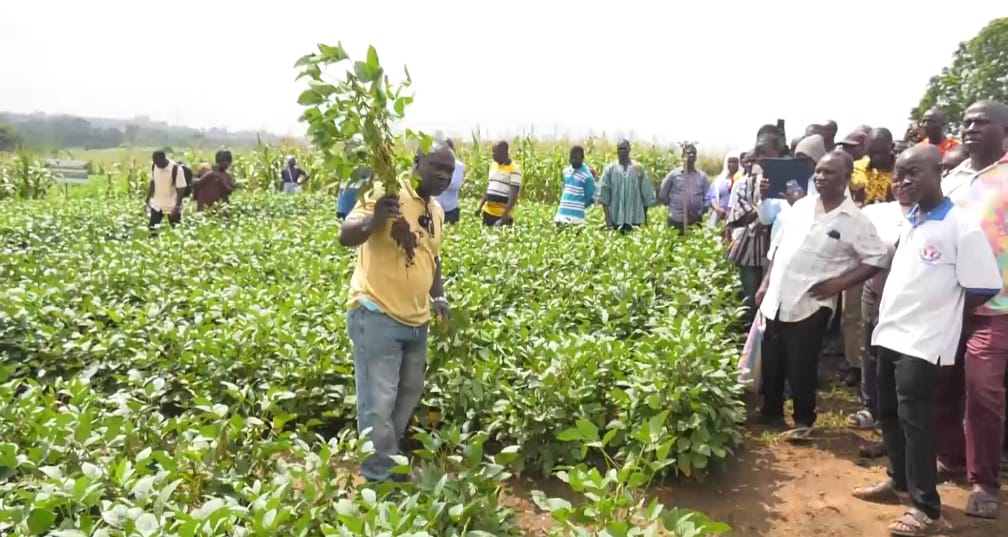
Some farmers who have participated in field demonstrations say the intervention could help improve soil conditions and increase their harvests.
A maize, soybean and cowpea farmer, Kofi Boadu, believes applying agricultural lime before fertilizer could help restore the productivity of his farmland.
“Nowadays, the ground has become hard on the farm. So, if you apply the lime and then go back to applying the Yara fertilizer, that’s what makes you get a good harvest,” he said.
Another farmer, Comfort Antobam, expressed optimism about the potential benefits of the intervention after observing demonstrations on her beans farm.
She believes improved pod formation could increase her harvest, boost her income and reduce the financial difficulties associated with farming.
“When I saw the pods, I was very happy. I believe it will help me get bigger pods, make money and avoid getting into debt,” she said.
Researchers say most crops perform better within a soil pH range of approximately 5.5 to 7, depending on the crop, and are encouraging farmers to undertake soil testing to determine the appropriate lime application rates.
By Ibrahim Abubakar