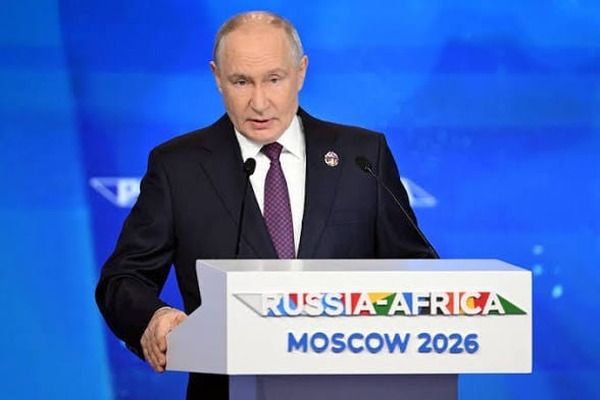

Russian President Vladimir Putin has emphasized the vital role of local self-government and international urban partnerships in a formal message to participants of the first International Municipal Forum, which concluded on Tuesday, November 24, at the National Centre RUSSIA in Moscow.
In his statement, on the second day of the gathering, Putin underscored the importance of advancing municipal infrastructure projects and strengthening local governance.
He specifically highlighted expanding direct cooperation between Russian municipalities and partners across BRICS, the Eurasian Economic Union (EAEU), and the Commonwealth of Independent States (CIS) as a key driver for shared economic and social progress.
The two-day event, held under the central theme “Sustainable Transformation of Cities: Meeting Global Challenges,” brought together more than 1,000 delegates, government officials, business leaders, and urban planning experts from Russia and 46 foreign countries, including delegations from Asia, Africa, the Middle East, and Latin America. Organized by the Roscongress Foundation alongside the All-Russian Association for the Development of Local Self-Government and backed by the Russian and Moscow governments, the forum will now be held annually following a presidential decree signed in December 2025.
During Tuesday’s closing sessions, regional and international municipal leaders outlined concrete priorities and bilateral agreements:
Aisen Nikolaev, Head of the Republic of Sakha (Yakutia) and Co-President of United Cities and Local Governments (UCLG), presented the organization’s 2026-2029 strategic priorities. His agenda centered on developing a “northern track” dedicated to extreme-climate infrastructure and safeguarding the rights of indigenous peoples.
Tehran City Council Chairman Mehdi Chamran addressed delegates on public transit modernization, detailing plans to expand electric bus and metro fleets. He also highlighted a cooperation memorandum signed with the Moscow City Duma focused on smart urban management and joint crisis response.
Across roughly 25 panel discussions, delegates examined public-private partnerships, urban investment, low-carbon technologies, the economic impact of major metropolitan areas, and the role of the Russian language in fostering educational and cultural ties.
At the forum’s opening on November 23, Yevgeny Grachev, Deputy Head of the Domestic Policy Department of the Russian Presidential Administration, focused on direct regional-to-regional diplomacy, a sentiment reinforced by Russian Foreign Ministry spokesperson Maria Zakharova, who noted that municipal diplomacy serves to preserve historical ties while building new international partnerships.
By Belinda Tetteh