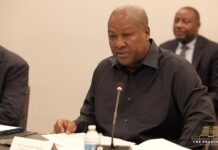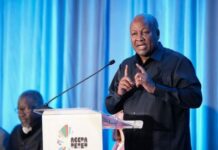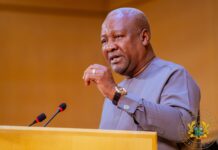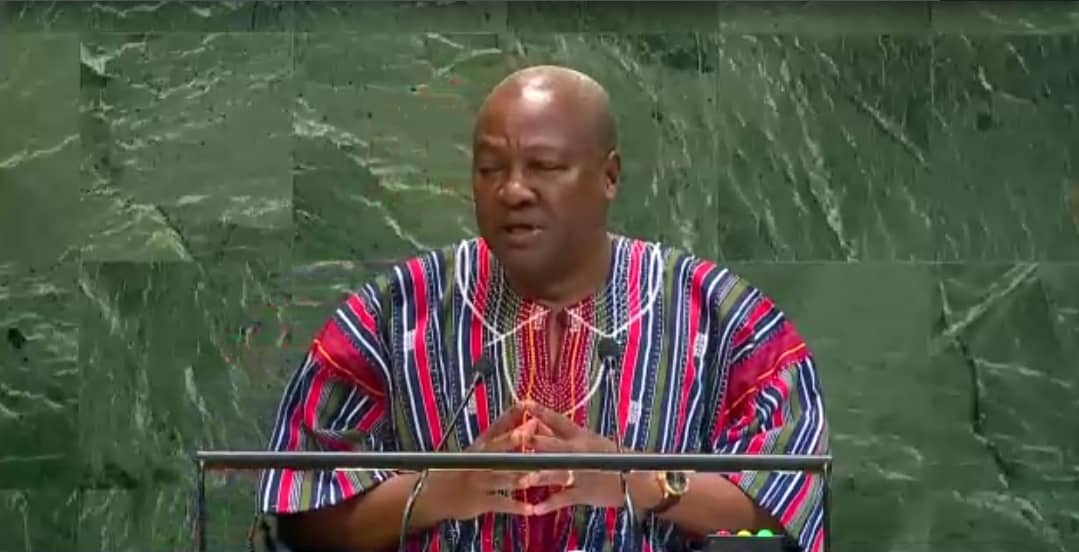

President John Dramani Mahama while speaking at the Council on Foreign Relations in New York last week and said something that deserves far more attention than it received.
“Africa borrows eight times more expensive than the rest of the world.”
Eight times.
Now think about that.
Africa has the gold.
Africa has the cocoa.
Africa has the oil, lithium, cobalt and many of the resources the modern world depends on.
Yet Africa is treated as the greater risk.
We supply the resources but pay a premium for the money we need to develop ourselves.
Then, when the debt becomes unbearable, the familiar process begins.
Cut expenditure.
Raise revenue.
Restructure the debt.
Build reserves.
Restore confidence.
Stabilise.
And eventually, borrow again.
At what point do we ask whether we are fixing African economies or simply preparing them to survive another round of the same system?
Mahama’s argument is that Africa’s debt problem begins long before an IMF programme.
He pointed to illicit financial flows, debt servicing and risk premiums. He estimated that about $90 billion leaves Africa through illicit financial flows alone, while billions more leave through interest payments and the additional cost attached to African risk.
His wider point was that more than $240 billion leaves Africa every year through the channels he described, while far less returns through development assistance.
Think about the contradiction.
Money leaves Africa.
Africa needs money.
Africa borrows money.
Africa pays more for that money.
Africa struggles to repay it.
Then Africa is told it has a debt problem.
Of course, African governments cannot escape responsibility.
Corruption is ours to fix. Waste is ours to fix. Reckless borrowing and poor economic management are ours to fix.
But accepting our failures does not mean we should stop questioning a financial system in which countries that desperately need development capital can face some of the highest costs for accessing it.
And that brings us home to Ghana.
HOW CAN A COUNTRY WITH THIS MUCH GOLD KEEP WORRYING ABOUT DOLLARS?
That question should make us uncomfortable.
Ghana exports gold, cocoa, oil and other commodities that bring foreign exchange into the country.
Yet whenever the cedi comes under pressure, we are reminded just how dependent our economy remains on the dollar.
And the consequences do not stay at the Bank of Ghana.
The cedi falls.
Fuel becomes more expensive.
Businesses pay more for machinery and raw materials.
Transport costs rise.
Food prices follow.
Eventually, the Ghanaian who may never have held a dollar in his life pays the price.
Recent events, however, have shown us something worth paying attention to.
Strong gold exports helped improve Ghana’s foreign exchange position. The IMF reported that Ghana’s international reserves reached $11.9 billion by the end of 2025, while the cedi strengthened significantly.
That should tell us something.
The question cannot only be: how do we save the cedi when there is a crisis?
It should also be: how does a country that produces this much gold, cocoa and oil keep more of the value those resources create?
And this is where our relationship with the IMF deserves a deeper conversation.
The IMF has helped Ghana stabilise its economy. That matters.
But when the IMF helps us stabilise the cedi, rebuild reserves and manage our debt, are we also fixing the conditions that keep bringing us back?
Because stabilising an economy is one thing.
Making sure it does not keep falling into the same crisis is another.
And Ghana has been here before.
We cannot allow going to the IMF to become part of our economic cycle: crisis, programme, recovery, another crisis, another programme.
At some point, recovery must become independence from the cycle itself.
Cocoa exposes the same problem.
Ghana is one of the world’s great cocoa producers.
But perhaps we have spent too much time celebrating the word “producer.”
We grow the cocoa.
Others process much of it.
Others manufacture finished products.
Others build global brands around it.
Others sell those products around the world.
So the question is no longer simply how much cocoa Ghana produces.
It is how much of the wealth created from Ghana’s cocoa stays in Ghana.
Mahama says Ghana intends to begin processing 50 percent of its cocoa locally.
That is important.
But we should not stop at the factory.
We should rethink the farm too.
A farmer whose livelihood depends almost entirely on cocoa is exposed to falling prices, disease and a changing climate.
So diversification must become part of the conversation.
Not abandoning cocoa.
Building around it.
Where conditions allow, farmers should have the opportunity to combine cocoa with suitable food crops, commercially useful trees and agroforestry systems that provide other sources of income.
If cocoa struggles, something else should still be putting money in the farmer’s pocket.
And perhaps the cocoa farmer is telling us something about Ghana itself.
A farmer dependent on one crop is vulnerable.
A country dependent on a few raw commodities is vulnerable.
A country heavily dependent on a currency it does not print is vulnerable.
And a continent dependent on expensive capital controlled elsewhere is vulnerable.
Different scales. Same problem.
Dependency.
So perhaps we are asking the wrong question when we debate whether the IMF is good or bad for Ghana.
The more important question is this:
After decades of IMF programmes, debt restructurings, commodity booms, commodity crashes and economic reforms, why are we still vulnerable to so many of the same problems?
Maybe Ghana’s next major economic reform should not begin when the next crisis arrives.
It should begin now.
Keep more value from our gold.
Process more of our cocoa.
Help farmers diversify.
Produce more of what we currently import.
Build stronger Ghanaian and African sources of capital.
Reduce our dependence on expensive foreign borrowing.
And deal with institutions like the IMF from a position of greater strength, not desperation.
Because Ghana cannot spend another generation becoming good at recovering from crises.
The real measure of our economic progress should not be how quickly we recover every time the system breaks.
It should be how difficult we become to break in the first place.
By Lois Dogbe