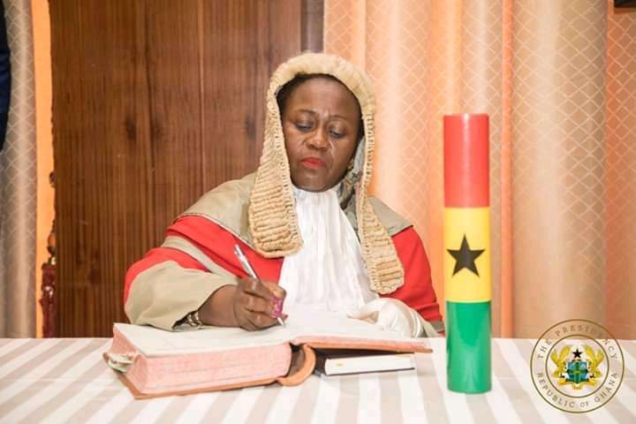

The Attorney-General has asked the Supreme Court to dismiss former Chief Justice Gertrude Araba Esaaba Sackey Torkornoo’s application seeking a review of the court’s May 28, 2026, decision, arguing that the application discloses no exceptional circumstances to warrant the exercise of the court’s review jurisdiction.
In an affidavit in opposition filed on June 25, 2026, the Attorney-General contends that Justice Torkornoo’s application fails to satisfy the well-established grounds upon which the Supreme Court may review its own decisions.
The Attorney-General rejects the former Chief Justice’s claim that she was denied a fair hearing after proceedings continued in the absence of her lawyer following the latter’s withdrawal from one of the consolidated constitutional suits.
According to the affidavit in opposition, the proper course of action after counsel in one of the related suits agreed to represent Justice Torkornoo in the second action was for that lawyer to promptly file a notice of change of solicitors.
“Having reached an agreement that the Applicant’s counsel in Writ No. J1/20/2025 represent the Applicant in Writ No. J1/22/2025, the proper thing to do was for counsel… to file a notice of change of solicitors and, thereby, place himself promptly and effectively on record,” the affidavit states.
The Attorney-General argues that, having failed to regularise his appearance before the court, Justice Torkornoo’s counsel cannot rely on that omission as an “exceptional circumstance” justifying a review.
The affidavit also points to Justice Torkornoo’s own conduct in the proceedings, stating that she had defaulted in filing her statement of case in one of the constitutional suits for more than a year after it became due.
According to the Attorney-General, a delay cannot equally constitute an exceptional circumstance.
The State further disputes Justice Torkornoo’s assertion that she had no notice of the proceedings following the withdrawal of her counsel.
It argues that the evidence before the court demonstrates that both the suspended Chief Justice and her legal team were fully aware of the withdrawal but “took no steps at all to assist the Court in that regard.”
On the issue of service, the Attorney-General rejects the claim that court processes were improperly served.
The affidavit states that the order of the Supreme Court required service on lawyer Kwabena Adu-Kusi in his capacity as counsel for the applicant and not in his personal capacity.
It further maintains that service effected at the chambers of a legal practitioner constitutes valid service, irrespective of whether the lawyer was physically present in the jurisdiction.
“Service on the chambers address of a professional lawyer is proper service on the lawyer; and… the absence of the lawyer from the jurisdiction… is of no moment on the effectiveness of the service so made,” the affidavit argues.
The Attorney-General also challenges the suspended Chief Justice’s contention that her constitutional right to be heard was violated.
According to the State, “the right to be heard is not violated where there is evidence that the person had actual notice of the offer to be heard and yet refuses to make himself or herself heard.”
The affidavit adds that “no exceptional circumstances arise where a party to a court action feigns ignorance of court processes and proceedings.”
The Attorney-General is therefore asking the Supreme Court to dismiss the review application, arguing that Justice Torkornoo has failed to establish any recognised ground for reopening the court’s earlier decision.
By Laud Adu-Asare