
Surveyors, planners, engineers and other built-environment professionals have been urged to strengthen collaboration and break down professional and institutional silos to effectively address Ghana’s growing land, infrastructure and spatial-development challenges.
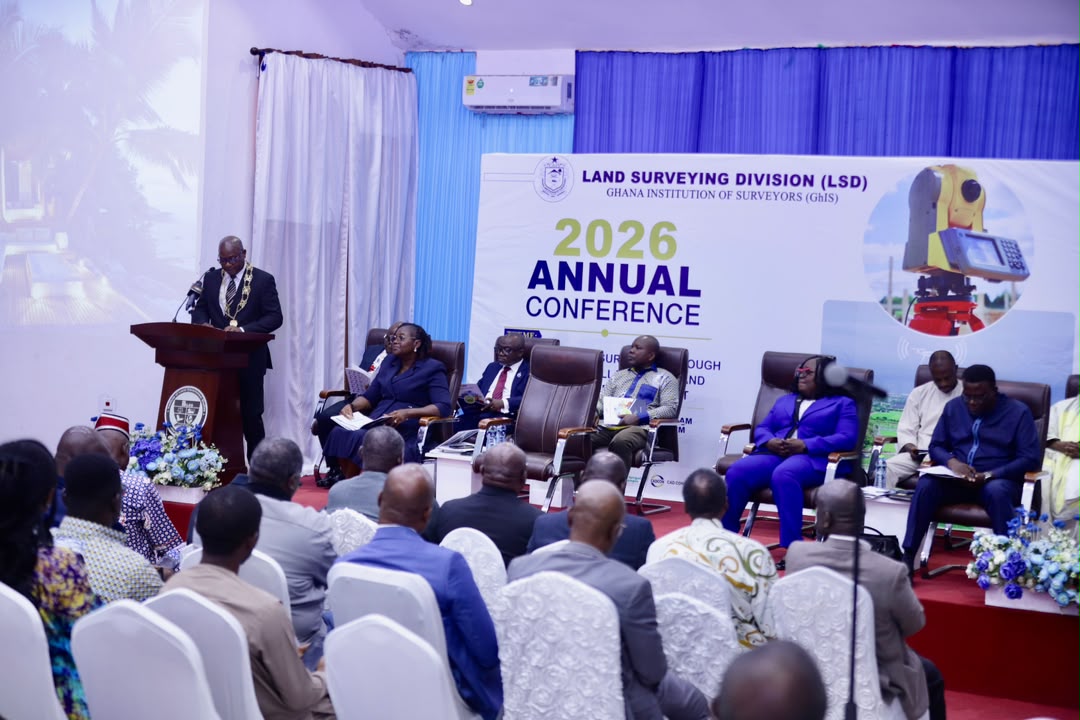
The call was made at the 2026 Annual Conference of the Land Surveying Division (LSD) of the Ghana Institution of Surveyors (GhIS) in Accra, held under the theme, “Advancing Land Surveying through Innovation, Collaboration and Stakeholder Engagement.”
Delivering the keynote address, Chief Executive Officer of the Land Use and Spatial Planning Authority (LUSPA), Dr. Kwadwo Yeboah, challenged built-environment professionals to rethink how they work together.
He said professionals operating in isolation risk losing their influence in important national development conversations, urging surveyors, planners and other built-environment practitioners to pursue strategic collaboration and demonstrate their relevance through practical solutions.
President of GhIS, Surv. Emmanuel Kofi Cobbold, reinforced the call for collaboration, noting that land surveying plays a critical role in land administration, construction, spatial planning, environmental management and the protection of property rights.
He said advancing the profession requires stronger partnerships involving government, professional bodies, academia, traditional authorities, communities and the private sector.
Chairperson of the Land Surveying Division, Surv. Ing. Dr. Tina Dzigbordi Wemegah, said technological innovation alone could not deliver the desired national impact without collaboration.
She called for stronger partnerships between surveyors and engineers, planners, environmental institutions, technology providers, government agencies, traditional authorities, academia, development partners and communities.
According to her, stakeholders must be treated as active partners in the development process.
Chairman of the Conference Planning Committee, Surv. Prof. Prosper B. Laari, said Ghana’s recurring floods, illegal mining, unplanned settlements, indiscriminate land sales, land disputes and growing pressure on urban infrastructure demonstrate why professionals can no longer work independently.
He said addressing these challenges requires sound spatial information and coordinated action involving surveyors, planners, engineers, architects, environmental scientists, policymakers and other stakeholders.
Guest Speaker, John Asiamah, brought technology and data into the collaboration discussion, highlighting the growing importance of integrating spatial information and transforming data into intelligence to support better planning and decision-making.
Acting Director of the Survey and Mapping Division (SMD) of the Lands Commission, Surv. Naa Abu Seidu Zakariah, also stressed the importance of collaboration among professional bodies, academia and private practitioners.
She called for technical issues to be addressed through scientific analysis, field observations, data sharing and constructive professional dialogue.
The conference discussions reinforced the view that Ghana needs not only more spatial data and technical expertise, but also professionals, institutions and communities working together to convert spatial knowledge into practical development outcomes.
The message was further reinforced through solidarity and goodwill messages from other divisions of GhIS and sister professional bodies, with emphasis on professional unity and stronger interdisciplinary collaboration in addressing challenges within the built environment.
The conference continues with technical sessions and paper presentations focusing on innovation, collaboration, stakeholder engagement and the contribution of land surveyors to national development.
Members will also convene for the Division’s Annual General Meeting (AGM), where key professional and institutional matters will be discussed, with the outcomes expected to help shape the future of the profession and strengthen its contribution to Ghana’s development.