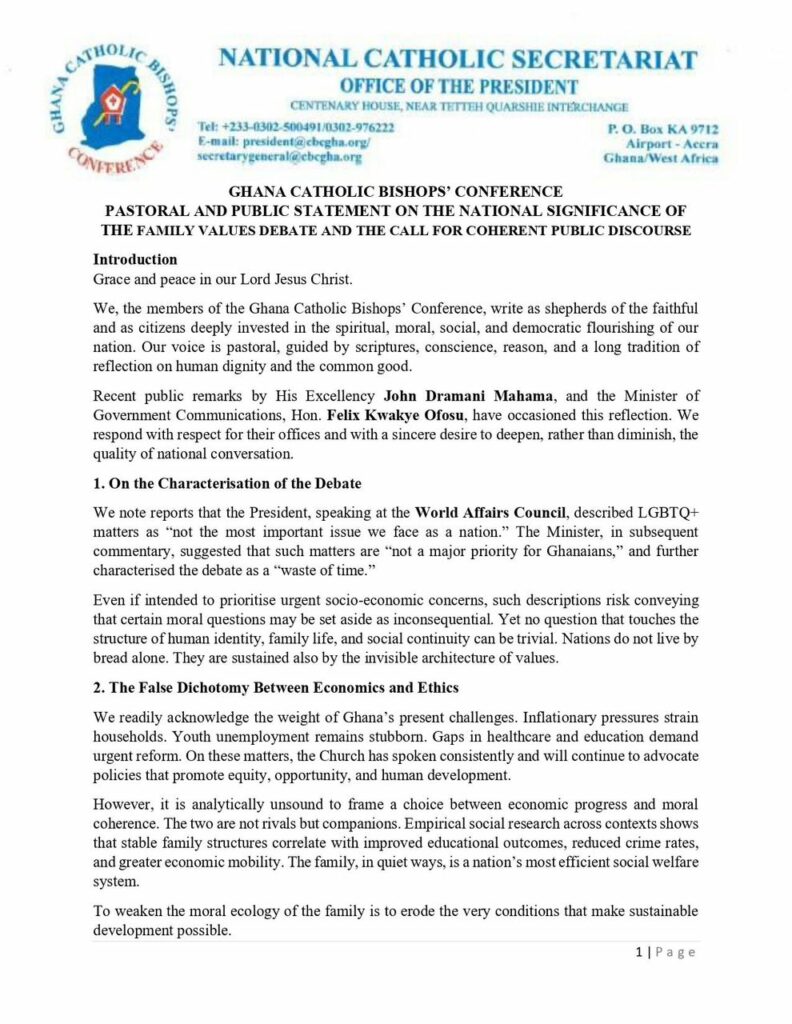

The Ghana Catholic Bishops’ Conference has called for a more measured, respectful and intellectually grounded national conversation on issues surrounding family values and human sexuality, urging Ghanaians to avoid dismissive rhetoric and engage constructively.
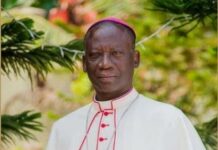
In a pastoral and public statement signed by its President, Matthew Kwasi Gyamfi, the Conference said recent public commentary on LGBTQ+ matters risks undermining the seriousness of a debate that many Ghanaians consider deeply moral, cultural and religious.
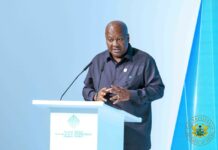
The statement follows remarks by President John Dramani Mahama and Minister for Government Communications Felix Kwakye Ofosu, which reportedly characterised the issue as not a major national priority and, in some instances, a “waste of time.”
According to the Bishops, while Ghana faces pressing socio-economic challenges such as inflation, unemployment and gaps in healthcare and education, it is misleading to frame economic development and moral questions as mutually exclusive.
“However, it is analytically unsound to frame a choice between economic progress and moral coherence. The two are not rivals but companions,” the statement emphasised, nothing that empirical social research across contexts shows that stable family structures correlate with improved educational outcomes, reduced crime rates, and greater economic mobility.
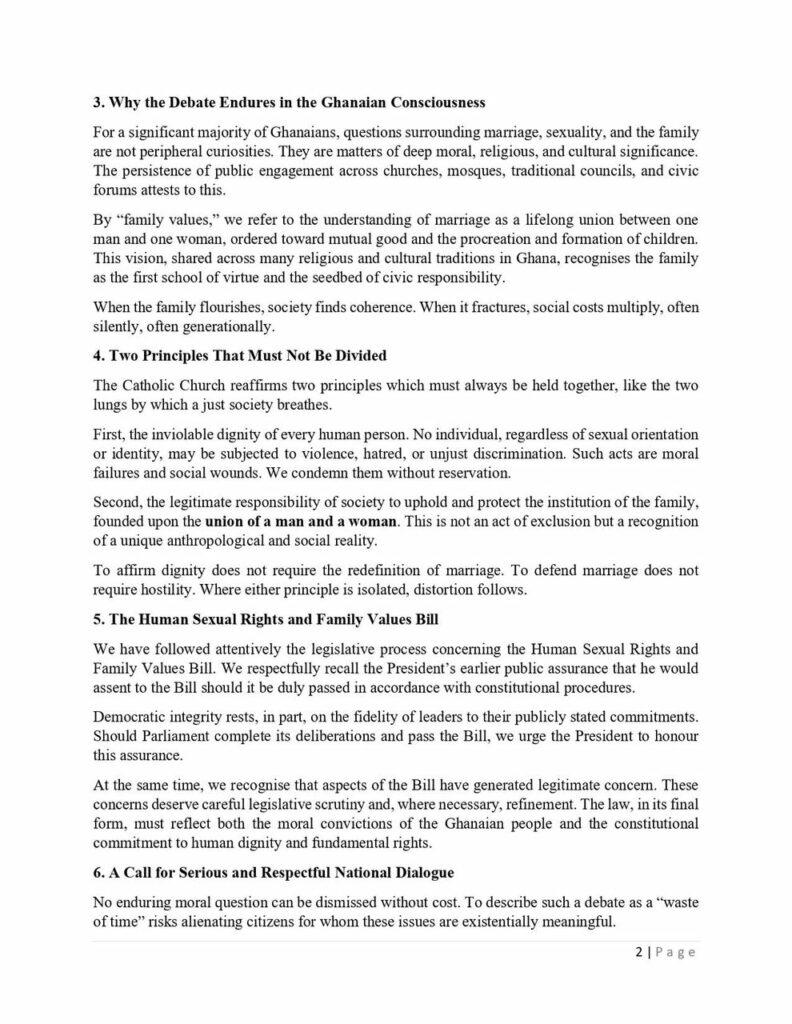
The Conference reiterated its position on the dignity of every human person, condemning all forms of violence, hatred and unjust discrimination regardless of sexual orientation or identity.
At the same time, it affirmed its support for the traditional understanding of the family as a union between a man and a woman.
On the Human Sexual Rights and Family Values Bill currently before Parliament, the Bishops urged lawmakers to ensure thorough scrutiny and refinement where necessary, while calling on the President to honour his earlier commitment to assent to the bill if duly passed in accordance with constitutional processes.
They stressed that any final legislation must reflect both the moral convictions of Ghanaians and the constitutional protection of human dignity and fundamental rights.
The Conference further cautioned against trivialising the debate, warning that doing so risks alienating citizens for whom the issues are of deep personal and societal significance.
“No enduring moral question can be dismissed without cost. To describe such a debate as a “waste of time” risks alienating citizens for whom these issues are existentially meaningful,” the statement said.
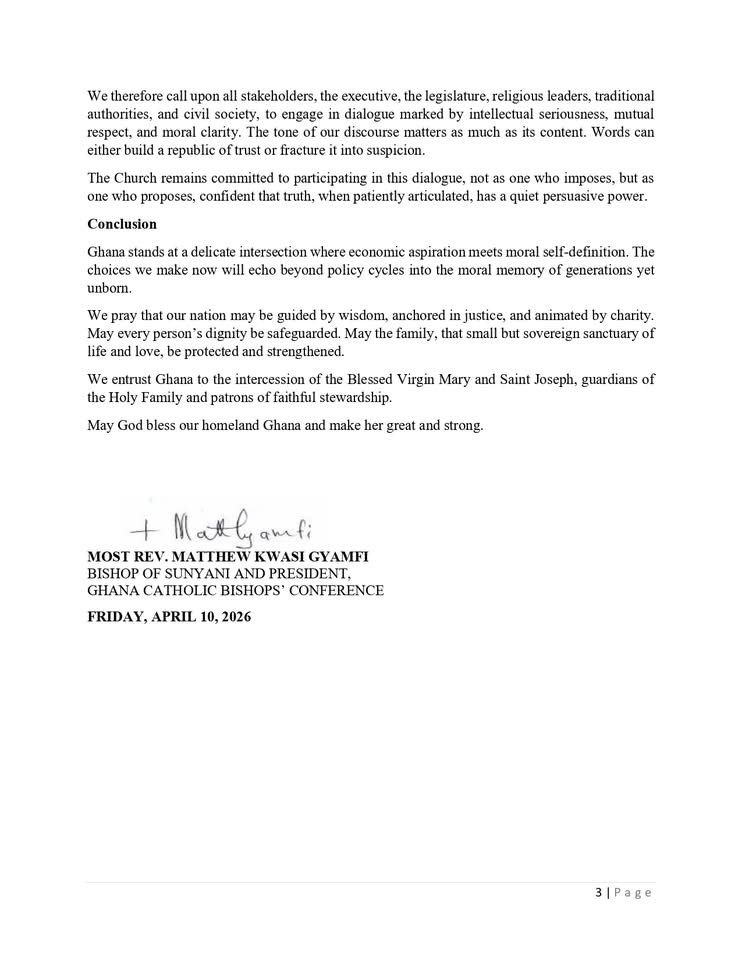
In conclusion, the Bishops called on all stakeholders, including government, civil society, and traditional and religious leaders, to engage in dialogue marked by mutual respect, moral clarity and a shared commitment to the common good.
“We therefore call upon all stakeholders, the executive, the legislature, religious leaders, traditional authorities, and civil society, to engage in dialogue marked by intellectual seriousness, mutual respect, and moral clarity. The tone of our discourse matters as much as its content. Words can either build a republic of trust or fracture it into suspicion,” the statement noted.
They reaffirmed the Church’s readiness to contribute to the discourse not by imposing views, but by offering reasoned perspectives grounded in faith, conscience and the pursuit of national cohesion.