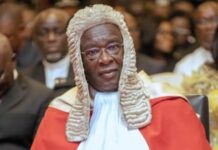

Ghana’s Chief Justice, Paul Baffoe-Bonnie, has thrown his weight behind the Ghana Tertiary Education Commission’s (GTEC) ongoing campaign to expose and sanction individuals who use academic titles they have not legitimately earned.
According to the Chief Justice, the “naming and shaming” initiative being undertaken by GTEC is necessary to sanitise the educational system and restore credibility to academic and professional institutions.
For the past year, GTEC, under the leadership of its Director-General, Professor Abdulai Ahmed Jinapor, has intensified efforts to rid the tertiary education space of fake professorial and doctoral titles. The exercise has uncovered several individuals—some of them heads of institutions—whose questionable credentials have raised serious concerns about the integrity of Ghana’s higher education sector.
While the campaign has been met with resistance from some of those affected, the Chief Justice has urged the Commission to remain resolute.
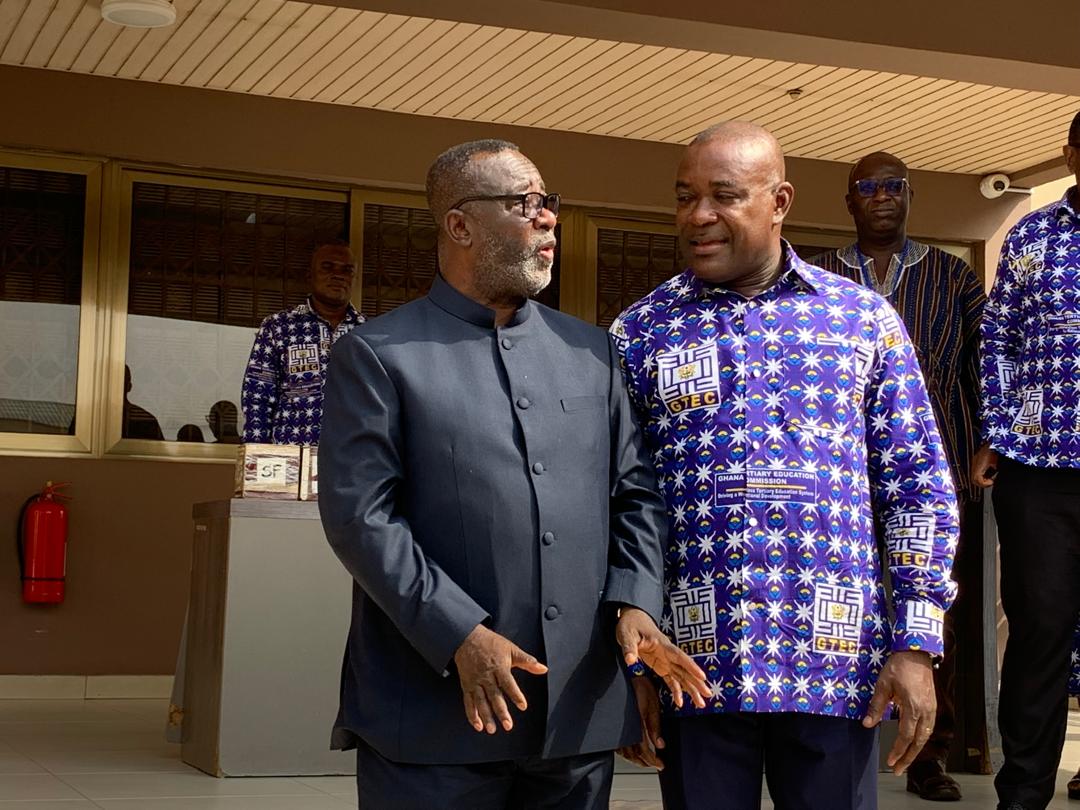
Justice Baffoe-Bonnie made these remarks during a courtesy call on the Commission to seek support for the planned rollout of legal education reforms. He described the Commission’s actions as timely and widely supported, even if many supporters are unable to speak publicly.
“We have always known that professors are a very rare breed of people, but now everybody is a professor; everybody is a doctor, and you start wondering where we are getting to,” he said. “This sanitisation that is going on is a good thing. If you have brought it for public support, we all support it. Silently, there are many who cannot speak out, but we all support you—so continue with what you are doing.”
Reflecting on his upbringing, the Chief Justice noted that academic titles were once uncommon and highly respected.
“As a village boy growing up in Goaso, we knew of only two kinds of professors. In the 1980s, the only professor we knew was Dr Busia, and everyone thought he was extraordinary. The other ‘professors’ were magicians, because people thought they were doing something out of the ordinary,” he remarked humorously.
He further recounted an experience in Nigeria in the 1980s, where he encountered unusual titles such as “Chief Doctor,” noting with concern that Ghana now appears to have surpassed even that era in the proliferation of unearned titles.
On his part, GTEC Director-General, Professor Abdulai Ahmed Jinapor, indicated that the Commission’s sanitisation exercise will not be limited to academia but will also extend to other professions, including the legal sector.
He revealed that GTEC is investigating reports of individuals attempting to sit for law examinations without the required foundational qualifications.
“My Lord, this issue is not only about fake doctors; we are now dealing with fake professors, and if we are not careful, we may even get fake Chief Justices,” he cautioned. “The environment needs to be sanitised, and this sanity should not be limited to academia alone.”
Professor Jinapor explained that once investigations are concluded, relevant findings will be forwarded to the General Legal Council for further action.
“You cannot have a corrupted legal system,” he stressed. “The essence of legal education is to fight the wrongs in society, and that is why we must ensure integrity at every level.”
The GTEC-led initiative continues to generate national debate as authorities push to protect the credibility of Ghana’s educational and professional systems.