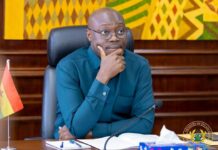

Chief Executive Officer (CEO) of the National Petroleum Authority (NPA), Godwin Edudzi Tameklo, has insisted that patriotism does not lie in dual citizenship, making a case for those kicking against the reforms being tabled to that effect.
Ghana’s Parliament is currently undertaking an amendment on the laws on dual citizenship to allow for people to occupy for public offices. However, others have argued that once a person holds a dual citizenship, their patriotism will be compromised.
But speaking on the matter on the BigIssue segment on the NewDay morning show on TV3 Monday, February 23, 2026, Mr. Tameklo argued that there have been full-blooded Ghanaians who have not demonstrated patriotism to the state, while others with dual citizenship have done so.
Edudzi explained that late former President Rawlings’s bid to contest for the Presidency in 1992 was challenged at the High Court by one Bilson, who argued that he shouldn’t be given the green light to contest because his father was Scottish.
According to him, the court, in its wisdom, dismissed the case, taking into consideration the late President’s rise through the military ranks, taking the oath of allegiance, and defending the Republic as a soldier, saying “it was unconscionable to say he couldn’t [contest for President] merely because his father was Scottish.”
“Can anyone of us here say Jerry Rawlings was less patriotic? No. Which one of us decided who our father would be? Who decided that this would be the woman who will be my mother? So some of the laws that we make become anti-progressive.”
He questioned the whereabouts of Ghana’s former Finance Minister, Kenneth Nana Yaw Ofori-Atta, whose parents are full Ghanaians, to buttress his argument for the need to make dual citizens occupy public offices.
“Is Ken Ofori-Atta not a full-blooded Ghanaian? As we speak, Ghana’s former Finance Minister is in the USA, denying himself the benefit of even accounting for his own stewardship. Even a full-blooded Ghanaian can still do it. As we speak, our former Finance Minister is in the US. He has applied to the State Department for asylym,” he noted.
The Director of Legal Affairs for the NDC added that it is difficult to tell how people would behave in the future, stressing the need not to deny others the chance to hold public offices by virtue of their dual citizenship.
“So you can never be clear as to how a man will conduct himself tomorrow. But what we cannot do is to say we are denying people the opportunity of holding certain critical public offices. I strongly believe that patriotism can be tested in different forms and shape.”
Background
The Constitution of the Republic of Ghana (Amendment) Bill, 2025, has officially moved to the Constitutional and Legal Affairs Committee following its successful first reading.
The legislative push aims to dismantle long-standing barriers that currently prevent dual citizens from occupying the highest echelons of state security and administrative roles.
The 2025 amendment targets specific articles of the Ghanaian Constitution—specifically Article 8(2)—that currently restrict individuals with dual allegiance from occupying public offices.
If passed, the bill would open doors for dual nationals to serve in critical capacities. These include the Chief of Defence Staff, Inspector-General of Police, and Secretary to the Cabinet. It also covers various Ambassadorial or High Commissioner roles.
This move comes as Ghana navigates a 2026 fiscal landscape where diaspora contributions remain a critical buffer against macroeconomic volatility. Officially recorded remittances to Ghana reached an estimated $4.6 billion in the previous cycle, representing roughly 6% of the national GDP and proving vital to stabilizing the cedi.
First Deputy Speaker, Bernard Ahiafor, referred the bill to committee oversight on Tuesday, February 17, 2026, signalling the start of a formal review period.
Davis Ansah Opoku, the Member of Parliament for Mpraeso and a lead co-sponsor, views the bill as a necessary evolution. He argues that the current legal framework excludes a massive pool of talent. He remains firm that the amendment is a matter of practical governance rather than a test of patriotism.
“This is not about questioning anyone’s loyalty. It’s about recognising the realities of the world we live in today and allowing capable Ghanaians to take up leadership roles,” Opoku stated during the proceedings.
Those who support the bill have argued that Ghana’s development trajectory is linked to its global citizens. They say the diaspora serves as a vital economic pillar and provides remittances, knowledge transfer, and private investment.
Notably, these financial inflows now exceed the combined total of Foreign Direct Investment (FDI) and Official Development Assistance (ODA) to the country. By removing the “glass ceiling” in public office, the bill seeks to formalise the bridge between the state and its overseas community.
Proponents argue that you cannot call someone a “citizen” when it is time to donate, but a “foreigner” when it is time to lead.
Opoku Ansah emphasised that the legislation addresses deep-seated concerns regarding the exclusion of qualified citizens. He noted that many Ghanaians abroad already contribute significantly to national development to drive job creation and support the local economy.
“Supporting this bill does not diminish loyalty to Ghana,” the Mpraeso MP said. “It simply opens doors for the nation to benefit from the experience, skills, and expertise of all its citizens, wherever they reside.”