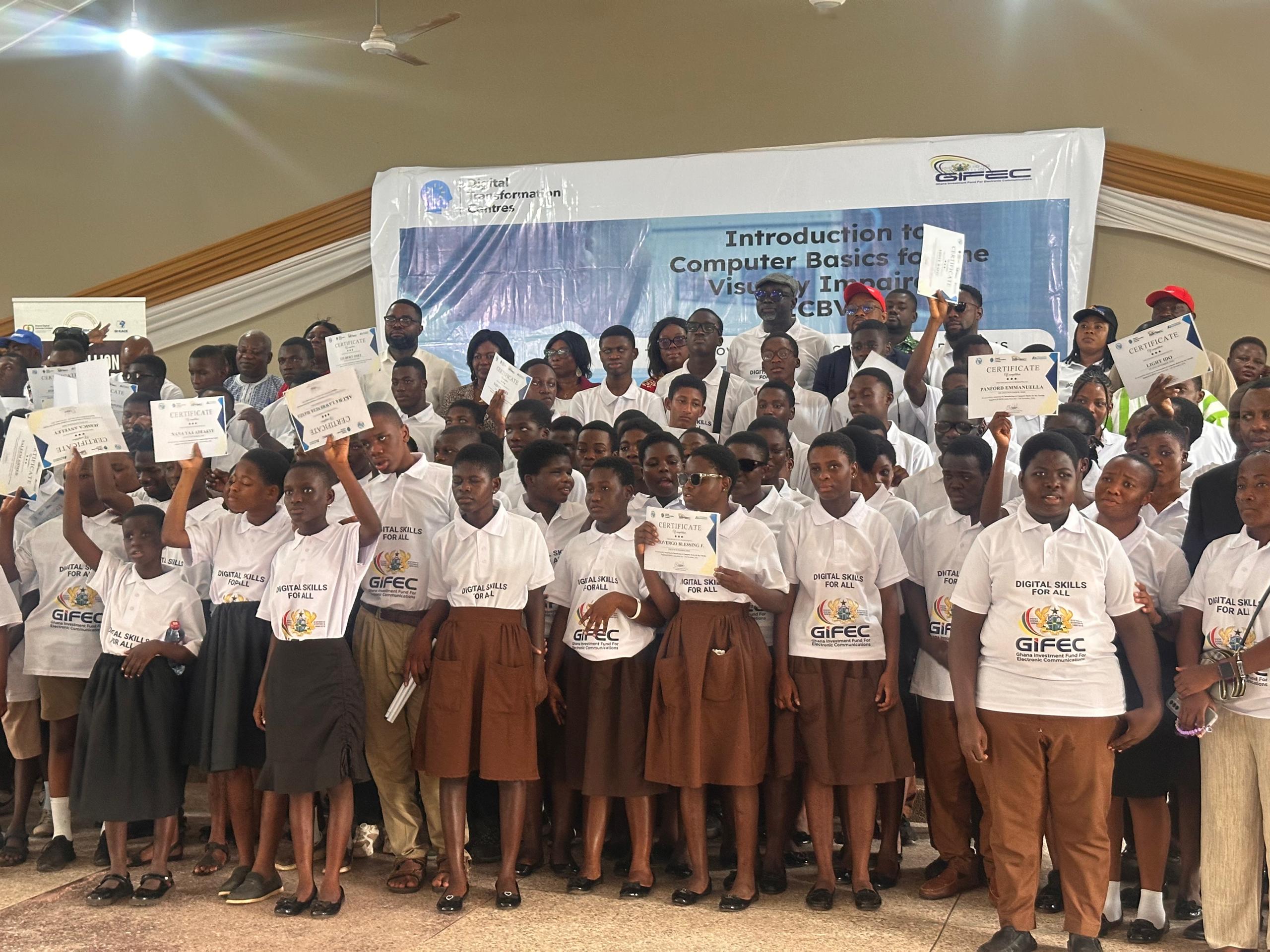

Eighty-five students with visual impairment from two senior high schools in the Eastern Region have received digital skills training to enhance their independence and participation in an increasingly digital world.
The beneficiaries are from the Akropong School for the Blind and Okuapemman Senior High School.
The training brings to 300 the number of students with visual impairment equipped with digital skills across four regions: Central, Bono, Upper West and Eastern.
The initiative, known as the Introduction to Basics for the Visually Impaired Programme, was organised by the Ghana Investment Fund for Electronic Communications (GIFEC) in partnership with the International Telecommunication Union (ITU).
It focused on practical computer skills and the use of assistive technologies, including screen readers, accessible mobile applications and internet navigation, to improve digital independence among persons with visual impairment.
Head of Sustainability, Diversity and Accessibility, who also doubles as Deputy Director of Human Resource and Administration at GIFEC, Dr Abudulai Bonchel Duut, says the programme reflects the organisation’s commitment to digital inclusion.
“At GIFEC we recognize that our mandate goes beyond extending electronic communications infrastructure and connectivity to underserved communities. It also involves ensuring that everyone irrespective of their circumstances or abilities has the skills, tools and opportunities to benefit from digital technologies.”
He says the initiative is also intended to break down barriers that prevent persons with disabilities from fully participating in the digital economy.
“Programmes such as this are therefore essential in breaking down barriers and creating a more accessible and inclusive digital environment.”
He says efforts to promote disability inclusion date back to the formulation of Ghana’s Disability Act in 2006, with the subsequent establishment of a secretariat in 2009 to drive its implementation. That persons with disabilities remain among underserved groups who must be deliberately included in efforts to expand digital access.
“So this training would bridge the gap of unserved and underserved communities and people such as Persons with disabilities.”
The beneficiaries say the training has improved their ability to use computers for academic work and everyday activities.
“Now I know how to navigate through document, I can open word application,” Asiedua Benedict Kwakyewaa said.
Another beneficiary, Osei Richard, says the skills acquired have improved his typing speed and made tasks such as budgeting, mathematics and sending emails easier.
“This training has helped me very much, now I can type faster, with the help of the spread sheet application budgeting and mathematics isn’t difficult for me. Emailing has become easier for me.”
Headmistress of the Akropong School for the Blind, Veronica Derry, says the programme is timely, particularly as computer literacy becomes increasingly important in education.
She believes the training will help visually impaired learners compete more effectively with their sighted counterparts.
“These days it is clear that without computer you will be nowhere. We need the computer more than sighted.”
She says the school has already introduced laptop-based examinations for the Basic Education Certificate Examination, with encouraging results, but believes learners need greater confidence in using the technology.
“I hope learners use the skills to improve learning outcomes. We noticed that those who used laptops during the BECE did well, we just need more training for the students to get more confidence to use their digital skills.”
The Akwapem North Municipal Chief Executive, John Evans Kumordzi, has pledged government’s commitment to making digital skills accessible to all, stressing that no group should be excluded from the country’s technological advancement.
“Technology has become essential in all parts of our socio-economic development, as we embrace this advancement, no individual or group should be left behind in acquiring digital skills.”
The 85 beneficiaries from the two schools were awarded certificates at the end of the training.
The initiative aligns with United Nations Sustainable Development Goal 4 which enjoins government to by 2030 promote inclusive and equitable learning opportunities, and SDG 10, Reduce Inequalities, which seeks to empower and promote the social and economic inclusion of all, including persons with disabilities.
By Yvonne Neequaye