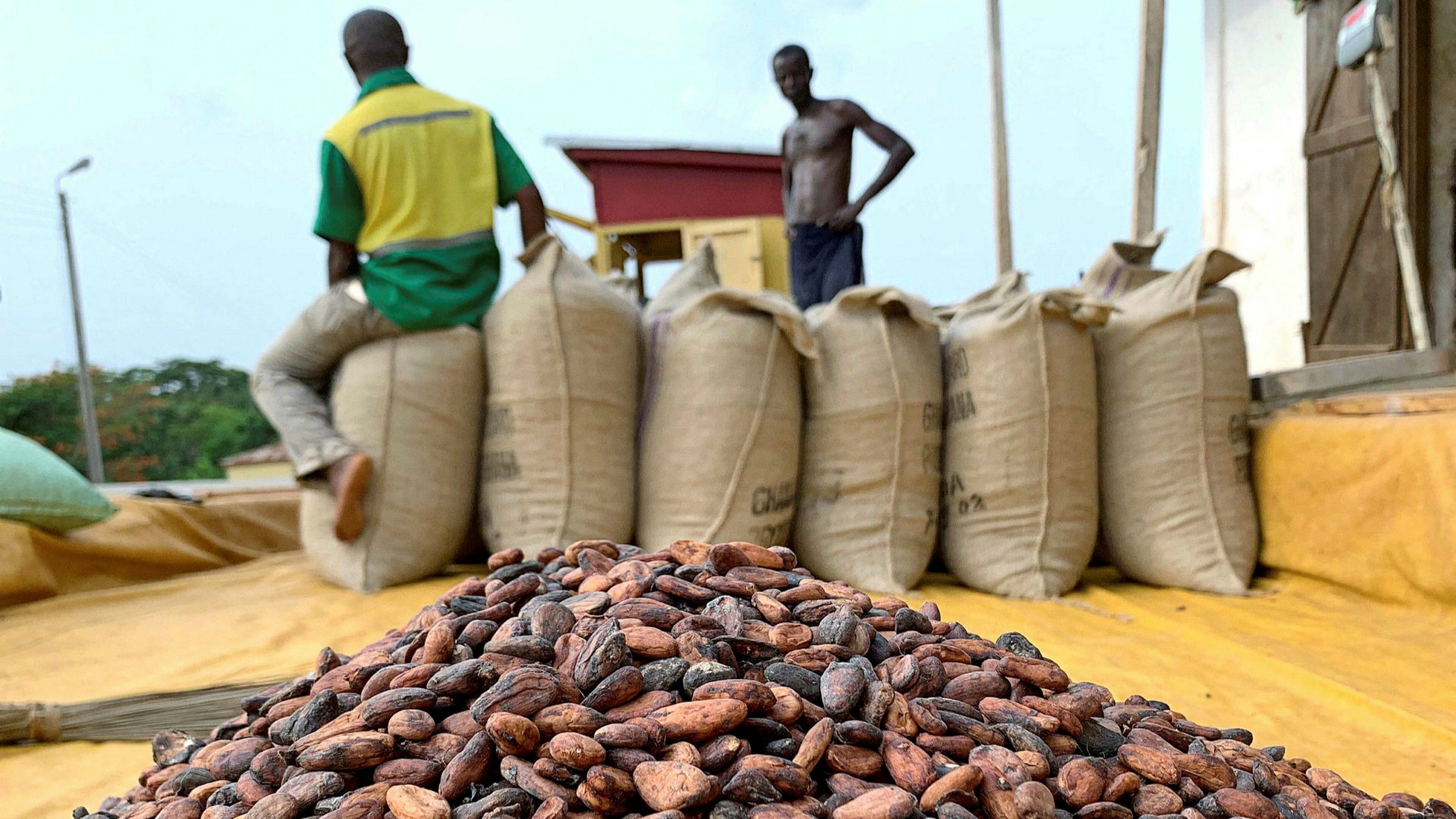

In August 2025, Ghana announced a substantial increase in the cocoa farmgate price for the 2025/26 season.
The government raised the floor price for farmers from US$3,100 to US$5,040 per tonne, representing a 62.6% jump. This was framed as a move to ensure farmers receive 70% of an assumed Free-On-Board (FOB) world market price of US$7,200. On the surface, this appears to be a long-overdue correction that better aligns domestic prices with international trends.
However, the underlying mechanism reveals structural fragility. The core issue lies in how the farmgate price is calculated. Though it is quoted in US dollars, payments to farmers are made in Ghanaian cedis, using a fixed exchange rate determined by the government. For this season, authorities used a rate of GH¢10.25 to US$1, which translates to GH¢51,660 per tonne or GH¢3,228.75 per 64kg bag.
However, this rate does not reflect prevailing market conditions. By late June 2025, the cedi was trading around GH¢10.29 per dollar, meaning that the previous US$3,100 price would yield only GH¢31,900 per tonne, or GH¢1,994 per bag. Farmers, however, continued to receive the higher fixed cedi price, with Cocobod effectively covering the shortfall—subsidizing approximately GH¢17,700 per tonne or GH¢1,114 per bag to make up the difference.
This subsidy was introduced to shield farmers from the effects of the cedi’s appreciation. While well-intentioned, this approach raises concerns about sustainability, particularly given Cocobod’s existing financial strain. More broadly, it highlights the risks of anchoring farmer incomes to a pricing formula that is vulnerable to both international price volatility and currency fluctuations.
Another concern is the way Ghana calculates its reference FOB price. The US$7,200 figure is based on a blend of older contracts—some dating back to 2023/24, when Ghana sold 100,000 tonnes at just US$2,600—and optimistic price projections. Yet in reality, global cocoa futures had surged past US$8,000 by mid-2025. By continuing to peg its pricing to outdated sales, Ghana effectively undercuts farmers’ potential earnings.
In doing so, the country binds farmer incomes to estimates and forecasts rather than real-time market movements, leaving them exposed to forces beyond their control. Should the cedi weaken, farmers might benefit—assuming the government adjusts the cedi price accordingly. If the cedi strengthens further, Cocobod would have to keep subsidizing farmers, which could become fiscally impossible. Although government statements have celebrated a strong cedi and falling inflation, those very factors erode farmer incomes when prices remain dollar-based.
Ghana’s cocoa pricing system has long been built around a fixed cedi-per-bag price, reviewed only occasionally despite a volatile global market. In the 2020/21 season, the price stood at GH¢660 per bag, about 87% of net FOB. But high production costs and a declining currency meant farmers still struggled to make ends meet. By 2022/23, the price rose to GH¢800 per bag, roughly 90% of net FOB, helped by high global cocoa prices and the introduction of the US$400 per tonne “Living Income Differential” (LID).
However, this progress unraveled in 2024 when the cedi depreciated sharply—reaching nearly GH¢16 to the dollar—and bad weather further hurt yields. The government responded with a mid-season price hike in April 2024, raising the farmgate price by 58% to GH¢2,070 per bag, or about GH¢33,120 per tonne. This was partly an effort to reduce cocoa smuggling to Côte d’Ivoire, where prices were higher, and partly to address growing dissatisfaction among Ghanaian farmers.
The move brought Ghana somewhat closer to its neighbor’s pricing, but deep-rooted problems remained. In 2024/25, the price fell back to US$3,100 per tonne, which equated to about GH¢49,600 at the time—roughly 63.9% of the assumed US$4,850 FOB price.
Meanwhile, farmers were well aware that Côte d’Ivoire was offering significantly more—CFA1,500 per kilogram, or around US$2,440 per tonne in early 2024—leading to a spike in smuggling. In response, the two countries reaffirmed plans to coordinate prices under the Cocoa Initiative, with Cocobod pushing for a shared pricing model to prevent the cross-border trade of cocoa that undermines the local industry.
Even as Ghana tries to stabilize pricing, the volatile exchange rate remains a persistent obstacle. In 2025, the cedi staged a dramatic recovery and became the world’s best-performing currency in the second quarter of the year. This unexpectedly strong currency caused the cedi value of cocoa earnings to fall, prompting Cocobod to step in again to maintain the announced farmgate price.
According to Cocobod’s June 2025 internal analysis, even if dollar prices rose 45% to US$4,500, at a rate of GH¢11 to the dollar, the cedi earnings would still fall short of the current GH¢3,100 per bag. This shows just how much a stronger cedi can diminish farmer incomes. On the other hand, a weakening cedi—like in 2024 when it lost 24% against the dollar—could push prices higher for farmers, unless the government chose to suppress price adjustments to avoid ballooning costs.
These dynamics unfold within a challenging macroeconomic context. From 2022 to 2024, Ghana experienced high inflation and sharp currency depreciation. By late 2024, the cedi had fallen to GH¢16 per dollar, while inflation remained above 20%. Aggressive economic reforms in early 2025 turned things around, and the cedi rebounded between April and June—strengthening by around 40 to 50%—which brought inflation down to between 13% and 18%.
While this trend has helped lower import costs, it has also meant that dollar-denominated cocoa prices now convert into fewer cedis. To prevent a drop in local earnings, the government has continued subsidizing the difference. But with public debt approaching 50% of GDP and Cocobod itself owing over GH¢32.5 billion, it is unclear how long such subsidies can be maintained.
A looming GH¢9.7 billion debt maturity further complicates the picture. Much of this debt came from cocoa bills issued during times of low global prices—now being rolled into long-term bonds. Given these fiscal constraints, Cocobod has announced plans to cut its operating costs—especially the 56% of FOB revenues currently spent on industry services like roads and logistics—down to just 10%, freeing up more funds for farmer payments.
The current pricing model’s flaws are increasingly hard to ignore. By relying on a fixed exchange rate to calculate a cedi price from a USD benchmark, it exposes both the government and farmers to major risks. If the cedi depreciates, the government must either raise the local price or accept that farmers are underpaid. If the cedi strengthens, Cocobod must subsidize the difference to prevent income losses.
Either way, there’s room for manipulation. For example, the government could quietly apply an unrealistically high exchange rate to reduce cedi payouts while publicly maintaining the dollar price.
The method for calculating the world price adds another layer of opacity. Ghana continues to use a “blended” FOB that includes outdated contract prices far below current market levels. This means farmers are unable to benefit from rising global cocoa prices, especially when futures have already crossed US$8,000. In effect, farmers are locked into a system that chronically undervalues their crop.
Political influence also complicates the pricing process. The committee that sets the producer price is chaired by the Finance Minister, and decisions are often justified in terms of national development goals. While such centralization can help coordinate pricing with Côte d’Ivoire and manage smuggling risks, it also removes transparency.
There is no real-time public data on sales, costs, or actual revenue shares—creating opportunities for delayed reporting, cost inflation, or the use of selective exchange rates to manipulate outcomes.
Even the recent claim that farmers now receive 70% of gross FOB revenue must be viewed with caution. Under previous governments, the share was closer to 63.9%—based on net FOB, after costs were deducted. The switch to gross FOB creates a more favorable headline figure, but it doesn’t necessarily mean farmers are getting more in practice.
The remaining 30% still goes to industry costs, many of which are not fully explained. Without deeper reform of how the price is calculated, Ghana’s cocoa pricing system remains vulnerable to manipulation and financial stress.
Going forward, Ghana has several options to reduce these vulnerabilities. One approach would be to follow Côte d’Ivoire’s lead by selling most of its cocoa in advance through forward contracts. This would allow the government to lock in a guaranteed dollar price for the season and reduce volatility. Another idea is to shift from a dollar-based system to one based on the Ghanaian cedi or link prices to inflation, so farmers earn a more stable income in local currency.
However, this would shift exchange-rate risk to Cocobod and the government, who would need to manage it—possibly through a stabilization fund. Alternatively, Ghana could guarantee farmers a fixed minimum percentage of global prices—say, 60% of gross FOB—as Cocobod’s Turnaround Strategy proposes. But for this to work, the process must be made transparent.
That means publishing real FOB sales prices, contract details, and deductions so that farmers and the public can verify the fairness of the model. Price coordination with Côte d’Ivoire should continue, but it could be strengthened by creating a joint Cocoa Stabilization Fund—saving money in good years to support prices in bad ones, just like commodity funds in other countries.
Ultimately, Ghana’s pricing reforms should go beyond just raising prices. Increasing productivity through fertilizer subsidies, improving crop quality, securing land rights, and helping farmers organize into cooperatives are all keyways to build real, lasting income gains. These strategies offer better protection than any short-term price adjustment.
In summary, Ghana’s August 2025 cocoa pricing policy was a positive step in dollar terms, but by tying it to a fixed exchange rate and outdated world prices, it only postpones the real challenges. To truly support farmers, the pricing mechanism must be redesigned—grounded in transparent, market-based rules and insulated from unpredictable currency movements. Without these changes, Ghana risks repeating the same cycle: flashy price hikes followed by fiscal pressure, political interference, and farmer frustration.