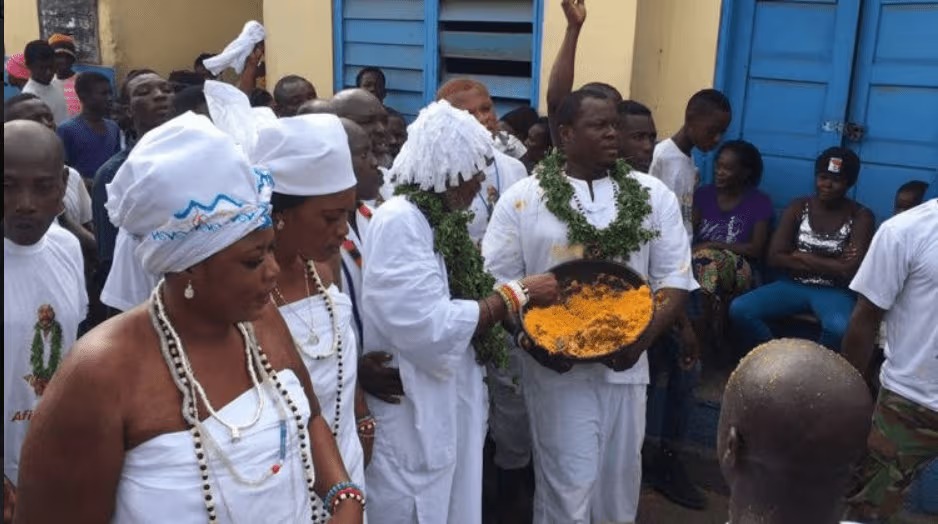

I grew up hearing whispers of the Homowo festival, a celebration of the harvest season in the Ga communities of Ghana.
The Ga people, from who I would love to marry, would come together to feast, sing, and give thanks for the bounty of the land. But what I wasn’t told was that beneath the vibrant colors and lively rhythms, young men are expected to hunt each other like a starving hunter.
The Homowo festival has its roots in the 14th century, a time when the Ga people were plagued by a devastating famine that dragged on for several years. As their crops withered and died, the people stood at the threshold of starvation, their desperation growing with each passing day.
In a final act of hope, they turned to their gods, crying out for relief under the leadership of the then priest-King Sakumo, who performed rituals and sacrifices to appease the gods.
Moved by the suffering of the Ga people, the gods smiled with a bountiful harvest, and the rains swept in, restoring fertility to the land. And from that divine intervention, the Homowo festival was born—a celebration of life, abundance, and the power of faith in the face of despair. And not a violent outburst that would see brother turn against brother.
Today, many believe the Homowo festival is losing its significance. In recent years, the celebration has been marred by incidents of violence, some of them deadly. “The gods who never demanded blood in exchange for the land’s fertility now bear witness to the bloodshed of their people.”
Rival factions now clash in the name of culture—driven by political tensions, chieftaincy disputes, and the fight for dominance and control over festival rites. In communities like Teshie, La, Sowutuom, and others, what should be a season of joy has instead become a period when families lock their doors in fear.
PAST INCIDENTS OF VIOLENCE
These are not just isolated skirmishes. The violence has left a trail of heartbreak.
In 2010, a 30-year-old man was stabbed to death during the Homowo celebration in Nungua, a suburb of Accra and in the following year, clashes between rival groups in La, a suburb of Accra, resulted in the death of one person and several injuries.
A 25-year-old man was shot dead during a Homowo celebration in Odododiodoo in 2012. Just this year, fatalities and injuries were recorded in Teshie and Sowutuom during the Kpokpoi Sprinkling ceremony.
The question I ask is, how did a festival that was meant to feed the hungry become a festival of bloodshed? How did a celebration of life and abundance become a celebration of death and destruction? Why are we doing this to ourselves as a country?
As I ponder these questions, I am filled with a sense of sadness and loss. Sadness for the lives lost, for the families torn apart, and for the community that has been changed by violence. Loss of the culture and tradition that has been distorted and disfigured by the actions of a few.
But even in the midst of this sadness and loss, I remain hopeful. Hopeful that we can find our way back to the true meaning of the Homowo festival. Leaping with faith that we can reclaim our culture and tradition and celebrate it with the joy and abundance that it was meant to bring. Keeping my chin up, we can learn from our past and create a better future for ourselves and the generations to come.
Until then, I say this: let us revive the spirit of our ancestors. Let us celebrate our culture and tradition with unbridled joy and immense pride. Let us pay tribute to our forebears, who paved the way for us through their struggles and sacrifices.
Let us unite as a community, embracing our rich diversity and showcasing our collective strength. Let’s punish perpetrators of these acts. And most importantly, let us show the world the true essence of being Ga and Ghanaian.