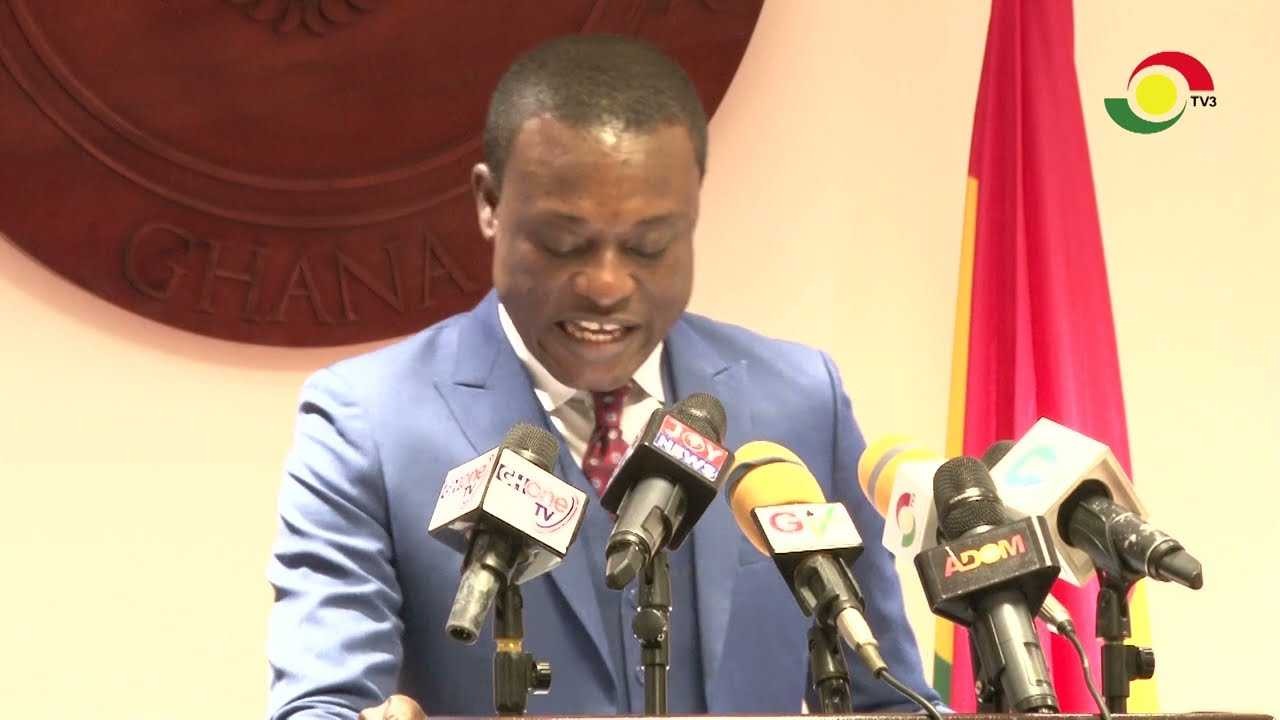

The Special Prosecutor, Kissi Agyebeng, has said that although his outfit has made mistakes in the execution of its mandate, that does not necessitate its dissolution.
According to him, if that argument is anything to by, then all public institutions would cease to exist.
“We acknowledge that we have made some mistakes. We do not claim to be a perfect institution. However, these mistakes are commonplace and none of them is near-enough basis for some public officers to actively rundown the Office and mount official challenges to its existence by seeking its collapse or removing its essential powers. And even where we have made mistakes, we have endeavoured to take curative action to set matters on a proper course. For us, this is the mark of a viable public office.
Indeed, the truism is that no human agency may claim perfection. And certainly not a public institution in this Republic. Therefore, if the basis of collapsing a public agency is that the entity in question committed common mistakes in the ordinary course of its work, then every public institution in Ghana should immediately be shut down. That is the absurd result of the official attacks against the OSP. It is always the OSP,” Mr Agyebeng stated.
PLEASE READ THE FULL TEXT BELOW:
Good afternoon, ladies and gentlemen of the media.
Today, I declare the re-birth of the Office of the Special Prosecutor (OSP).
It has been five years since I was sworn in as the Special Prosecutor of the Republic. Remarkably, we have spent much of the five years fighting for the survival of the OSP – fighting just to exist and to perform our functions. It has been one battle after another of a sustained and coordinated effort to strangle the OSP and to shut it down. If the attacks on the OSP were orchestrated only by persons who are subjects of investigations and their associates, one may fairly dismiss them merely as corruption fighting back. Sadly, the most blood-letting attacks have emanated from official action by some public officers.
We have seen attempts to abolish the OSP by a withdrawn private member’s bill in Parliament based on contrived charges of lack of performance without any evidence and in the face of publicly available proof of stellar performance by the Office in its very short period of existence. We have also witnessed the actions of some public officers, whose duty it is to protect the OSP and guardrail its work through collaboration and cooperation, mount spirited attacks on the Office intended to extinguish its powers and reduce it in the estimation of the public and to unfairly pass it off as moribund and ineffective. Perhaps no other public institution has endured such debasement in the history of our Republic. It is always the OSP.
We admit that we are not above criticism. So, we have taken the trouble to do a frank introspection as to whether these attacks, especially those by public officers, intended to shut down the office or to extinguish its powers, have reasonable basis. We acknowledge that we have made some mistakes. We do not claim to be a perfect institution. However, these mistakes are commonplace and none of them is near-enough basis for some public officers to actively rundown the Office and mount official challenges to its existence by seeking its collapse or removing its essential powers. And even where we have made mistakes, we have endeavoured to take curative action to set matters on a proper course. For us, this is the mark of a viable public office.
Indeed, the truism is that no human agency may claim perfection. And certainly not a public institution in this Republic. Therefore, if the basis of collapsing a public agency is that the entity in question committed common mistakes in the ordinary course of its work, then every public institution in Ghana should immediately be shut down. That is the absurd result of the official attacks against the OSP. It is always the OSP.
Our introspection leads us to conclude, rather startlingly but guardedly so, that the coordinated attacks against the OSP to shut it down or at least, render it ineffectual, are largely traceable to what the Office stands for and its powers and functions, especially its prosecutorial function and even more so its independent power of investigation – the capacity to independently decide who to investigate and what cases to investigate within its mandate. These functions and powers of the OSP represent such a spectre of discomfort among some public officers, that they would rather see the Office abolished. It is always the OSP.
On another score, I state with extreme reluctance, that some of the attacks intended at abolishing the OSP or dimming its light stem from personal dislike against the occupant of the seat of the Special Prosecutor and the operational directors. The evidence has not shown that these unliked persons, including me, engage in obnoxious or untoward conduct. On the contrary, it is a case of simply a preference for other persons to me and the operational directors.
To drive down a public institution set up to fight corruption and to actively call for its abolition out of personal dislike for the principal office holders not arising from any unbecoming conduct but a preference for other persons is the antithesis of development. It is always the OSP. This is no way of building a nation.
Through it all, the Office has held high and been irrepressible and today I announce the rebirth of the OSP.
To those who hold the view that the OSP has achieved nothing and that it should be scrapped, your claims are testable. To those who say the OSP is ineffective, your claims are testable. You are respectfully invited to check the statistics of our performance and benchmark them against your preferred institution, taking into account mandate, year of establishment, resources, complexity of cases and legal constraints. If done dispassionately, it would occur to you that the OSP has performed creditably. Our performance is neither shrouded in secrecy nor obscurity. We pride ourselves with openness.
As at 31 December 2025, the OSP was conducting the prosecution of 33 persons, and had 79 cases at full investigation stage and 161 other cases at the preliminary investigation level. The OSP had secured seven convictions at the same time through court sanctioned plea agreements.
The performance ledger transcends convictions and cases under investigation. Our mandate is not only investigations and prosecutions. It includes the recovery of assets and taking steps to prevent corruption. And by December 2025, the OSP had secured financial recoveries including GHC8.518 million and US$2 million in addition to substantial movable and immovable assets in ongoing proceedings.
The OSP has saved the nation billions of dollars in its work in the assessment of the risk of corruption, especially in relation to our natural resources and the potential loss of sovereignty over same and our seaports. The OSP also safeguarded Tema Oil Refinery from being pawned off and it is now in operation after years of inactivity.
The OSP’s intervention in the customs sector has led to a reimagination and institution of a more robust auction of items system and a huge reduction in the often-abused customs advance ruling regime in aid of the recouping of more revenue.
The OSP’s shake-up of the Government payroll system has saved the nation a little over GHC100 million so far.
The OSP has saved the nation more than twenty-fold the total amount of money released to it since its establishment and it has thereby fully paid for and far above the resources invested in it. No person, whether in the public or private space, now engages in corruption lightly. This is because such acts have become costly as a result of the operations of the OSP.
These are measurable outcomes. These are verifiable outcomes. Criticism is legitimate. Scrutiny is necessary. However, they must be based on facts and not on baseless dismissiveness.
The performance of the OSP should not be measured by political applause, social media volume, the preferences of persons affected by its work, or the preferences of those who dislike the institution and its officers out of sheer ill-will. It should be gauged by investigations undertaken, persons prosecuted, assets recovered, losses prevented, systems corrected, public funds saved, and steps taken to prevent corruption.
So, when next it is said that the OSP has not performed, the answer is straightforward. Check the statistics and benchmark them against your preferred alternative. Wo kyiri okwaduo a yi ni mmirika – no matter how much you disapprove of the duiker, acknowledge its notable speed and swiftness.
On 15 April 2026, an Accra High Court sought to exercise powers which are the sole preserve of the Supreme Court and struck down parts of the Office of the Special Prosecutor Act, 2017 (Act 959) as unconstitutional. The court decided that the OSP lacks independent prosecutorial mandate. It invalidated all prosecutions conducted by the OSP and nullified all convictions and assets secured by the Office. It then directed that all OSP cases should be handed over to the Attorney-General. The court so decided although there was a matter pending before the Supreme Court which was directly on the point of whether the prosecutorial mandate of the OSP under Act 959 was unconstitutional.
This development brought the investigative and prosecutorial work of the OSP nationwide to a standstill and uncertainty. Other courts, except one, adjourned all proceedings awaiting the Supreme Court decision. Therefore, prosecutions stalled; investigations were gravely hampered; and corrupt actors became emboldened in their opprobrious conduct. The cost to the nation is staggering.
On 29 July 2026, the Supreme Court delivered its decision in the much-awaited case of Noah Ephraem Tetteh Adamtey v. Attorney-General, which was to decide the fate of the OSP. Upon the filing of the writ by the plaintiff on 8 December 2025, the OSP sought to join the matter acting upon our gathered intelligence that the Attorney-General had no intention of defending the suit and that he would rather agree with the plaintiff that the impugned provisions of Act 959 should be struck down as unconstitutional. However, we admit that intelligence is not evidence and so the Supreme Court dismissed our application for joinder on 27 January 2026 by holding that the State, represented by the Attorney-General, was the only proper defendant and that the OSP was not a necessary party. Well, we tried; and the records so reflect. History may be kind to us for trying to join the suit and not merely sitting back.
Subsequent events confirmed our intelligence. On 8 April 2026 the Attorney-General obtained an extension of time within which to file his statement of case in which he supported the plaintiff’s case albeit on his own separate grounds. Consequently, just as we feared and forecasted, the suit stood undefended until named civil society organisations applied to and were permitted by the Supreme Court to join the suit and file an amicus brief as amici curiae – friends of the court.
In its landmark decision, the Supreme Court, by a well-reasoned and emphatic 7-0 verdict, upheld the constitutionality of the prosecutorial function of the OSP and its legal foundation and set-up under Act 959; L.I. 2373; and L.I. 2374; and it expressly overturned the decision of every other court to the contrary.
We express our appreciation to all citizens and organisations who continue to defend the work of public anti-corruption agencies. We set out for especial mention the following civil society organisations that defended the cause in the Noah Ephraem Tetteh Adamtey case at the Supreme Court:
Ghana Center for Democratic Development
Transparency International Ghana
Ghana Anti-Corruption Coalition
Democracy Hub
Star-Foundation Ghana
NORSAAC
Pen Plus Bytes
Africa Centre for Energy Policy
Odekro PMO Foundation
A Rocha Ghana
Parliamentary Network Africa
Imani Centre for Policy & Education
OneGhana Movement
Africa Education Watch
The OSP considers such civic vigilance essential to safeguarding Ghana’s anti-corruption architecture, institutional independence, and the rule of law.
We also salute the legal team of the amici curiae. Every page of your legal brief was a delight and eye-opener.
The Supreme Court decision should be celebrated. It has set matters clear as to the functions and operations of the OSP and the co-existent relationship between the Attorney-General and the OSP. It has greatly strengthened the fight against corruption. And it is upon the decision of the Supreme Court that I declare a rebirth of the OSP.
We will show no fear or favour. We will remain resolute in the lawful discharge of our mandate. We will rigorously investigate cases. We will vigorously prosecute cases where the evidence indicate wrongdoing. We will actively recover assets. We will take all necessary steps to prevent corruption.
Recognising that the fight against corruption will persistently be heckled by the pushback of corrupt actors, we have championed and we will continue to champion that the powers of anti-corruption agencies should be enlarged and enhanced, especially in respect of two main indices. First, global anti-corruption best practices indicate that broad-based lifestyle audit non-conviction-based asset recovery represents the fairest and optimal method of frontally addressing corruption and unexplained wealth.
Therefore, we have championed and we will continue to champion that institutions like the OSP and the Economic and Organised Crime Office (EOCO) should be invested with express and effective lifestyle audit non-conviction-based asset recovery powers to assure that persons show legitimate sources of income sufficient to justify their ownership of property. Therefore, where a person’s resources far outstrip his legitimate income, the unexplained portion should be liable to confiscation. This will also be a critical tool to detect fraud and undeclared income for tax purposes. Added to this, conviction after criminal proceedings should not be a condition-precedent for asset recovery. Civil proceedings should suffice.
Second, we have championed and we will continue to champion the institution of a reverse onus clause of a presumption of corruption tied to lifestyle audit. Therefore, where a person is in possession of property disproportionate to his known legitimate sources of income, he should be deemed to have obtained it through corrupt means unless he proves the contrary.
This proposed unexplained wealth mechanism is not a shortcut around justice or a licence for arbitrary confiscation. On the contrary, once the appropriate legal threshold is established before a civil court, unreconcilable assets not traced to legitimate sources of income should be liable to confiscation.
Even though our investigative and prosecutorial work was gravely hampered after 15 April, we have not been indolent. We have reviewed all cases under investigation and at trial. In some cases, we have uncovered more evidence of wrongdoing. In some cases, we have identified more suspects. We will refile some of the pending major cases based on our discoveries.
The nature of the cases the OSP handles are extraordinarily complex, and it is acknowledged globally that corruption cases are among the most difficult to prove. These cases cannot be judged simply by how swiftly an arrest is announced or a prosecution is commenced and concluded. They require immense time, painstaking mining of credible information, forensic analysis, adequate resources, and cooperation across jurisdictions.
On 6 August 2026, a federal jury in Brooklyn, New York, convicted Asante Kwaku Berko (a dual citizen of Ghana and the United States and former Managing Director of Tema Oil Refinery and former Executive Director in the Investment Banking Division of the U.S. based Goldman Sachs group) of conspiring to pay and paying more than $1m in bribes between 2014 – 2015 to multiple Ghanaian officials in connection with the development and financing of a 370 megawatt fuel oil plant in Tema, Ghana under a deal between the Republic of Ghana and Aksa Enerji Uretim A.S., a Turkish energy company and Goldman Sachs client.
The OSP provided investigation and evidentiary assistance to the Federal Bureau of Investigation (FBI) of the United States through Ghana’s established mutual legal assistance framework. The involvement of the OSP has been acknowledged by the United States Department of Justice (DoJ) as providing “significant assistance” to the prosecution. The conviction underscores the importance of international cooperation in the investigation and prosecution of complex corrupt acts spanning multiple jurisdictions.
Predictably, the outcome of the trial of Berko in the United States ignited immense public interest and discourse on the domestic dimension of the investigation in Ghana. We wish to state clearly that the OSP’s work on the matter did not end with the assistance provided to the authorities in the United States. We have been actively and carefully investigating the Ghanaian dimension. I say carefully, because it must always be borne in mind that a conviction of a person in a foreign jurisdiction does not, without more, establish criminal liability under Ghanaian law or justify the immediate prosecution of other persons in Ghana connected with the underlying conduct. Each person’s acts must be assessed under Ghanaian law, using lawfully obtained evidence capable of supporting a prosecution here. The nature of the evidence and the applicable law determine whether prosecution should be commenced in Ghana or otherwise.
That is to say, the conviction of Asante Kwaku Berko in the United States does not provide automatic basis for the prosecution of identified persons who acted with him under Ghanaian law. The circumstances of the case are such that the actions of Berko may not necessarily establish culpability in other persons under Ghanaian law. The OSP will not prosecute a person solely on the basis that a person’s name appears in proceedings conducted in another country. Equally, the OSP will not hesitate to prosecute such persons where the evidence establishes a proper basis for so proceeding.
As I stated earlier, we have been carefully investigating the Ghana dimension, and our public silence has not meant inaction. Our involvement with the case, and the evidence so far, enable us to identify the following as the main persons of interest:
Kwabena Donkor, at all times the Minister of Power
Francis Walkson Kwesi Dzata, at all times the Technical Advisor to the Minister of Power
Solomon Adjetey Sowah, at all times a Deputy Director at the Ministry of Power
Lyndon George Nii Saul Mettle, at all times a Director at Tricorp Group Limited
Baffour Ankoma Brobbey, at all times an employee at Tricorp Group Limited
Other persons of interest include some present and former employees of Volta River Authority, Ghana Grid Company Limited, Electricity Company of Ghana, Public Utilities and Regulatory Commission, and some staff of the entity formerly known as Ministry of Power.
Please bear in mind, and this point should be strongly emphasized, that a person of interest is not necessarily a suspect. The two categories are distinct investigative classifications and should not be treated as interchangeable. Then again, identification in either category does not constitute criminal culpability or conviction until guilt is proved beyond reasonable doubt to the satisfaction of a court of competent jurisdiction. So, we should be circumspect as to how we report this announcement and how we treat the named persons of interest.
Still on this case, we have heard talk that the OSP should not be the institution investigating the matter and that the OSP lacks the capability and track record to investigate the matter. This begs the obvious – the institution which provided significant assistance to the successful prosecution of Berko in the United States lacks the capability and track record to investigate the Ghana dimension; and other institutions, which were not even involved in the matter, are more competent than the OSP? Once again – wo kyiri okwaduo a yi ni mmirika.
At the OSP we do not regard the fight against corruption as a competition between institutions and as pitching one public agency against the other. At the OSP we reckon that the anti-corruption drive is better served through cooperation and collaboration among public institutions. History teaches us that where investigative and intelligence agencies compete among themselves and fail to cooperate with each other, unhappy events ensue – as was the case with the infamous events of 11 September 2001 in the United States.
We call on our sister investigative, intelligence and prosecutorial institutions – let us cooperate with each other. Let us collaborate. Let us share intelligence. Let us compare notes. Let us work together. It is one Republic of Ghana we all work for. So let us make her great and strong.
Thank you for coming. We appreciate your time. We appreciate your custom. We appreciate the use of your resources for gratis.
Kissi Agyebeng
26 August 2026
The Special Prosecutor