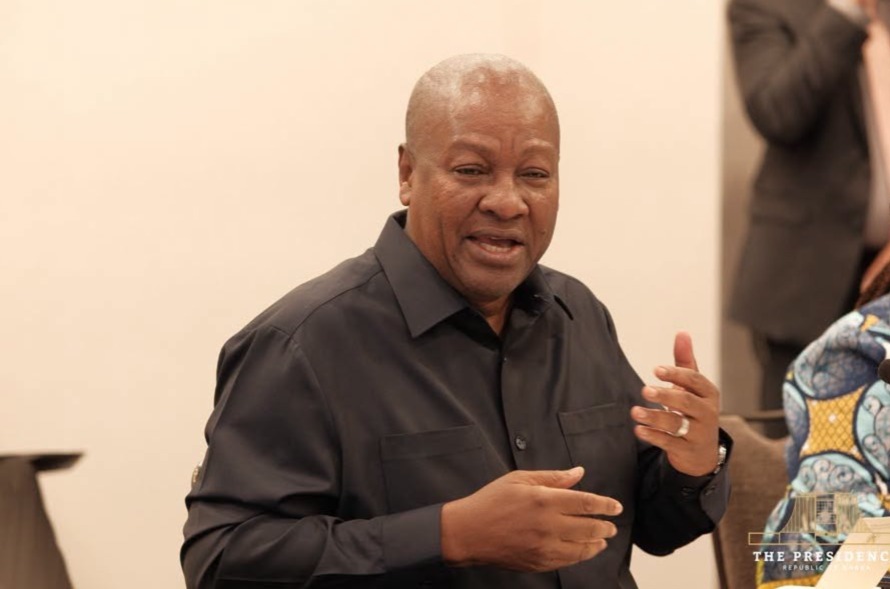

President John Mahama has stated that the Accra Reset agenda will not succeed without the support of the global community.
He said any industrialisation efforts that would be undertaken as part of the Reset agenda would require access to at least the African regional market to sell the products.
“We are resetting our national economy, fiscal management, governance structures, and industrial sector. But as we undertake this heavy lifting at home, one truth becomes clear: you cannot successfully reset a national house if the global architecture around it remains fundamentally flawed,” President Mahama said.
He made the statement while addressing a High-level side event on the Accra Reset: Global Reset Dialogue at the 81st United National General Assembly in New York on September 21.
The President explained that, “Our domestic agenda in Ghana, which is built on economic self-reliance, local value addition, robust public health infrastructure, transparent governance, and the 24-Hour Economy initiative, mirrors the objectives of the Accra Reset.
When we say we are resetting Ghana’s health sector, we do not mean simply building medical facilities and waiting for foreign donors to supply the essential vaccines or IV fluids. We mean building local industrial capacity, encouraging our domestic pharmaceutical companies in Ghana to manufacture essential medicines locally, backed by guaranteed state purchasing and regional market access.
READ FULL TEXT BELOW:
Opening Remarks by H.E. John Dramani Mahama, President of the Republic of Ghana
At a High-level side event on the Accra Reset: Global Reset Dialogue.
81st United National General Assembly
Marriott Marquis, New York | Monday, 21 September 2026._*
Your Excellencies,
Distinguished Ladies and Gentlemen,
My Dear Friends:
Welcome.
I want to start by expressing my profound gratitude to Presidents Olusegun Obasanjo, Ellen Johnson Sirleaf, and Laura Chinchilla.
Thank you for welcoming us on behalf of the Guardians’ Circle. You are the moral stewards and the intellectual bedrock of the Accra Reset. Your challenge and conviction set us on this path.
Excellencies, one year ago, in this very city, we launched the Accra Reset. We came together out of a shared refusal to accept that the only response to a fragmenting and dwindling aid architecture was a more eloquent plea for charity.
We refused to accept that our people’s health, dignity, and future should remain perpetually tied to the shifting political winds of donor magnanimity.
At that launch, we diagnosed three heavy burdens weighing down the Global South:
– Geostrategic Marginalisation—where others write the rules that determine our destiny;
– Geopolitical Vulnerability—where decisions taken thousands of miles away can undo our national plans overnight; and
– Donor Dependence—where the life-saving services our citizens require rest on funding levers completely out of our reach.
We recognised then, as we do now, that these are not three separate misfortunes. They are interconnected threads of a broken global system.
To break them, our response must connect political authority, productive capability, and financial resilience.
Excellencies, as many of you know, at home in Ghana, I have laid before our people a clear, uncompromising agenda: The Resetting Ghana Agenda.
We are resetting our national economy, fiscal management, governance structures, and industrial sector. But as we undertake this heavy lifting at home, one truth becomes clear: you cannot successfully reset a national house if the global architecture around it remains fundamentally flawed.
Our domestic agenda in Ghana, which is built on economic self-reliance, local value addition, robust public health infrastructure, transparent governance, and the 24-Hour Economy initiative, mirrors the objectives of the Accra Reset.
When we say we are resetting Ghana’s health sector, we do not mean simply building medical facilities and waiting for foreign donors to supply the essential vaccines or IV fluids.
We mean building local industrial capacity, encouraging our domestic pharmaceutical companies in Ghana to manufacture essential medicines locally, backed by guaranteed state purchasing and regional market access.
The Accra Reset takes that exact logic to the international stage. A national reset without a global reset leaves us building on shifting sand. Likewise, a global reset without domestic discipline is unfeasible. They are two sides of the same coin.
Over the past year, we built the machinery to turn this philosophy into actionable policy. We established the Presidential Council, constituted the Guardians’ Circle, and formed the High-Level Panel on Reform of the Global Health Architecture and Governance.
In Dakar, in July, I asked the Panel to be bold: avoid vague diplomatic generalities, choose their controversies wisely, and, above all, write for the Global South citizen on the street.
Today, the Panel has delivered. I offer my deepest appreciation to our Co-Chairs— Peter Piot, Elhadj As Sy, Priscila Ferraz Soares, and Budi Gunadi Sadikin; our Special Advisor, Michel Sidibé; and every member of the Panel for fulfilling this mandate.
Their report begins with an undeniable historical truth.
In 1955, twenty-nine nations gathered in Bandung demanding a seat at the world’s table.
We won political independence; we raised our national flags and sang our anthems. Yet, the levers of global trade, finance, and health governance remained firmly anchored elsewhere.
Fifty years later, in 2005, the world met in Paris and crowned “country ownership” as the guiding principle of development cooperation. It was a pleasant phrase. But in truth, we were handed a broken cauldron; we were asked to own a soup cooked entirely in someone else’s kitchen!
For decades, nations of the Global South have been asked to own the results of health and development programmes, while others retain the control.
Today, through the Accra Reset, we declare unequivocally that there can be No Ownership Without Control. Sovereignty does not magically appear because a country signed a donor agreement.
But let me be equally frank with my brothers and sisters across the Global South. Moving power from distant boardrooms in Geneva or Washington into an unaccountable ministry in Accra, Abuja, or anywhere else will not magically manifest sovereignty either.
If we demand control, we must earn it through uncompromising domestic accountability. In our Resetting Ghana Agenda, we are tightening fiscal controls, fighting corruption, and ensuring that every public cedi is accounted for down to the last pesewa.
The same principle applies across the Global South: No ownership without control, yes—but no control without absolute accountability to our people.
This is the bedrock of our New Global Bargain: responsibility matched by authority; authority backed by real productive capability; and every partner held accountable for their promises.
The report we unveil today, A Sovereign Future for Health, sets out ten practical recommendations, which will be presented after my remarks.
We are now moving from design to execution. Too often, visionary ideas are born with great fanfare, only to die quietly in New York’s diplomatic corridors. We will not let that happen to the Accra Reset.
Over the coming months, Ghana and the Presidential Council will convene governments, global health bodies, development finance institutions, philanthropies, and the private sector to translate these recommendations into country-level compacts.
We invite strategic partners, from Brazil’s Fiocruz to leading institutions in India, Indonesia, the Gulf, and across Africa, to partner with us. We want to build self-sustaining networks that connect research, regulatory oversight, local manufacturing, and reliable distribution.
Let me be clear: this sovereign health agenda is not a retreat into isolationism.
We are seeking pragmatic interdependence: a mature, equal partnership where we see one another as equals. Stronger, self-reliant Southern partners are not a threat to the Global North. On the contrary, resilient health systems in Africa and Asia make the entire world safer for all of us.
I warmly welcome the leaders from France, Spain, the United Kingdom, the G77, the OECD, and the Commonwealth who are here today.
Special thanks to Prime Minister Gordon Brown for accepting the mantle to mobilise global political leadership around this New Global Bargain.
Some argue that structural reform must wait until global geopolitical tensions ease. I respectfully disagree. Crisis is precisely when new paradigms are forged.
Many a time, out of chaos are born new ideas and partnerships. Health is any human’s most precious possession.
That is why we selected health as the first battleground for this global reset, and why maternal and child health is our first critical test.
Globally, nearly seven out of ten maternal deaths occur in Sub-Saharan Africa. And my own country, Ghana, is still three times above the recommended SDG target. This is unacceptable.
Through the Mother Africa initiative, championed by my dear sister, President Samia Suluhu Hassan of Tanzania, and the Business United for Mothers, Babies and Youth (BUMBY) campaign, we are bringing public policy and corporate responsibility together to safeguard the lives of mothers and children.
These initiatives will stress-test our new financial and governance architecture in real-time, delivering measurable results where they matter most.
I wish to express my appreciation to Dr Tedros Adhanom Ghebreyesus, Director-General of the WHO, for his steadfast support of global health reform.
Excellencies, as Ghana prepares to assume the Chairmanship of the African Union in 2027, we will carry this Reset agenda into the heart of Africa’s collective policy framework, working hand in hand with the Non-Aligned Movement and the G77 plus China.
On behalf of the Presidential Council, I am honoured to launch A Sovereign Future for Health officially.
The Panel has completed its assignment. Now, the responsibility falls on us to deliver its promise. We have come full circle; let us not go around in circles.
Let this New Global Bargain begin today:
– Ownership backed by real control;
– Cooperation defined by human dignity; and
– Promises that manifest as real protection for that baby girl born tonight— whether in Kathmandu, in Arusha, or in Damongo.
Thank you, and may God bless our collective endeavour.