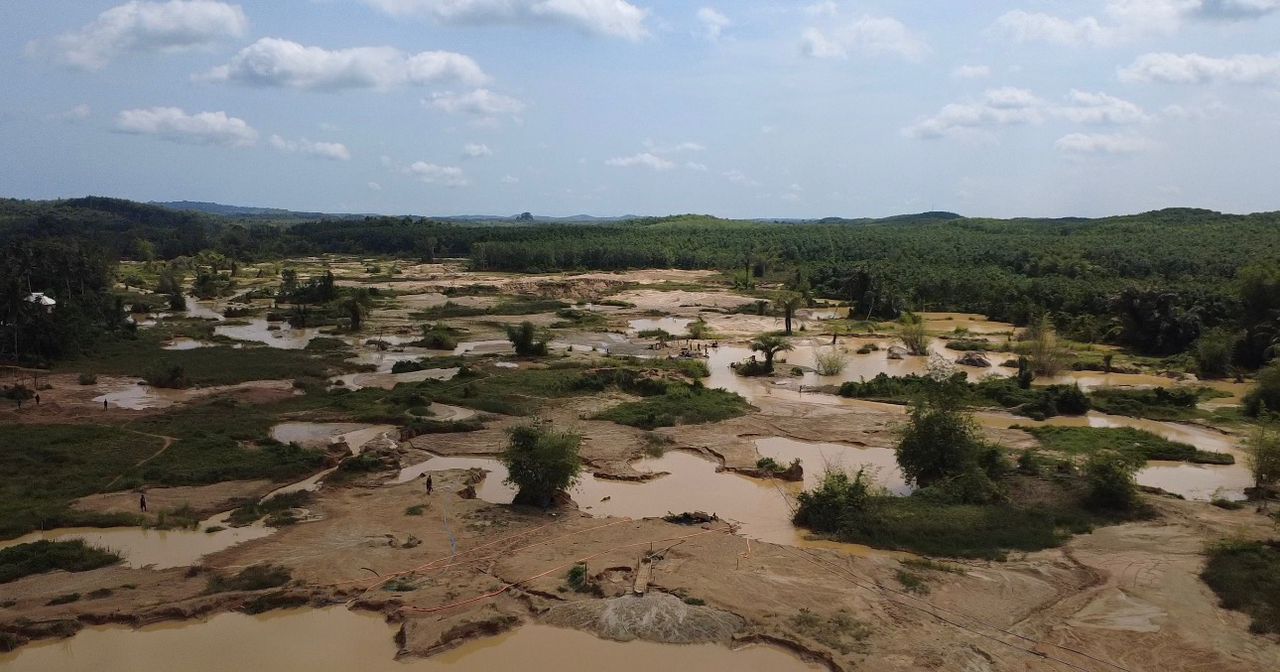

Beneath the emerald canopy of the Ghana Rubber Estate, a silent war is being lost. To the untrained eye, the plantation still looks like a vast, living blanket of green. But step closer, and the earth groans.
The ground is pockmarked with mining pits. Entire rows of rubber trees tens of thousands of them have been yanked down, their roots pointing skyward like skeletal hands.
And in their place? Not rubber. Not latex. But the muddy, mercury-stained scars of illegal gold mining- galamsey.
For the men and women who protect this land, each morning begins with a grim inventory: How many trees fell last night? How many new holes were dug?
“It is getting out of hand,” says Perry Acheampong, Head of Corporate Communications for the Ghana Rubber Estate Limited (GREL).
His voice carries exhaustion, not just frustration.
“Every day, we are dislodging illegal miners,” he tells us, standing near a freshly dug pit. “In the first quarter of this year alone, we have reported more than seventy galamsey incidents within the plantation. And clearly, you can see they are felling more trees, expanding their business,” he said.
The numbers are staggering. But numbers don’t tell the full story. The full story is this: even when the miners are caught, they almost always come back.
Last year, the Western Regional Security Council (RESEC) launched a major operation. Many illegal miners were arrested. There was hope, fragile hope.
But hope died when the courts failed to act.
“If the people are arrested and not prosecuted, they simply return to the scene to do it again,” Acheampong pleads. “We are grateful that REGSEC is here to help. But we plead with the Ghana Police Service and the Judicial Service: fast-track the prosecutions. ”
It is a clarion call echoed by every legal miner, every farmer, and every security guard watching their livelihood vanish into a muddy hole.
The illegal miners, emboldened by impunity, have grown bolder. They no longer hide only in darkness.
“What we have observed is that these days, they operate during the daytime as well,” says Mr. Joseph Nelson, Western Regional Minister and Chairman of RESEC, his jaw tight as he surveys the destruction.
“They have devised new ways of entering the plantation, allowing them to operate at night when nobody is watching.”
After a site visit on Thursday joined by Colonel Dominic Buah, Director of Operations for the National Anti-Illegal Mining Operations Secretariat (NAIMOS) Nelson had a message for the residents and miners destroying the plantation. It was not a gentle one.
“From now on, you must desist from entering the plantation to engage in such activities,” Nelson warned, his voice calm but edged with steel. “If you do not, you will face a very serious and befitting response one that will not be good for you.”
There may be hope yet. Operations Director of NAIMOS, Colonel Dominic Buah, speaking off camera after witnessing the devastation, revealed that plans to deploy permanent NAIMOS troops to the Western Region are already far advanced.
“Within a few weeks,” he said quietly, “we will announce our presence.”
For the rubber plantation workers, those weeks cannot come fast enough. Every night they wait, more trees fall. Every day the courts delay, the miners grow stronger.
The question hanging over the plantation is no longer just about rubber or gold. It is about whether Ghana’s laws still carry weight or whether galamsey has already won.