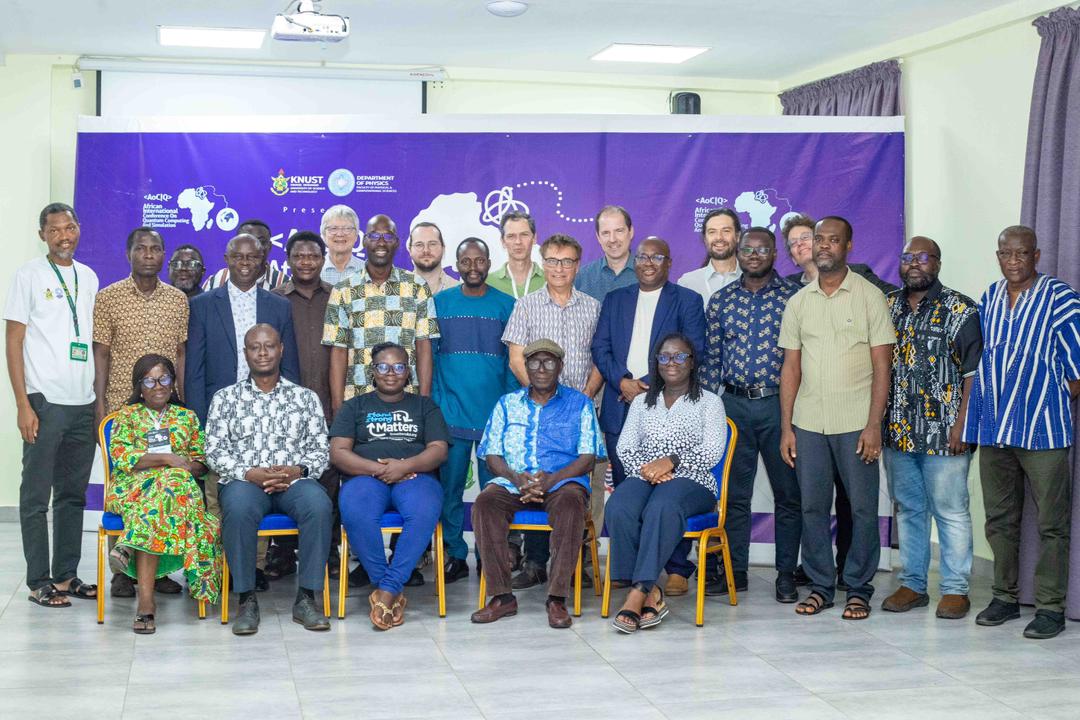

Ghana is taking a deliberate step toward the future by establishing a Center for Quantum Computing and Simulation. This move signals the country’s determination to enter the global quantum landscape.
Long dominated by major scientific powers, quantum technology is now creating openings for nations willing to invest early, and Ghana is positioning itself among them.
This momentum follows the African International Conference on Quantum Computing and Simulation, held in Kumasi under the theme “Quantum for Impact: Fostering Education, Research, and Collaboration Towards the SDGs.”
The theme captures a growing continental belief: Africa should not stand on the sidelines while the next technological revolution unfolds.
A new scientific frontier for Ghana
Quantum computing, once perceived as an abstract scientific pursuit, is quickly evolving into one of the most influential technologies of the coming decade. Unlike classical machines, quantum computers can process enormous datasets and simulate complex systems at previously unimaginable speeds.
At a high-level stakeholder engagement in Kumasi, participants outlined the far-reaching possibilities quantum technologies could unlock for Ghana:
- Health: Accelerated disease modeling, improved diagnostics, and advanced drug-discovery tools
- Agriculture: Data-driven farming, crop performance simulations, and climate-informed planting decisions
- Climate Action: Enhanced forecasting, risk-assessment models, and refined adaptation strategies
- Cybersecurity: Quantum-safe encryption and ultra-secure communication systems
- Industry & Innovation: Smarter logistics, precision analytics, and stronger digital infrastructure
Researchers at the event emphasized that Ghana’s interest in quantum science is not merely about staying current. It is about using advanced computation to build precise solutions tailored to Ghana’s own development challenges.
Why Africa needs quantum science now
Africa’s footprint in quantum research remains limited, owing to gaps in infrastructure, training, and investment. Ghana’s initiative aims to disrupt that pattern.
The African Centre of Excellence in Quantum Science and Technology (ACE-QST) is already leading efforts to create a continent-wide ecosystem that nurtures talent, strengthens collaboration, and connects academic research with industry needs. Its long-term goal is clear: ensure that quantum science contributes directly to Africa’s development priorities by 2035.
“Quantum science is no longer a luxury; it is a necessity for Africa’s development,” said Thomas Konrad, Associate Professor of Physics, University of Kwazulu_Natal South Africa,called for heightened government support in funding, infrastructure, and policy formulation.
What “Quantum for Impact” means for Africa
At its heart, “Quantum for Impact” is a call to use emerging technologies to solve real societal problems. It seeks to close three long-standing gaps:
- The innovation gap: Reducing dependence on imported technologies by strengthening local problem-solving capacity
- The skills gap: Preparing young Africans for the high-tech careers that will define the global economy
- The development gap: Applying advanced tools to accelerate progress toward the Sustainable Development Goals
For Africa, quantum technologies are not merely scientific curiosities; they are strategic assets for building a resilient, knowledge-driven future.
How Ghana can use quantum computing to advance the SDGs
Experts at the conference outlined how Ghana can integrate quantum computing into its national development agenda:
Health: Quantum-based simulations can help forecast disease outbreaks, model virus behavior, and optimize hospital resource allocation.
Agriculture: Farmers could benefit from quantum-enhanced climate analysis, soil simulations, and crop optimization tools that support food security initiatives.
Climate action: High-precision models can strengthen Ghana’s climate adaptation strategies, improve disaster preparedness, and support renewable energy planning.
Industry, innovation & infrastructure: Quantum-safe encryption, advanced fintech solutions, and robust digital systems can drive Ghana’s innovation agenda and strengthen its competitiveness.
A call for policy, leadership, and collaboration
Beyond the science, stakeholders made it clear that strong policy leadership is critical. They urged African governments to establish national quantum ecosystems, research hubs, funding frameworks, updated STEM curricula, and industry partnerships.
Sustained collaboration across universities, government institutions, tech companies, and international partners will be central to Ghana’s success.
Prof. Aba Bentil, former President, Ghana Academy of Art and Sciences, a key speaker and contributor at the meeting, underscored the urgency of coordinated investment. “We cannot forge a quantum future through scattered efforts. The government must invest in people, laboratories, policy, and partnerships,” she said.
Ghana steps into the future
The proposed Center for Quantum Computing and Simulation will stand as one of Ghana’s most forward-looking scientific investments and for Africa at large.
The center seeks to expand the nation’s research capacity, prepare its youth for emerging industries, and position Ghana as a contributor, not just a consumer, in the global quantum economy.
Ghana has opened the door to a transformative chapter in its digital development.
The challenge now is to build the momentum needed to walk confidently into that future, which according to the Head of Department for Physics, KNUST, is attainable.
KNUST College of Engineering, NYA partner to drive youth skills training
By Benjamin Aidoo and Portia Akosua Anomah