
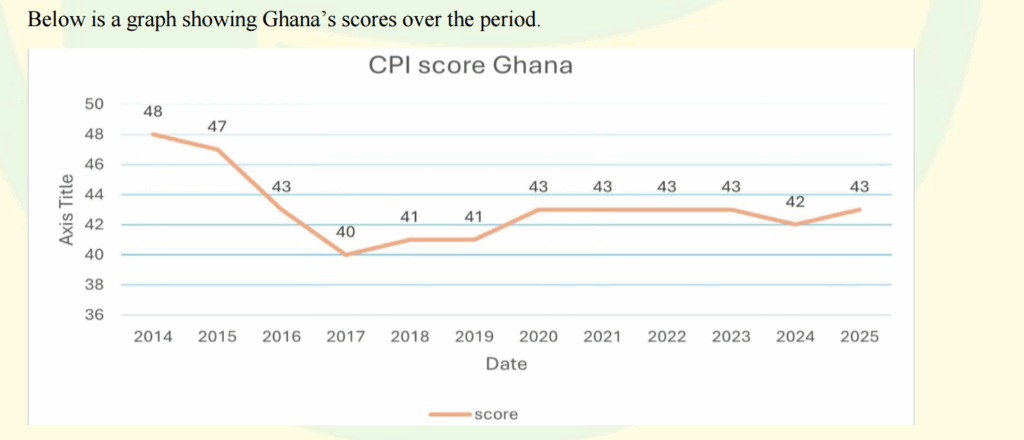
Ghana has scored 43 out of 100 in the 2025 Corruption Perception Index (CPI), placing 76 out of the 182 countries assessed within the period.
This was a progress from the 42 recorded in 2024, but too marginal, according to experts, to signal real progress in the fight against corruption.
Transparency International which released the score on Tuesday, February 10, 2026, indicated that Ghana’s one-point increase, per its methodology, does not constitute a significant change to drive the needed progress in the graft fight.
Board Chair of Transparency International, François Valérian, stressed the need to adopt both domestic and international cooperation to fight corruption.
According to him, “in an interconnected world, we need both national action and multilateral cooperation to protect the public interest and tackle shared challenges like corruption. At a time when we’re seeing a dangerous disregard for international norms from some states, we need to protect a rules-based global order that is grounded in tr ansparency, accountability to citizens and respect for human rights.”
Ghana has stuck at a CPI score of 43 since 2020, except for the dip to 42 in 2024. The country’s highest score was 48 in 2014, after which it experienced a downward trajectory until 2018.
The major issues that are making waves in the midst of the 2025 assessment is what many describe as the politicisation of Ghana’s justice system and law enforcement agencies.
Affecting the score include the dismissal of the former Chief Justice, petitions for the removal of heads of independent institutions, and the discontinuation of corruption cases through a controversial 60:40 settlement arrangement have raised questions about executive interference.
Following the establishment of the government’s Operation Recover All Loot (ORAL), many believed the settlement process, which allowed government officials facing corruption charges to avoid prosecution by paying a portion of the alleged misappropriated funds, was a means to propel corruption rather than fighting it.
The Ghana Integrity Initiative (GII), the local chapter of Transparency International, has said the Office of the Special Prosecutor’s (OSP) efforts to increase transparency in its corruption investigations and prosecutions have failed to yield any significant impact so far.
Global and regional context
Globally, corruption is worsening even in established democracies. The number of countries scoring above 80 has shrunk from 12 a decade ago to just five this year, with the global average standing at 42 out of 100.
Sub-Saharan Africa continues to rank lowest on the index with an average score of 32 out of 100. Ten of the region’s 49 countries have significantly deteriorated since 2012, while only seven have improved.
Recommendations for reform
TI-Ghana is calling on the government to strengthen the justice system, fast-track the creation of anti-corruption courts, and expeditiously adopt the National Ethics and Anti-Corruption Plan (NEACAP).
The organisation also recommends that Parliament hasten passage of the Community Tribunal Bill, reform political party financing regulations, and protect civic space and media freedom.
Other recommendations include cultural reorientation focused on ethics, promoting transparency in state regulatory agencies, and strengthening awareness among Designated Non-Financial Businesses and Professions of their anti-money laundering obligations.
TI-Ghana stressed that the CPI serves as a warning signal, not a verdict, adding that defensive responses will not change perceptions.
“With sustained political will and measurable reforms, Ghana can rebuild public trust and improve its anti-corruption outcomes over time,” the organisation stated.
CPI the most credible way to measure a government’s fight against corruption – Mary Addah