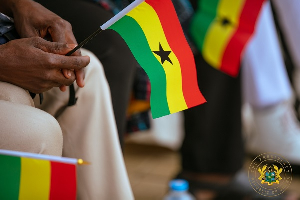

In Ghana, every school child knows two powerful pieces of national scripture.
One we sing.
The other we swear.
The Ghana National Anthem and the Ghana National Pledge.
Yet, most of us recite them the way people mumble grace before food, quickly, politely, and without thinking about what we just said to God… or to the country.
But if you slow down and read them carefully, something fascinating emerges.
They are both talking about the same Ghana.
Just from opposite directions.
A Nation That Prays
Let’s begin with the anthem.
The Ghana National Anthem is, in essence, a prayer. A national prayer.
Every line is an appeal upward:
“God bless our homeland Ghana…”
“Make our nation great and strong…”
“Bold to defend forever the cause of Freedom and of Right…”
The grammar of the anthem is supplication.
We are asking.
We ask for blessings.
We ask for guidance.
We ask for justice.
We ask for unity.
In other words, the anthem imagines a nation looking upward, hands raised, asking heaven to shape the destiny of Ghana.
And there is nothing wrong with that.
Ghanaians pray about everything.
We pray about elections.
We pray about fuel prices.
We pray about galamsey.
We even pray before football matches we already know we might lose.
Prayer is part of our national DNA.
But then comes the pledge.
And the tone changes completely.
A Nation That Promises
The Ghana National Pledge does not begin with prayer.
It begins with a promise.
“I promise on my honour to be faithful and loyal to Ghana, my motherland…”
That is a “dangerous” sentence when said loosely.
Because once you say I promise, you have entered into a covenant.
A contract of honour. Bound by duty.
Suddenly, the responsibility shifts.
No longer “God bless Ghana.”
Now it becomes:
“I will serve Ghana.”
The pledge is not asking God to build the nation for us.
It is asking us to build the nation ourselves.
Loyalty.
Service.
Honesty.
Sacrifice.
These are not divine duties.
They are citizen duties.
Then, and only then, the pledge makes a small request to God:
“So help me God.”
Notice the order.
First duty.
Then help.
Not the other way around.
The Quiet Genius of These Two Texts
Now here is where it becomes interesting.
The anthem and the pledge are not competing ideas.
They are two halves of the same national philosophy.
The anthem expresses our hope.
The pledge expresses our obligation.
The anthem asks God to make Ghana great.
The pledge commits us to making Ghana great.
Think of it this way.
The anthem is vision.
The pledge is implementation.
Or in Management language, something a lot of our big men might appreciate, the anthem is strategy, the pledge is execution.
One inspires.
The other binds.
The Problem: We Sing More Than We Commit
In Ghanaian schools today, we sing the anthem almost every morning.
But the pledge?
Sometimes.
Occasionally.
When a teacher remembers.
Which is interesting.
Because if a country had to choose between singing beautifully and keeping its promises, which one would actually build the nation?
Exactly.
The pledge is the operational manual of citizenship.
It turns patriotism from a feeling into a discipline.
And discipline, as someone once wisely said, is not a natural trait, it is a habit we cultivate.
What if we take nationalism more serious and a bit further than wearing Ghana colours, eating Ghana food and traditional Dancing. How about wearing Ghana in our hearts and borrowing a few more lines from another great national song “Yen are Asaase ni…”.
That is another conversation for another day.
Imagine If We Took the Pledge Seriously too
Perhaps Ghanaians should regularize teaching and saying (not singing) the pledge more often than we do now as it enforces the anthem. Not just at official functions but in our daily lives and quiet moments.
Let’s imagine something radical for a moment.
What if the Ghana National Pledge were treated like a real contract?
Imagine a public official standing before a mirror each morning and repeating:
“I promise on my honour to be faithful and loyal to Ghana…”
Imagine a journalist reflecting:
“I pledge myself, in all things, to uphold and defend the good name of Ghana…”
Imagine a contractor reading:
“I pledge myself to the service of Ghana…”
Before inflating a road contract by 300%.
Imagine a uniformed officer whispering:
“I promise to uphold and defend the good name of Ghana…”
Before collecting “something small.”
The pledge would become something more serious.
Because promises have a strange way of confronting our conscience.
And conscience, when awake, is a stubborn judge.
Turning a Wish Into a Duty
That is why the pledge matters.
It operationalises the anthem.
It transforms the anthem from a wish into a duty.
The anthem says:
“Make our nation great and strong.”
The pledge replies:
“Fine. I will help do it, with all my strength and all my heart”
A nation thrives when faith and honour move together.
Faith without duty becomes laziness.
Duty without faith becomes despair.
But when prayer and promise meet, something powerful happens.
A country stops waiting for miracles…
…and begins becoming one.
Live by your pledge to Ghana.
So help us God. 🇬🇭
By Astus Kwasi Ahiagble