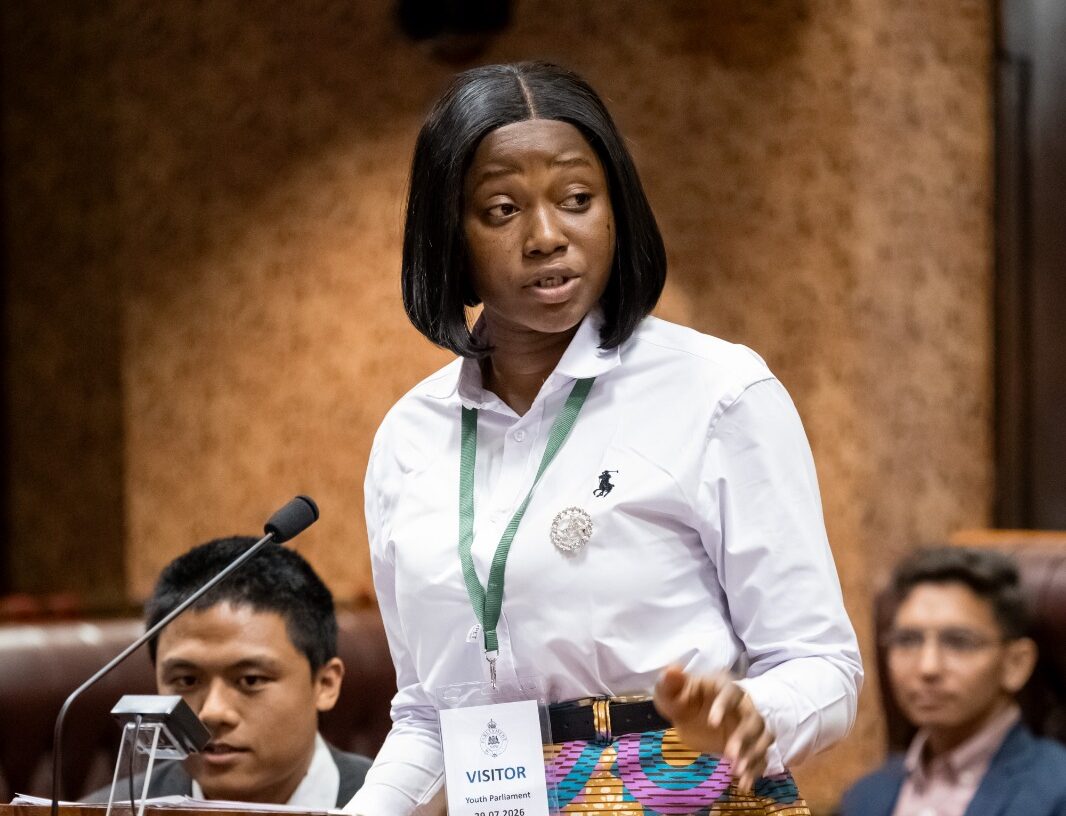

A Ghanaian student and youth leader is using her participation in the 13th Commonwealth Youth Parliament at the Parliament of New South Wales to champion greater opportunities for young people, girls’ education and responsible innovation in a rapidly changing world.
Precious Akos Agrobesa, a Development Communication student at the University of Media, Arts and Communication (UniMAC), is among 60 young people aged 18 to 29 who took part in a week-long parliamentary simulation in Sydney.
The programme brings together young leaders from across the Commonwealth, giving them the opportunity to assume government, opposition and crossbench roles, debate legislation and develop practical skills in parliamentary procedure and democratic governance.
For Agrobesa, the experience has provided a deeper appreciation of how democratic institutions work and strengthened her resolve to contribute to positive social change.
“The Commonwealth Youth Parliament has given me valuable insights into parliamentary procedures, legislative work and how democracy functions,” she said.
Her academic background in Development Communication has also shaped her approach to leadership.
Her studies examine how communication can influence behaviour, drive social change and contribute to sustainable development, while her wider interests include gender equality, climate change, sustainability and community development.
Education as a pathway to women’s leadership
One of Agrobesa’s strongest areas of advocacy is girls’ education. She believes ensuring that every girl has access to quality education is fundamental to building more inclusive societies and creating opportunities for women to participate meaningfully in leadership.
“Every young girl should have access to education because education is the key to success and the pathway to greater inclusion and leadership opportunities for women.”
For her, the case for educating girls extends beyond individual opportunity. Greater access to education can help challenge social attitudes and traditional gender expectations that have historically restricted women’s participation in public life.
She argues that societies must recognise the changing role of women and create space for them to contribute across all sectors, including leadership.
According to Precious, “things have changed; we have evolved. Women are leaders, and they can do the same jobs and hold the same leadership roles as men.”
Her position reflects a broader call for young women to be given the confidence, skills and opportunities to take part in decision-making at every level of society.
Young people as agents of change
Agrobesa’s leadership interests extend beyond gender equality. As a Development Communication student with experience in student governance, national student organisations, media internships and journalism-related work, she sees young people as critical actors in shaping the future.
She believes communication has a central role to play in changing behaviours, challenging attitudes and mobilising communities around shared development goals.
Rather than viewing young people simply as beneficiaries of development, she advocates for them to be recognised as active participants in creating solutions to the challenges confronting their communities.
“We should all be agents of change and work to transform behaviours that hold our communities back. That is how we achieve the development we need.”
Her participation in the Commonwealth Youth Parliament has therefore provided an opportunity to connect her academic interests and leadership experience with practical lessons in democratic participation.
The experience also comes at a time when young people are increasingly being called upon to respond to complex challenges, from climate change and sustainability to technological disruption and changing social expectations.
Navigating the opportunities and risks of artificial intelligence
Discussions at the Commonwealth Youth Parliament have prompted her to consider both the potential of AI to strengthen democratic systems and the responsibilities that accompany its rapid expansion.
She believes the technology offers significant opportunities but cautions that its wider effects on communities and the environment must not be overlooked.
She noted: “Artificial Intelligence is here to stay. It can help strengthen our democracies, but we also need to understand its impact on our communities and the environment.”
This highlights the need for young people to be part of conversations about emerging technologies rather than simply being consumers of them.
Responsible innovation, in her view, requires an understanding of how technological change affects different groups within society, particularly communities and vulnerable populations that may not have equal access to new opportunities.
Taking the Commonwealth experience home
Agrobesa’s participation in the Commonwealth Youth Parliament represents another step in her development as a young Ghanaian leader interested in inclusive and sustainable development.
Through her studies, leadership activities and engagement with media and journalism, she is building an approach to public leadership that places communication, inclusion and civic participation at its centre.
Her experience in Sydney has reinforced the importance of giving young people platforms where they can debate ideas, understand democratic institutions and develop the confidence to participate in public life.
As the world continues to evolve through technological, social and environmental change, Agrobesa believes young people must be prepared not only to adapt but also to shape the future they want to see.
Her message is straightforward: young people have a role to play, girls must have the opportunity to learn and lead, and innovation must be matched by responsibility.
– With relevant contributions from, and credit to Frances Cordaro, Media and Communications Lead, Parliament of New South Wales.