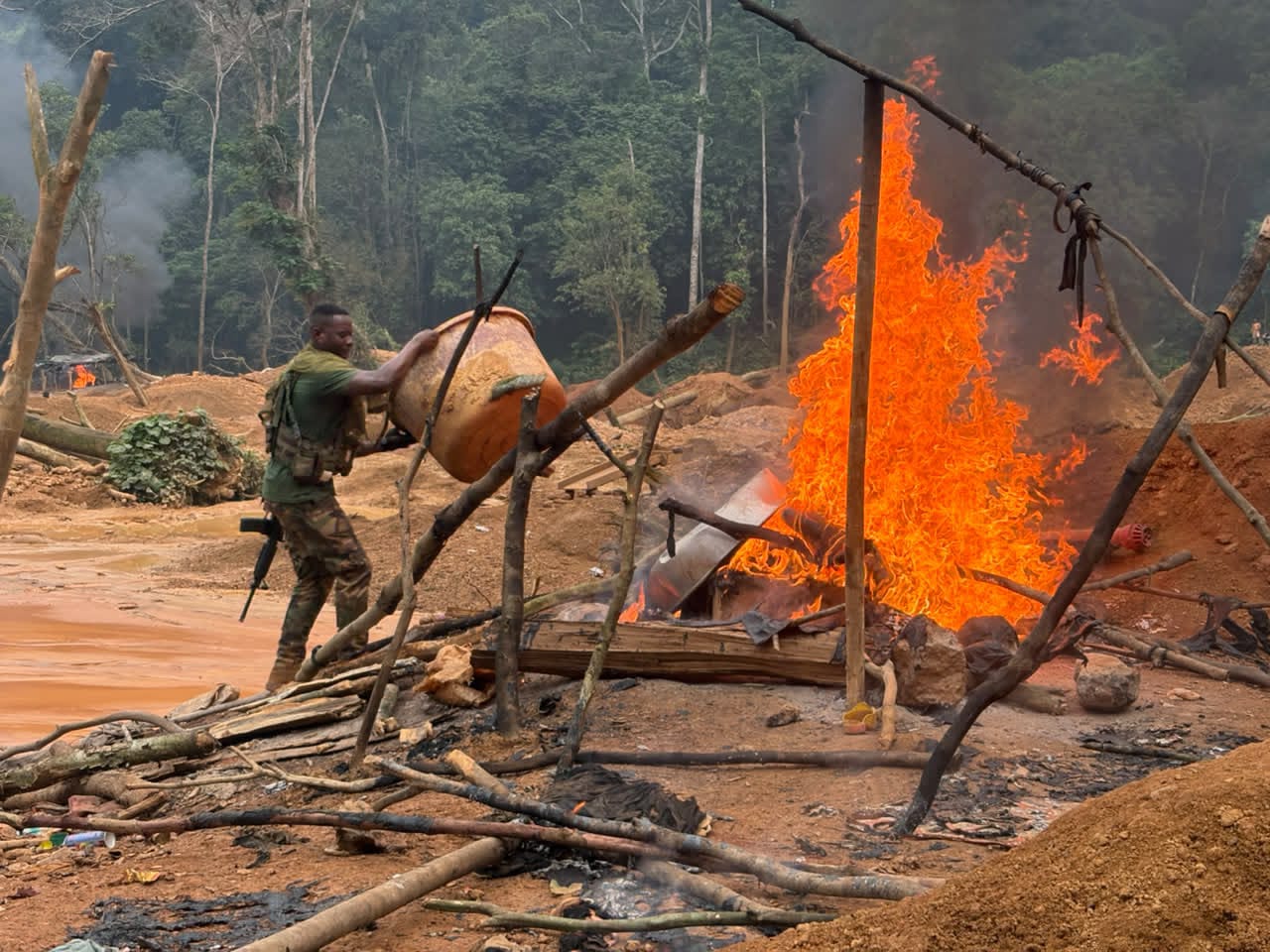

A violent confrontation involving suspected illegal miners has prompted a major operation by the National Anti-Illegal Mining Operations Secretariat (NAIMOS) in part of the Atiwa Forest Reserve in the Eastern Region.
The clash which reportedly involved machetes, left one person seriously injured before the intervention of the NAIMOS Special Task Force prevented the situation from escalating.
The injured person was taken to the Asiakwa Police Station and later referred to a medical facility for treatment.
Following the incident on August 17, the NAIMOS Task Force conducted a reconnaissance operation in the forest reserve, uncovering extensive illegal mining activities along river systems and significant environmental degradation.
The operation led to the destruction of 15 makeshift structures and 11 water pumping machines believed to have been used for illegal mining.
Despite the difficult and rugged terrain, the Task Force accessed several mining sites on foot, motorbikes and tricycles.
No arrests were made during the reconnaissance operation.
The continued destruction of the Atiwa Forest Reserve highlights the urgent need for government to intensify efforts to curb illegal mining and protect Ghana’s forest resources.
Such measures are critical to achieving Sustainable Development Goal 15 ,Life on Land, which seeks to protect, restore and sustainably manage forests and terrestrial ecosystems, as well as SDG 13, Climate Action, given the important role forests play in climate regulation and carbon absorption.
Acces to potable water for millions of the country’s populace is under threat if minning activities in the Atewa Forest continues.
Local sources suggest that a large number of illegal miners may still be operating within the reserve, raising concerns about the scale and persistence of illegal mining in the area.
NAIMOS has commenced investigations into the illegal mining activities and the circumstances surrounding the violent confrontation.
The Secretariat says it will intensify operations in the Atiwa Forest Reserve and surrounding areas to disrupt illegal mining, protect water bodies and prevent further environmental degradation.
The Deputy Director of A Rocha Ghana, an environmental NGO, Daryl Bosu, says the Atewa Forest has now become a Red Zone due to the growing threat of illegal mining.
The Atewa Forest, covering approximately 23,000 hectares, an area equivalent to more than 32,000 standard football pitch is one of Ghana’s critical ecological assets, serving as a major watershed, biodiversity hotspot and carbon sink.
The continued destruction of the Atewa Forest through illegal mining threatens the water security of more than five million Ghanaians who depend on rivers originating from the forest.
The Kyebi Forestry Manager, Alfred Owusu Ameyaw, says illegal mining activities in parts of the Atewa Forest Reserve remain a major challenge, as some miners are reportedly armed, making it difficult for forest guards to effectively patrol and protect the reserve.
He says the Forestry Commission has managed to flush out illegal miners from some areas and made arrests in collaboration with the Police, but the miners continue to find alternative routes into the forest.
“When I came, the illegal mining activities were all over. But we have been able to flush them out of some areas. Currently, at the Sagyimase section, the guys there are wielding guns. Last year, my men were held hostage, and I had to call the Regional Command for reinforcements before they were released. Since then, they have become reluctant to go there because the miners have guns, while we are not mandated to carry guns.”
He added, although some arrests have been made, the activities persist, with miners creating bypasses to access the forest despite efforts to block entry points.
“We have made some arrests with the Police Command, hoping that they would stop, but they haven’t. The Sagyimase gate leading to that portion of the Atewa Forest has been closed and gated, but they still find ways to enter. They have created their own bypasses, using Aboboyaa tricycles and motorbikes to gain access.”
He explained the Forestry Commission has also taken measures to discourage the use of unauthorised motorbikes in the forest, but the illegal activities have not completely stopped.
“We took a decision that any motorbike moving into the forest area without a proper reason would be seized and dealt with. We have dealt with a few of them, but the problem still persists. The numbers are coming down, but I cannot say that we have completely flushed them out.”
The Forestry Manager says the recent intervention by NAIMOS, is a positive step towards addressing the problem.
“This weekend, NAIMOS came around, and I believe that is part of the solutions we suggested to MUSEC. We need stronger interventions to deal with the situation.”
On long term solution, the Kyebi Forestry Manager says the Forestry Commission is also considering establishing forest camps close to the reserve’s boundaries to enable forest guards to respond quickly to illegal mining activities.
“In the long term, we intend to establish forest camps to accommodate about eight or nine people at a time, specifically to stay close to the boundary lines and intervene in illegal mining activities. Hopefully, they would be armed and backed by law. If that comes into fruition, we may have a lasting solution because sending forest guards without guns to confront miners who are armed is daunting.”
By Yvonne Neequaye