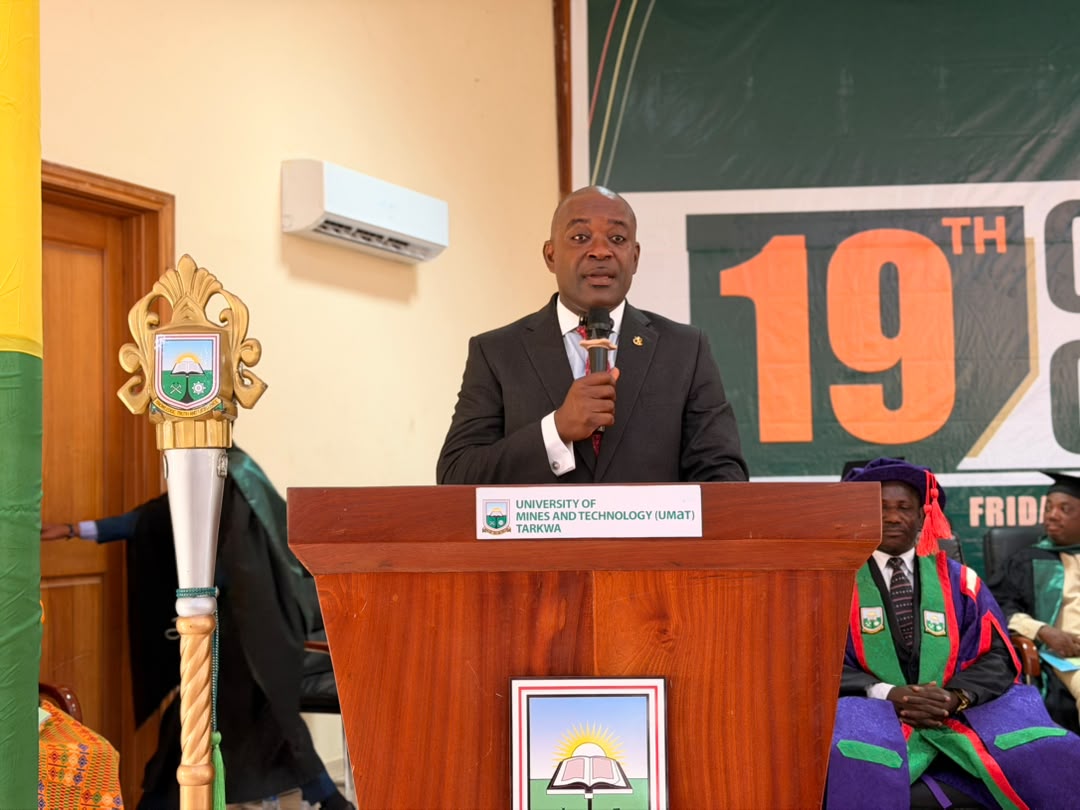

The University of Mines and Technology (UMaT) has been challenged to spearhead the development of technological solutions to Ghana’s illegal mining menace.
Director-General of the Ghana Tertiary Education Commission (GTEC), Professor Abdullah Jinapor, says the fight against galamsey must go beyond arrests and military operations to embrace research, innovation and technology.
He believes UMaT, with its expertise in mining and engineering, is strategically positioned to drive this transformation.
Speaking at the university’s 19th Congregation in Tarkwa, Professor Jinapor urged the institution to develop practical solutions, including mercury-free gold recovery methods, land reclamation technologies and digital systems to monitor illegal mining activities.
“This is a fight that cannot be won by enforcement alone. It also needs knowledge, technology and solutions, and that is where UMaT must lead,” he said.
Professor Jinapor described galamsey as a major economic threat, cautioning against simplistic approaches such as declaring a state of emergency without addressing the underlying challenges.
He called for stronger collaboration among academia, government, mining companies and affected communities to develop sustainable solutions.
“If not, this issue of galamsey is going to come back and bite us. It is an economic issue. We cannot give a simplistic prescription of a state of emergency to solve it,” he cautioned.
The congregation also celebrated a remarkable academic milestone, as Ansah Anna Hannah became the university’s first female Overall Best Graduating Student since 2013.
The Petroleum Engineering graduate recorded an impressive Cumulative Weighted Average (CWA) of 91.02 per cent, despite initially aspiring to become a cardiac surgeon.
She said her transition into engineering was challenging, but a conscious decision to give her academics her best transformed her university experience.
“A sudden decision by my father to pursue engineering changed the course of my journey. Before I could fully process what was happening, I found myself studying petroleum engineering.
“Honestly, the transition was difficult. I lost confidence in myself and struggled to find my footing. But somewhere along the journey, something changed. In my second year, I made a conscious decision to give life, and more importantly, my academics, my very best,” she recounted.
Her achievement brought immense joy to her mother, Francisca Cudjoe, who said the family had initially envisioned a career in medicine for her daughter.
She said although the change in career path was difficult for the family, Hannah’s determination and resilience had paid off.
“Throughout her childhood, she dreamt of becoming a cardiac surgeon, and so we used to call her ‘our doctor’ until she went for an interview, passed and almost enrolled in medical school.
“Then the change came. In fact, it was not easy for all of us, but she decided to make it a try-and-see, and through determination, resilience and the favour of God, here we are today as proud parents of an engineering overall best graduating student,” she said.
Meanwhile, Vice-Chancellor of UMaT, Professor Bernard Kumi-Boateng, says the university is making significant progress in increasing female participation in engineering and mining programmes.
He disclosed that women now number 5,954, representing approximately one-third of the university’s undergraduate population.
Professor Kumi-Boateng attributed the progress to the university’s gender mainstreaming agenda, which seeks to encourage more women to pursue programmes traditionally dominated by men.
“I am particularly happy to report on the progress of our female students, as we consciously encourage women to enrol in our programmes through our gender mainstreaming agenda.
“Across our whole undergraduate body, women now number 5,954, about one in every three students in a mining and hardcore engineering environment once regarded as the preserve of men.
“This is a change we are proud of, and we will keep our doors wide open to every young woman who wishes to pursue engineering and geosciences,” he said.
By Ebenezer Atiemo