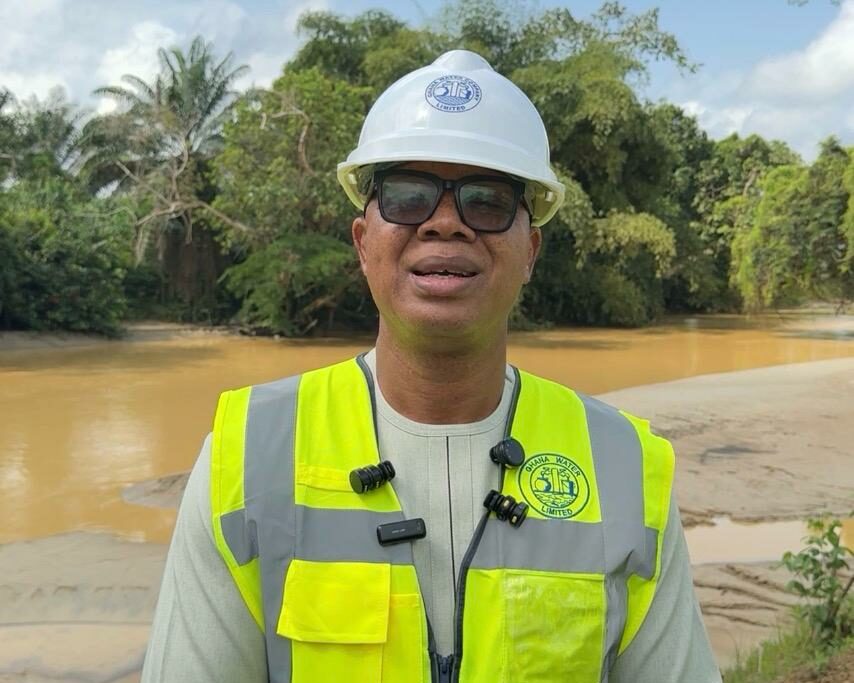

The Managing Director of Ghana Water Company Limited (GWL), Adam Mutawakilu, has announced that the company is actively seeking an alternative water supply for the Tarkwa Nsuaem municipality and surrounding areas.
The proposed solution involves negotiating with a leading large-scale mining company in the area to repurpose the abundant underground water that their operations currently extract and discard.
This initiative is a direct response to a severe water crisis. The sole water source, the Bonsa Treatment Plant, was designed to produce five million gallons per day but has seen its output plummet to just thousand gallons daily.
Originally designed in 1982 to produce five million gallons per day, the plant’s output has drastically fallen to just one thousand gallons daily. This crisis is driven by an extreme increase in source water turbidity.
While the plant is designed to treat water with a turbidity of 15 Nephelometric Turbidity Unit (NTU), reading on the morning of Tuesday, November 18, was 4,400 Nephelometric Turbidity Unit (NTU), making effective treatment nearly impossible.

The Western Regional Manager, Ing. Richard Essoun, explained that the company continually spends money on dredging the water intake to manage the sediment load.
He revealed that a recent dredging project cost GHC4 million cedis, an amount that exceeds the company’s monthly income.
Given these challenges, he appealed to the government and relevant authorities for urgent intervention.
“The plant’s operational viability is under severe threat. While its capacity is five million gallons per day, current production has fallen to under a thousand gallons. The revenue from this trickle of water is completely overshadowed by the exorbitant cost of maintaining the water intake.
“The core issue is the unsustainable frequency of dredging. We incurred a cost of nearly four to five million cedis for a dredging operation just six weeks ago. To face the prospect of repeating this multi-million cedi expenditure every month is catastrophic.

“When regular operational expenses power, chemicals, and labor are compounded by these relentless dredging costs, the plant is pushed into a financially untenable position. Simply put, under these conditions, we are not running a sustainable business,” the Western Regional manager of Ghana Water Company, Richard Essoun mentioned.
In a bid to find a sustainable solution to the persistent water crisis in the Tarkwa Nsuaem municipality and surrounding districts, the Managing Director of Ghana Water Company Limited, Adam Mutawakilu, has revealed a promising initiative.
During his familiarization visit to the Bonsa Treatment Plant, he disclosed that the company is actively negotiating with a leading large-scale mining company in the region.
The objective is to repurpose the abundant underground water that the mining operation extracts and currently discards.
He emphasized the significant advantage of this source, stating that this water has a zero turbidity level, which would greatly simplify the treatment process and enhance water supply.
“As mining companies excavate deeper, they frequently encounter large, clean aquifers. Our proposed solution is to tap into these vast underground reservoirs and pump the water to our treatment plant.
“This strategy offers several key advantages. First, the water has a zero turbidity level, making it far easier and cheaper to treat than sediment-laden river water.
“Second, because the source is deep underground, it is completely protected from the pollution and seasonal variability that affect surface rivers, particularly the disruption caused by illegal mining activities.
“We have already completed preliminary technical studies on one such source, which holds an estimated twenty million cubic meters of water. With the plant’s capacity at five thousand cubic meters per day, this single reservoir could supply the plant with a reliable, year-round source of water. Partnering with the large mining companies to access these aquifers is one of the most secure and sustainable options for providing consistent water to the surrounding communities,” he said.
By Ebenezer Atiemo