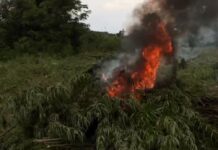

The Volta Regional House of Chiefs, led by its President Togbe Tepre Hodo IV, has sounded the alarm on what they describe as a growing crisis of marijuana cultivation and youth drug addiction in the region.
Addressing a formal session of the House, the chiefs expressed grave concern over reports that children some still in basic school are abandoning classrooms to work on cannabis farms in towns such as Vakpo, Wusuta, and Gbefi.
Even more troubling, they allege that these children are sometimes given marijuana to smoke while working, drawing them into early-stage addiction and criminal vulnerability.
The chiefs blamed this trend in part on misinterpretation of Ghana’s Narcotics Control Commission Act, 2020 (Act 1019), which permits the cultivation of cannabis with limited tetrahydrocannabinol (THC) content strictly for industrial and medicinal use.
They argued that this has opened the floodgates for unregulated farming, enabling unscrupulous actors to exploit the law for recreational and commercial gain. But while the concern for the welfare of children is legitimate and shared, the assertion that marijuana cultivation in the Volta Region is a new phenomenon triggered by Act 1019 is very misleading if not altogether inaccurate.
The Volta Region has, for decades, been one of Ghana’s primary centers of cannabis cultivation. More bluntly put it is the capital of cannabis cultivation! Alongside the Bono East Region, Volta is known nationally for producing some of the highest quality marijuana available in the country. This is not a sudden development, it is an entrenched reality, one that long predates the passage of the 2020 Narcotics Control Commision Law.
Indeed, during the past eight years, cannabis farming in Volta persisted openly and at scale, yet there was little to no public alarm from traditional authorities, not even a peep! i
This raises a critical question; where were the loud objections from the chieftaincy institution during the years when cultivation expanded in the shadows, without regulation or safeguards? If today’s concerns are truly rooted in a desire to protect the youth and preserve community values, then consistency and historical context must also form part of the narrative.
Volta Regional Minister James Gunu, responding to the chiefs’ concerns, acknowledged the seriousness of the matter and pledged full support from the Regional Coordinating Council. He emphasized continued cooperation with traditional authorities to maintain peace and security.
Beyond enforcement, he outlined key developmental initiatives; including the expansion of the Eastern Corridor Road, modernization of the Aflao Market Complex, kenaf agro-processing, and the evolution of the Volta Region as a 24-hour economy.
These, he argued, will provide sustainable alternatives to illegal farming and address underlying issues like youth unemployment and economic hardship.
Nonetheless, the episode reveals a deeper national dilemma: how to reconcile the promise of Ghana’s emerging cannabis industry with the country’s longstanding informal cultivation networks, widespread misunderstanding of the law, and weak enforcement mechanisms. Ghana’s cannabis economy has existed in the shadows for decades. What the Narcotics Control Act 1019 offers is not the cause of proliferation, but the first opportunity in years to regularize, monitor, and responsibly develop a sector that has long operated without oversight.
If stakeholders; both traditional and governmental, fail to seize this moment with clarity, unity, and an honest reckoning with the past, then Ghana risks turning what could be a transformative agricultural opportunity into a polarizing and mismanaged enforcement war.
The challenge now is not just about eradicating illegal farms, but about rewriting the national approach; one that includes education, legal reform, economic alternatives, and community empowerment.
The Volta Region does not face a new marijuana crisis. It faces the consequences of decades of silence; and now, the challenge of charting a new path forward that is grounded in truth, not fear, panic and alarmism!
In the wake of mounting public concern and the alarm raised by the Volta Regional House of Chiefs, the Narcotics Control Commission (NACOC) has stepped forward with reassurances that it is actively dismantling the entire value chain sustaining illegal cannabis cultivation; particularly the exploitation of children as cheap labour on farms in the Volta Region.
Speaking on the Citi Breakfast Show on July 23, 2025, NACOC’s Director of Public Affairs, Francis Opoku Mensah, acknowledged the deeply troubling nature of the situation, emphasizing that the Commission is not merely focused on destroying farms, but on a broader enforcement strategy targeting financiers, cultivators, storage operators, distributors, and recruiters of child labour.
“Once you are getting your results, everybody who reads that will see that indeed you’re not only talking,” he said, suggesting that visible, impactful outcomes will vindicate NACOC’s ongoing efforts.
He was clear that effective intervention requires more than surface-level raids. “If you go and burn the farm, you might get people who are also doing storage that you need to go after,” he explained.
This signals an intention to go beyond optics and address the invisible architecture of the trade, which includes networks of actors who profit from the system without ever stepping foot on a cannabis plot.
Yet, despite these assurances, critical questions remain; especially when viewed through the historical and political lens outlined earlier. NACOC’s intensified enforcement drive is being rolled out in a region where cannabis cultivation is not a new crisis but a decades-old practice, deeply interwoven with political complicity and economic survival.
The current alarm over child labour, while serious and deserving of urgent redress, also risks becoming the latest pretext for a crackdown that fails to confront the root causes of the problem.
Furthermore, the use of child labour in cannabis farming is symptomatic of a deeper failure of state intervention in education, rural employment, and public health. A genuine solution requires coordinated investment in alternative livelihoods, legal cannabis production for industrial use, and education campaigns, not just police boots and press releases.
What Ghana needs is not a reactionary enforcement blitz, but a national reckoning with its decades-long cannabis economy: a transparent system that identifies and transitions existing cultivators into a legal framework, cracks down on exploitation, and repositions cannabis as a driver of health and economic growth, not criminality and chaos.
Ghana can either continue to treat cannabis cultivation as a criminal vice, rooted out with force and stigma, or confront the undeniable truth; cannabis, when properly regulated, holds immense economic, medicinal, and environmental potential. What the country needs now is policy coherence, not fear and panic!
My view is the following steps need to be taken.
First, Parliament must expedite the approval and publication of the Fees and Charges Legislative Instrument that will finally operationalize licensing under Act 1019. Ghana cannot continue to criminalize cultivation while simultaneously dragging its feet on offering a legal alternative. Licensing offers the only path toward transparency, accountability, and economic inclusion.
Second, NACOC must try it’s very best to shift from purely enforcement-led operations to a dual mandate; one that prioritizes harm reduction, public education, and community engagement; which is enshrined within the law as its priorities, alongside strategic enforcement. That means working with stakeholders, local leaders, NGOs, and educators to keep children in school, not simply arresting farmhands and torching fields.
Third, the government must jointly with HAG and other stakeholders establish a transitional framework to register and train existing cannabis farmers, many of whom have been cultivating for decades. This mirrors the logic of the artisanal mining policy in principle, where rather than indiscriminate criminalization, the state creates room for professionalization, formal taxation, and export potential. To ignore this is to push the trade further underground, where abuses like child labour thrive unchecked.
Fourth, traditional authorities must acknowledge their historical silence and now take an active role in guiding their communities through this transition. They must serve not just as enforcers of state messaging, but as facilitators of opportunity, ensuring that legal cultivation is not monopolized by political elites or foreign firms, but includes the very people who have sustained the industry for generations.
Finally, the Presidency must publicly commit to a rational cannabis policy that aligns with national development goals, youth employment strategies, and export diversification.
Ghana can no longer afford to straddle both sides of the fence publicly prohibiting cannabis while simultaneously studying regulatory models from countries such as Malawi and in particular Morocco, the leadership must be bold, transparent, open-minded and forward-looking.
The crisis in Volta is not new. It is simply exposed. And what lies beneath is a national failure to regulate what we have long known to exist. But in every crisis lies opportunity. If Ghana acts decisively now, through legal reform, inclusive policy, and smart enforcement then cannabis can be transformed from a cause for concern into a catalyst for growth.
The window is narrow. But the path is clear.