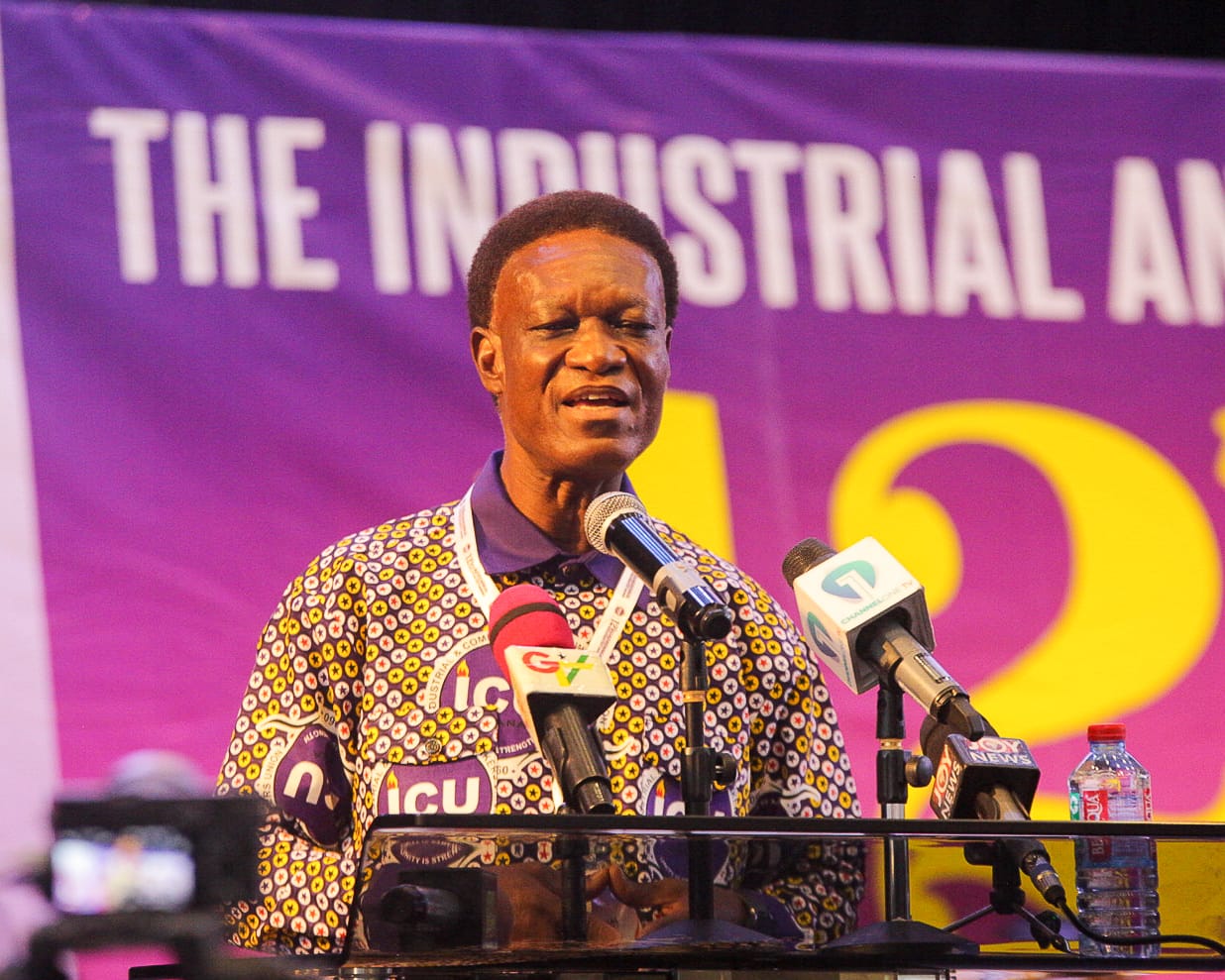

The Industrial and Commercial Workers’ Union (ICU), Ghana, has once again joined hands with global labour movements in marking Precarious Workday, calling for a united and immediate global response to the growing crisis of precarious employment—particularly in Africa.
“Precarious work continues to rob millions of workers across the globe of their right to decent work and dignity,” said Morgan Ayawine, General Secretary of ICU-Ghana.
“Here in Ghana and across Africa, the situation is even more dire. We cannot remain silent while our youth are locked into indefinite casual employment, denied basic protections and stripped of hope,” he added.
A Global Crisis with Deep Local Roots
Since the inception of World Day for Decent Work in 2008, observed annually on October 7, labour unions and workers’ rights advocates have intensified efforts to spotlight exploitative employment practices. Precarious work—commonly found in outsourcing arrangements, casual or contract labour, and fixed-term contracts—is a rapidly spreading phenomenon, especially among transnational and multinational corporations operating in Africa.
“It is an injustice of the highest order,” Mr. Ayawine stated, “when young citizens are forced to work as casuals for over five years with no prospect of permanency or decent working conditions.”
While ICU-Ghana acknowledges the job creation potential of foreign direct investment, the union warns that this should not come at the cost of workers’ rights.
“We welcome investment and employment opportunities from multinational companies, but not at the expense of our people’s dignity. We will not sit idle while profit is prioritised over people,” Mr. Ayawine added.
Systemic Exploitation Through Outsourcing
ICU-Ghana condemned outsourcing practices that systematically deny workers their basic rights. Outsourced and casual workers are often barred from unionising, receiving fair wages, accessing healthcare, paid leave, and retirement benefits, among other protections.
“This is pure exploitation,” said Mr. Ayawine. “Two workers may be doing the same job, working the same hours, and in the same company—but only one enjoys social protection. That is not just unfair—it is immoral.”
The union noted that in many Ghanaian branches of multinational companies, the number of casual and contract workers now exceeds that of permanent staff—despite identical workloads.
A Call to Action
ICU-Ghana issued a strong call for urgent and sustained action to reverse this dangerous trend:
“We call on all social partners—governments, employers, and civil society—to show renewed commitment and take bold steps to end precarious work,” Mr. Ayawine urged.
“Casual and contract workers must be allowed to form or join unions without intimidation. Their rights must be protected like every other worker.
Multinational corporations must not focus solely on profit maximisation while trampling on the rights of workers. It is time they rethink their employment models.
Political leaders must act boldly, enforce existing labour laws, and introduce stronger legislation to prevent abuse of labour under the guise of outsourcing or contract work.
Decent Work is a right, not a Privilege,” he stressed.
ICU-Ghana reaffirmed its unwavering commitment to the global movement for decent work and its stand against all forms of exploitation.
“Precarious work is modern-day servitude. It must be condemned in no uncertain terms. It dehumanises workers and erodes the very foundation of decent labour practices that the ILO and other institutions have fought hard to protect,” Mr. Ayawine. noted.