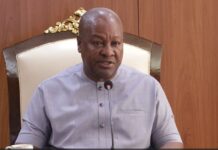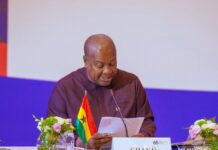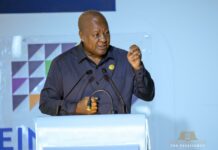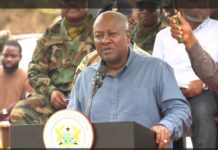

President John Dramani Mahama has declared that Ghana must transition from a leading exporter of raw minerals into a full participant across the entire extractive value chain.
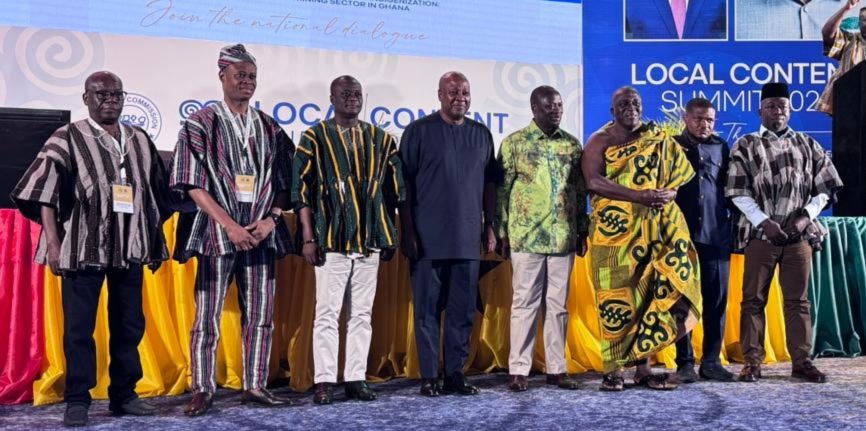
Addressing the 2026 Local Content Summit in Takoradi, organized by the Minerals Commission under the theme “Strengthening Local Content and Indigenization: Building a Resilient Mining Sector in Ghana,” President Mahama outlined an ambitious roadmap to deepen local content, accelerate industrialization, and establish Ghana as a technology-driven mining hub.
“Although Ghana remains Africa’s leading gold producer and ranks among the top six globally, much of the high-value activity advanced engineering, processing, equipment manufacturing, technical services and refining—still takes place outside the country,” the President observed.
“We have been prolific producers, but we have not yet become full participants in the extractive value chain.”

He challenged stakeholders to reflect on the long-term legacy of the country’s mineral wealth, asking whether, a century from now, Ghana would be remembered merely for export statistics and royalty payments, or as the foundation for world-class industries, thriving Ghanaian enterprises, and resilient mining communities.
President Mahama outlined key strategies to reposition the sector:
First, local content must evolve from transactional procurement to transformational partnerships. He announced that government is reviewing mining legislation to ensure Ghanaian enterprises move up the value chain—from suppliers of consumables to manufacturers of critical components and innovators. “Equity participation, technology transfer and knowledge sharing must become standard practice,” he added.

Second, he declared that it is unacceptable for Ghana to continue exporting raw ores while importing finished products.
Setting a five-year target to eliminate raw ore exports, he pledged support for refineries, bullion infrastructure, mineral-based innovation and industrial clusters, while promoting downstream processing of bauxite, manganese and lithium in line with the global green energy transition.
Third, he emphasized human capital development. Institutions such as the University of Mines and Technology and technical universities will be strengthened, alongside expanded apprenticeship programmes in partnership with the mining industry. Skills in automation, robotics, drone technology, data analytics, environmental sustainability and renewable energy integration will be prioritized.

Fourth, the President stressed that the future of mining is digital. “Ghana must position itself as a hub for AI-assisted exploration, IoT-enabled asset management, blockchain-based supply chain transparency and locally driven research and development,” he said. Government will explore establishing a national mining innovation and research hub to institutionalize this transformation.
The Chief Executive of the Minerals Commission, Isaac Andrews Tandoh, described the summit as the beginning of an annual platform to rally industry players around responsible resource management.
He issued a strong warning against fronting arrangements, where foreign businesses operate behind Ghanaian proxies. “Why do you lend your name to such agreements? Open your eyes you are being used,” he cautioned.

Mr Tandoh also announced that the Commission is working on a new royalty regime and reviewing long-term leases that often outlive prevailing policies and regulatory systems.
“We are ready to support Ghanaian businesses, civil society organizations, local communities and other stakeholders to derive tangible benefits from the sector,” he stated.
Western Regional Minister Joseph Nelson described the summit as timely, urging traditional authorities and host communities to maintain a peaceful environment for sustainable mining.

He stressed that local content must evolve from basic participation to high-value technical engagement from supply of goods to engineering, digital services and manufacturing, and from labour provision to knowledge-based roles.
He also linked local content to the fight against illegal mining, arguing that empowering local enterprises, formalizing supply chains and ensuring transparent indigenization would reduce incentives that fuel unlawful operations.
“These measures will create lawful and structured participation in the mining sector,” he said. “The region stands ready to support policies that promote capacity building, transparent procurement, environmental sustainability and strong collaboration between mining companies and host communities.”

The Minister for Lands and Natural Resources, Emmanuel Armah-Kofi Buah, reaffirmed the government’s commitment to strengthening local procurement and fostering industrial partnerships within the mining industry.
According to the Minister, the Minerals Commission has developed a Local Procurement Policy Framework aimed at promoting meaningful Ghanaian participation in the sector not as an afterthought, but as a strategic imperative.
Mr. Armah-Kofi Buah also issued a strong caution against fronting arrangements, in which foreign firms use Ghanaian companies as mere cover while retaining control and siphoning profits out of the country.
“The platform we are creating this great opportunity we are opening for Ghanaian participation comes with a solemn warning: we will not condone any form of fronting.
The practice where foreign companies hide behind Ghanaian names, using our people as cover to satisfy regulatory requirements while retaining all control and benefits, is a theft of opportunity and a betrayal of our country’s resources.” He added.
He urged Ghanaians not to “sell our birthright to cronies” while “we can own the bakery ourselves.”
By Ebenezer Atiemo