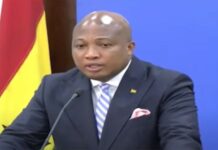



On 6 October 2026, Foreign Affairs Minister Samuel Okudzeto Ablakwa announced that President Mahama’s Cabinet has decided Ghana will apply to join BRICS.
The announcement came during a visit by India’s External Affairs Minister, Subrahmanyam Jaishankar. Nothing has been decided beyond this intention: admission needs the agreement of existing members, no application date has been given and officials have not said whether Ghana would accept the lighter “partner country” status first.
Five points frame the rest of this article:
• Ghana already trades heavily with BRICS economies. Four of them (the UAE, India, South Africa and China) took roughly 57% of Ghana’s 2025 export earnings, from Ghana Statistical Service data. Membership would formalise an existing pattern more than redirect trade.
• The most useful financial tools are reachable without full membership. The New Development Bank (NDB) admits members who are not in BRICS and cedi-yuan settlement is already being piloted by Stanbic Bank Ghana, a commercial bank.
• The main risk is sequencing, not the bloc itself. AGOA access expires on 31 December 2026, a bespoke US trade deal is unfinished and Ghana is rebuilding its standing with international investors after a debt default.
• BRICS is a divided club. Its members include Iran, Russia and the UAE, and recent summits papered over sharp disagreements.
• A staged approach looks stronger than a leap. Partner status, NDB membership and payment corridors capture much of the upside while keeping full membership as an option.
1. What has actually been announced
Ablakwa told reporters the Cabinet had decided to put in a formal application and that Ghana had already asked India, the BRICS chair for 2026, for help with the process. He framed the move as diversification, saying Ghana will not walk away from traditional partners but wants “new friends”. He stressed that Ghana remains a member of the IMF and the World Bank and cited roughly US$700 million of support from Afreximbank during the 2023–24 crisis as evidence that non-Western institutions already matter to Ghana.
Jaishankar was warm but careful. He described India as sympathetic to Ghana’s aspirations and called the request a matter for collective consideration by the bloc. Two Ghana–India memoranda (agriculture, and science and technology) were signed alongside the announcement, with further cooperation flagged in railways, pharmaceuticals, ICT and defence.
What is not yet known: the date of the formal application, the category of membership Ghana will seek, any response from other members and what the government’s cost-benefit analysis shows. The Minority in Parliament, led by the ranking member of the Foreign Affairs Committee, Samuel Abu Jinapor, has demanded an urgent briefing.
2. What BRICS membership is, and is not
It is a consensus club with two tiers. BRICS now lists 11 members: Brazil, Russia, India, China and South Africa, plus Egypt, Ethiopia, Iran, the UAE and Indonesia, with Saudi Arabia invited but not publicly confirmed. A separate partner tier, created in 2024, includes Nigeria and Uganda from Africa, along with Belarus, Bolivia, Cuba, Kazakhstan, Malaysia, Thailand, Uzbekistan and Vietnam. Partners join selected activities but do not take part in the most consequential decisions. Egypt, Ethiopia and South Africa are the only African full members, and West Africa has none, so Ghana would be the first.
It is not a common currency. The September 2026 New Delhi summit endorsed work on payment-system interoperability and local-currency settlement, and it did not revive the idea of a BRICS currency. Even the strongest example of de-dollarisation, India–Russia trade, reached its high share of national-currency settlement through bilateral arrangements, not a bloc-wide mechanism.
It is not a harmonious alliance. BRICS foreign ministers failed to agree a joint statement in May amid the war involving Iran, and the leaders’ declaration in September avoided condemning either the US-Israeli strikes or Iranian attacks on Gulf states. Iran and the UAE are both members. This matters for Ghana because the UAE is its single largest export market.
It does include financial institutions. The NDB, headquartered in Shanghai, lends for infrastructure and sustainable development and has been asked by leaders to expand local-currency lending. The Contingent Reserve Arrangement (CRA), a roughly US$100 billion liquidity backstop for members facing balance-of-payments stress, only serves members. The September summit approved amendments to the CRA treaty and a further test run.
3. Why is Ghana moving now?
Several currents converge in late 2026.
A stabilised economy gives the government confidence. The IMF Executive Board completed the sixth and final review of Ghana’s roughly US$3 billion Extended Credit Facility in July 2026 and moved Ghana to a 36-month Policy Coordination Instrument, which carries IMF monitoring but no new money. The Fund says inflation fell sharply, reserves nearly doubled by 2025, the primary balance swung to surplus and the risk of debt distress returned to moderate. Fitch upgraded Ghana to B (positive outlook) in May, Moody’s moved its outlook to positive on Caa1 in April, and S&P rates Ghana B-.
Western support is more transactional. USAID has been dismantled and the United States proposed a health compact worth US$109 million over five years as a replacement. Ghana’s Cabinet rejected it over health-data and specimen-sharing demands, with President Mahama calling the terms humiliating. For context, US assistance to Ghana was about US$219 million in 2024, of which US$96 million was for health. US tariffs on Ghanaian goods reached 15% in August 2025 before the Supreme Court ruled in February 2026 that the emergency-powers statute used to impose them does not authorise tariffs.
Other doors have opened. China began zero-tariff treatment for Ghana and other African partners on 1 May 2026. The Bank of Ghana says banks are already piloting cedi payments for Chinese imports, with Stanbic Bank Ghana live and GCB preparing a similar service. India, after Prime Minister Modi’s July 2025 visit, has become a major buyer of Ghanaian gold and President Mahama says Ghana’s exports to India rose from about US$3 billion to nearly US$7 billion. (Some reports describe the US$7 billion as two-way trade, so the figure should be treated with care.)
The policy narrative is resource sovereignty. The government wants to stop exporting raw materials and capture more value from gold, cocoa and minerals, a theme that links to its 24-Hour Economy and export programmes. BRICS is presented as another route to capital, technology and markets for that agenda.
SOCIO-ECONOMIC IMPLICATIONS
Trade: formalising what already exists
Ghana’s export base is narrow and tilted toward BRICS economies. Gold bullion was about two-thirds of export earnings in the fourth quarter of 2025, and the top five destinations took 71.2% of 2025 export earnings:
Destination
Share of 2025 exports
BRICS status
UAE – Member
25.9%
India – Member
16.0%
Switzerland – Not a member
14.2%
South Africa- Member
10.3%
China – Member
4.9%
Adding the four BRICS rows gives about 57%. Much of this reflects the mechanics of the gold trade, which flows through Dubai, Indian refiners and South African and Swiss hubs, more than any strategic choice. On imports, China is Ghana’s largest supplier, at roughly 22–23% of imports in recent quarters according to the Ghana Statistical Service.
The implication is that BRICS membership would not suddenly open new markets. Its value lies in lowering frictions with partners Ghana already depends on, and in giving Ghana a stronger negotiating voice with them. The corollary is a concentration risk: deeper integration with a handful of gold and import counterparties does little for diversification.
Industrialisation and value addition
The government’s strongest argument is that Ghana wants to move up the value chain. Indian interest in pharmaceuticals and vaccine manufacturing, railways and agriculture fits that goal and the new India MoUs point in the same direction.
The evidence so far also carries a warning. China’s proposed purchase of Atlantic Lithium (about US$210 million), the developer of Ghana’s first lithium mine at Ewoyaa, would place the country’s first lithium output in a Chinese supply chain. South-South partnership does not guarantee local processing. Whether Ghana gets value addition depends on contract terms, local-content rules and bargaining power, and BRICS membership does not set those.
Jobs and exposure to the West
The immediate employment risk is not BRICS but AGOA. The US duty-free preference programme runs for Ghana until 31 December 2026 and renewal is undecided. Garments and cocoa products are the main beneficiaries, and the trade minister has said a single garment factory can employ up to 5,000 people. The EU, meanwhile, is a long-standing cocoa market and its deforestation regulation takes effect on 30 December 2026. Both are reminders that the livelihoods most exposed to Western rules are concentrated in sectors where Ghana has few substitutes.
Aid, health and sovereignty
The health compact episode shows where the public case for BRICS is strongest: a government that wants to negotiate without conditions it regards as intrusive. But rejecting US$109 million over five years also has a cost, and Ghana has not yet shown how health financing will be replaced. The Accra Reset initiative and Mahama’s health-sovereignty agenda are, so far, aspirations rather than funded programmes.
Distribution
Cheaper Chinese imports help consumers and importers but compete with local manufacturers. Zero-tariff access to China helps cocoa and other exporters, but Ghana’s goods trade with China remains lopsided: Chinese figures put two-way trade at US$14.1 billion in 2025 with Ghana’s exports to China at US$2.67 billion, implying an imbalance of roughly US$11 billion (my calculation). Without a strategy to lift exports and local production, deeper ties could widen that gap.
Watch out for Part II
By Daniel Afari-Djan
Business Development Manager
Personal & Private Banking
Stanbic Bank Ghana
MSC International Business