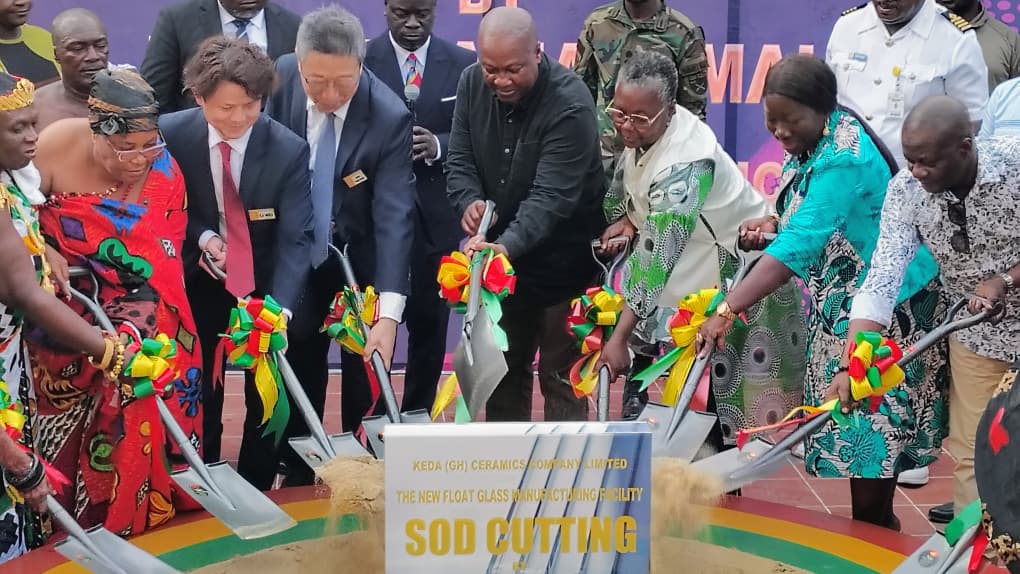

The President John Dramani Mahama, has officially broken ground for the construction of one of Africa’s largest float glass manufacturing facilities in Shama, located in the Western Region.
With a total investment value of $250 million, this new facility expands KEDA (Ghana) Ceramic Company Limited’s investment portfolio in Ghana and is expected to produce 1,400 tonnes of glass products daily.
Over the past decade, KEDA (Ghana) Ceramic Company Limited has invested more than $300 million in its tile and sanitary ware production lines. The float glass manufacturing facility represents the company’s latest venture in Ghana, following a strategic investment dialogue between the government and company officials in China last year.
Phase one of the facility is scheduled for completion in August next year, with an initial production capacity of 600 tonnes per day. The final phase will add an additional 800 tonnes per day, bringing the total to 1,400 tonnes.
At a ceremony marking the sod-cutting for the float glass facility, the inauguration of Phase 5 of the tile production line, and the commissioning of the sanitary ware factory in Shama, President Mahama highlighted the significant impact of KEDA’s investment on Ghana’s industrial sector and national economy.

He emphasized that the company’s growing investment aligns closely with the government’s 24-Hour Economy Policy, the African Continental Free Trade Agreement (AfCFTA), and other economic initiatives under his administration.
“This project aligns fully with our national industrial strategy and the broader objectives of the 24-Hour Economy Program, the Accelerated Export Development Program, the AfCFTA, import substitution and value addition,” he noted.
The Minister for Trade and Industry, Elizabeth Ofori-Adjare, expressed satisfaction with the outcomes of her engagement with KEDA representatives at the company’s headquarters in China. She noted that the investment in the new float glass manufacturing facility was made possible by the incentives and investor-friendly policies guaranteed by the Government of Ghana.
“I am confident that the conducive business environment this government has built over the short period offers a strong foundation for smooth operations and strong returns on investment, and then the promised incentives will follow,” she reassured the company.
KEDA Ghana envisions the country becoming a global manufacturing hub within the subregion. For this reason, the company regards Ghana as its single largest investment destination in Africa. Managing Director of KEDA Ghana, Li Wei, stated that the company’s investment in Ghana has been both deliberate and long-term. He added that the float glass manufacturing facility is intended to address a significant local capacity deficit in the country.
“Upon completion, the project will create 1,453 direct jobs and approximately 3,000 indirect jobs, increasing total employment to nearly 6,000 while significantly boosting national revenue generation,” he added.
These expansive projects are expected to generate job opportunities, increase tax revenue, and support social impact initiatives across the country. Western Regional Minister Joseph Nelson took the opportunity to reaffirm the strategic drive for industrialization and wealth creation being pursued in the Western Region.
“The Western Region has long been known for its abundant natural resources—from minerals to hydrocarbons, from timber to fertile land. Yet for decades, much of this wealth left our shores in raw forms with limited value addition and local benefit. Our aspirations have always been clear: to translate natural resource endowment into sustainable wealth creation for our people. The investment by KEDA Ghana Limited speaks directly to that aspiration.” He said.
KEDA Ghana is cementing its position as one of the largest foreign investors in the country’s manufacturing sector. Beyond the numbers, this development signals a growing confidence in Ghana’s industrial potential and its ability to compete on the continental stage.