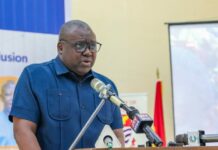
Former Director of the Institute of Statistical, Social and Economic Research (ISSER), Prof. Peter Quartey, has called on government to strengthen revenue mobilisation by expanding property tax collection and bringing more of the informal sector into the tax net.
Speaking ahead of the 2026 Mid-year budget review presentation, Prof. Quartey acknowledged that the revenue shortfall in the first quarter remains significant but noted that it typically improves in the second and third quarters of the year.
“I think the shortfall is still quite significant and I am not surprised everybody is bringing that issue. Usually, the first quarter revenue is not as high as one would expect. It is usually in the second and third quarter that it picks up,” he said on TV3 NewsCentral, Thursday, July 24.
He argued that Ghana continues to overlook major sources of domestic revenue, particularly property taxation.
According to Prof. Quartey, many high-value properties across the country remain inadequately taxed, resulting in substantial revenue losses.
“I always talk about property rates. There are a lot of beautiful high-value properties. I am not sure we have mastered the process of taxing these properties. If I look at the property rate and how much we raised in the first quarter, I think it is very insignificant, and it is about time we raise revenue from that,” he stated.
The Economist also pointed to Ghana’s large informal economy, saying many individuals engaged in productive economic activities yet are not being taxed.
He stressed that while efforts are being made to improve revenue collection, government still has considerable room to expand the tax base.
“Our economy is highly informal and there are many who engage in meaningful employment, and a lot of money has not been taxed. It is an area that is still a work in progress, but I think there is more we can do to shore up revenue,” he said.
Prof. Quartey further observed that Ghana’s revenue-to-GDP ratio remains low compared with several countries in the sub-region.
“Our revenue GDP is not very high as compared to our compatriot in the sub-region,” he added.