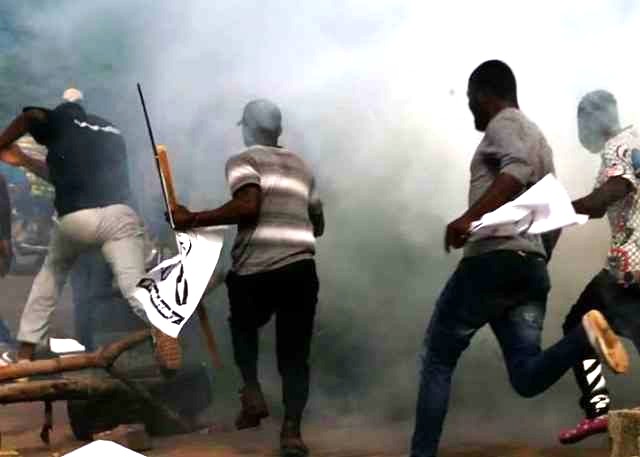

A panel of security and political governance experts has called for renewed political commitment, legal reforms and stronger enforcement of Ghana’s Vigilantism and Related Offences Act, 2019 (Act 999), warning that the law risks losing its deterrent effect if political considerations continue to undermine its implementation.
The experts were speaking at a National Policy Dialogue on the implementation of Act 999 organised by Election Watch Ghana at the Kofi Annan International Peacekeeping Training Centre (KAIPTC) in Accra on August 25.
The panel comprised former National Security Minister Kofi Totobi Quakyi, KNUST Professor of History George Meyiri Bob-Milliar, former National Security Minister Francis Poku, and security and defence analyst Col. (Rtd.) Festus Aboagye.
Mr. Totobi Quakyi, Ghana’s first Minister for National Security in the Fourth Republic, revisited the circumstances surrounding the establishment of the Justice Emile Short Commission following the violence that marred the 2019 Ayawaso West Wuogon by-election.
He said he had written to the Presidency requesting an inquiry into the violence but expressed disappointment with the subsequent handling of some of the commission’s recommendations.
According to him, although the government rejected some recommendations in its White Paper, that did not necessarily mean other recommendations contained in the commission’s report could not be pursued.
He argued that the effectiveness of recommendations should be tested through implementation rather than simply being set aside.
Mr. Quakyi said the handling of some recommendations could create the perception that perpetrators of political violence would escape accountability, potentially encouraging vigilantism.
Mr. Francis Poku described the passage of Act 999 as an immediate response to the political violence that preceded its enactment.
He, however, argued that the law remains relevant and should not simply be discarded because it has not been extensively used.
Mr. Poku questioned whether some activities, particularly land guardism, should necessarily be prosecuted under Act 999 when existing criminal laws could address them.
He suggested that the practical challenges associated with the law, including its mandatory prison terms, could partly explain why law enforcement agencies have been reluctant to rely on it.
His position is consistent with his public description of Act 999 as a “knee-jerk reaction” to the circumstances surrounding its enactment.
Professor George Meyiri Bob-Milliar argued that the biggest obstacle to the enforcement of Act 999 is political.
He said the law directly affects political parties because its effective enforcement could lead to the prosecution of party members involved in political violence.
“Why is the law not enforceable? Because if the law is going to work, it’s going to affect political parties,” Prof. Bob-Milliar said.
He noted that political foot soldiers involved in violence could potentially identify political actors who instructed them to carry out violent activities, creating a further disincentive for parties to support vigorous enforcement.
Prof. Bob-Milliar therefore called for a political solution involving Ghana’s major political parties to review and refine the law.
He said the fact that Act 999 was passed under a previous administration should not prevent the current government from using it as a basis for strengthening the legal framework.
He also argued that Ghana’s winner-takes-all political system and the intense competition between the two dominant political parties contribute to the persistence of political vigilantism.
Col. (Rtd.) Festus Aboagye shifted attention from the law itself to the broader political and institutional environment that sustains vigilantism.
He identified political party financing as one of the fundamental issues Ghana must confront, arguing that the high stakes associated with political power encourage politicians and supporters to resort to excessive measures to win elections.
He also criticised the use of recruitment into the security services as a means of accommodating political party foot soldiers.
Col. (Rtd.) Aboagye argued that political parties have increasingly influenced recruitment into the security services, partly because of their inability to accommodate large numbers of political foot soldiers.
He said this practice could create further security and governance challenges.
He also pointed to the failure to operationalise provisions of Act 999. In particular, he cited Section 10, which requires the Minister of Justice to make regulations for the implementation of the law.
According to him, those regulations have not been produced despite the passage of the Act in 2019.
Col. (Rtd.) Aboagye called for greater transparency among political parties, stronger institutional reforms and preventive measures rather than waiting for political violence to occur before responding.
He further advocated early intervention and mechanisms that would allow political parties to discuss threats to peaceful elections before they escalate. His concerns about political parties and security-service recruitment were also highlighted in reports from the dialogue.
Despite their criticisms, the panelists generally agreed that Act 999 should not be repealed simply because its enforcement has been limited.
They instead called for the legislation to be reviewed, strengthened and backed by political commitment.
Prof. Bob-Milliar said political parties must be part of the process of refining the law, while Col. (Rtd.) Aboagye emphasised institutional reforms and preventive measures.
The discussion also highlighted the need to distinguish political vigilantism from other forms of crime while ensuring that existing laws are effectively enforced.
The dialogue comes amid renewed concerns about the changing nature of political vigilantism in Ghana. The National Security Coordinator, COP Abdul-Osman Razak, separately warned at the event that some vigilante groups may have gone underground or rebranded themselves as internal security teams, volunteer task forces and community security initiatives.
He also acknowledged that prosecutions under Act 999 have been limited and called for the law to be enforced fairly, consistently and without political interference.
The panel discussion therefore placed the effectiveness of Act 999 within a wider debate about political party conduct, campaign financing, security-sector recruitment, accountability and the need for Ghana to develop stronger preventive mechanisms ahead of future elections.