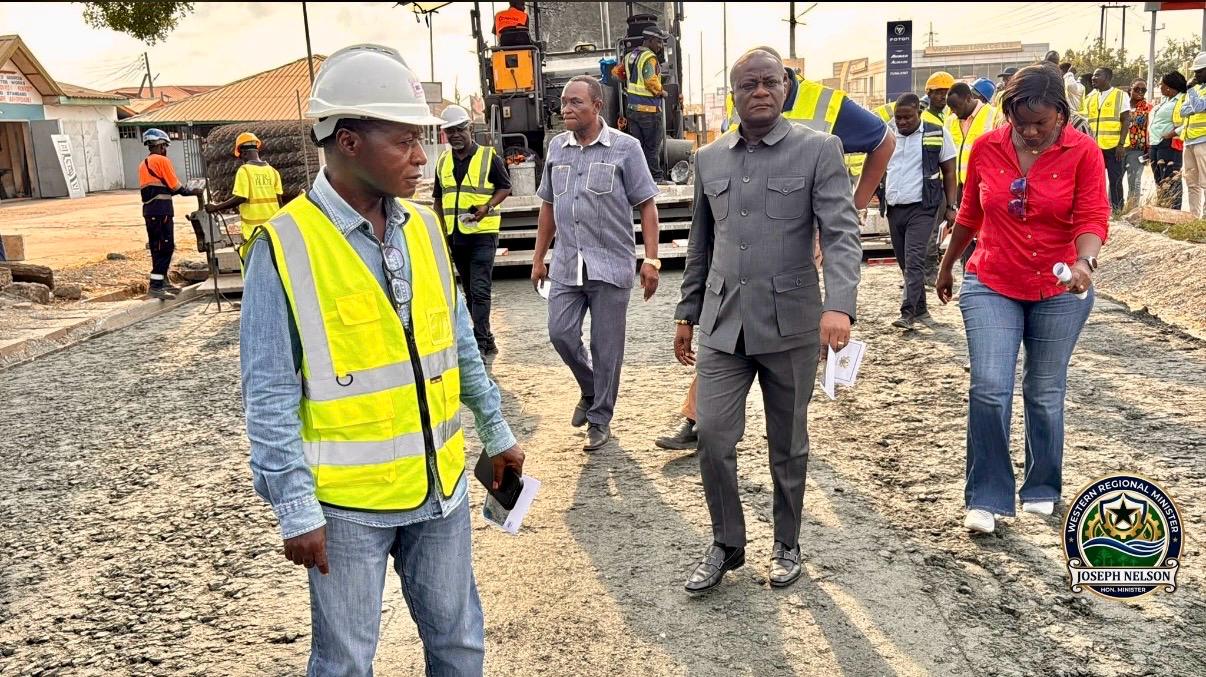

Roads leading into and within Sekondi-Takoradi, including key routes that connect to the Port of Takoradi, are set to undergo extensive rehabilitation following the award of a 39-kilometre intra-city roads contract to wholly Ghanaian firm Justmoh Construction Limited.
The project targets strategic corridors that serve residential, commercial and industrial traffic in the Western Regional capital, where road connectivity plays a central role in linking urban communities to port-related logistics and trade.
Among the roads scheduled for rehabilitation is the stretch from the Western Regional Coordinating Council to the Sekondi College Junction, which will be dualised. When completed, the expanded corridor is expected to provide an alternative route for motorists who currently rely on the heavily used Kojokrom–Fijai Highway.

The dualised road will also link with the ongoing expansion works connecting Takoradi through Kweikuma to the roundabout at the Regional Coordinating Council, creating an additional circulation route within the metropolitan road network.
Another key stretch captured under the project is the Paa Grant Roundabout – Ghacem Roundabout – to the Kwame Nkrumah Roundabout, (PTC Roundabout). The corridor serves as a route frequently used by heavy-duty trucks transporting bulk commodities such as manganese and bauxite to the port enclave. Over time, sections of the road have deteriorated under the weight of heavy cargo traffic.

Rehabilitation works are therefore expected to improve the condition of the carriageway and enhance the movement of freight vehicles within the city’s industrial transport corridor.
Managing Director of Justmoh Construction Limited, Justice Amoh, explained that construction has progressed beyond the initial mobilisation phase.
“The first stage was the mobilisation, where we mixed cement with the existing asphalt to create a sub-base. What you are seeing now is the first layer of the base itself, which consists of two layers. After this there will be another layer, followed by the curves and walkways before the asphalt is finally laid,” he said while briefing Joseph Nelson, the Western Regional Minister, during an inspection of the works.

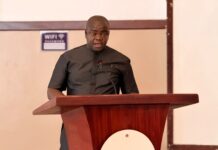
Regional Director of the Department of Urban Roads, Abraham Danquah, said the agency will supervise the project to ensure compliance with engineering specifications. “There will be streetlights on all the roads that will be rehabilitated, including the ones at Sekco, Paa Grant and Beach Road. We will ensure that the work is executed to the required specification so that it lasts its expected lifespan,” he said.
Urban transport infrastructure plays a central role in port cities such as Sekondi-Takoradi, where internal road networks connect industrial areas, residential communities and export terminals. The Port of Takoradi, the country’s main hub for bulk cargo including manganese, bauxite and timber, relies on road transport systems for the movement of goods between inland production zones and the port.
Efficient road corridors within the metropolis therefore serve both urban mobility and freight logistics, particularly for trucks that shuttle commodities between mining areas, processing facilities and port terminals.
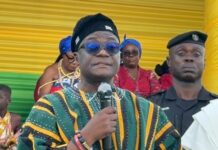
Western Regional Minister Joseph Nelson said the rehabilitation works are expected to improve traffic flow and facilitate movement within the city.
“We want to ensure that there is ease of doing business and one important driver is the road network. Once there is free flow on the roads, turnaround time will be enhanced and trading activities can improve. Residents will also be able to move to work and back more easily, while streetlights will improve visibility and security on these corridors. The reset agenda is one that is essentially aimed at economic fortification and all these measures are meant to consolidate that,” he said.
The rehabilitation forms part of ongoing efforts to improve intra-city road infrastructure in the Western Region’s commercial capital, where urban expansion and port-related economic activity continue to place increasing demand on existing transport routes.
Eric Yaw Adjei