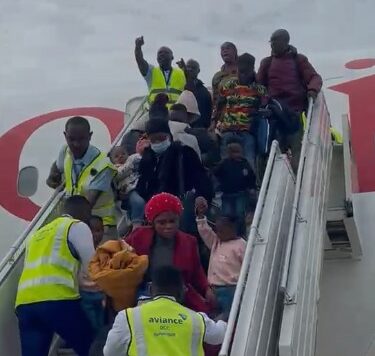

Vice President of IMANI Africa, Kofi Bentil, has called on South African Companies operating in Ghana to contribute towards the evacuation exercise being undertaken by government for Ghanaians being attacked in their country.
He said this demonstrate their stance against the unfortunate happening in their country of origin.
He argued that businesses benefiting from African markets have a responsibility to publicly condemn violence against fellow Africans and support affected communities.
Mr. Bentil singled out major South African businesses operating in Ghana and elsewhere on the continent, urging them to demonstrate corporate responsibility by speaking against xenophobia and assisting victims
“Companies that make billions across Africa cannot remain silent when Africans are attacked in their home country. What the government is doing comes at a cost. They must bear part of the cost,” he said on The KeyPoints on May 30.
He advocated tougher measures against South Africa following recent attacks on Ghanaians and other foreign nationals, arguing that the issue should be treated as an attack on Ghana itself.
Speaking on the treatment of Ghanaians in South Africa, Mr. Bentil said governments have a duty to protect their citizens abroad and should respond firmly when their nationals are targeted.
“When citizens of a country are under attack, the country itself is under attack,” he said.
He commended the Ghanaian government’s efforts to evacuate affected citizens, revealing that he had previously suggested that authorities organize emergency flights to bring Ghanaians home if their safety could no longer be guaranteed.
According to him, moments of national crisis should transcend political divisions and unite citizens behind the protection of national interests.
“There are times when a nation must assert itself, and one of those times is when its citizens are under attack,” he stated.
Mr. Bentil dismissed arguments centered solely on the immigration status of victims, maintaining that every person within a country’s territory deserves protection under the law regardless of their documentation status.
“If anybody enters your territory, you have a responsibility to protect that person,” he argued.
The IMANI Vice President described the recurring attacks as evidence of a broader failure by South African authorities to address xenophobia.
He noted that repeated incidents over the years suggest the violence can no longer be viewed as isolated occurrences.
“When something happens once, it may be accidental. Twice may be coincidence. By the third time, it becomes a pattern that demands accountability,” he said.
Mr. Bentil also criticized the African Union for what he described as its inability to effectively respond to challenges affecting ordinary Africans.
According to him, continental institutions should play a more active role in protecting citizens and holding member states accountable when such incidents occur.
He suggested that Ghana should reassess aspects of its economic relationship with South African businesses if meaningful action is not taken to address the attacks.
While clarifying that he was not advocating violence against South African businesses or citizens, he maintained that governments have legitimate economic and regulatory tools they can use to defend national interests.
He stressed that future engagements with South African companies should take into account the treatment of Ghanaians and other Africans within South Africa.
“We must ensure that our citizens are respected wherever they are. There has to be accountability and there has to be consequences,” he said.
Mr. Bentil ultimately called for a coordinated response involving diplomacy, legal action and economic pressure to ensure that recurring attacks on foreign nationals are brought to an end.
By Christabel Success Treve