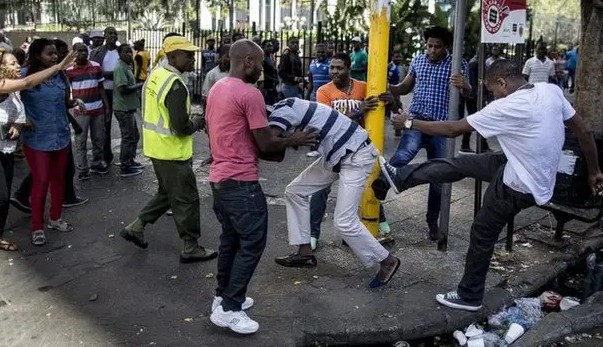

The recent xenophobic attacks in South Africa have once again exposed a painful problem facing Africa. Videos showing foreign nationals being attacked, threatened and harassed have spread across social media. Among the victims are Ghanaians living and working in South Africa.
The Ghanaian government has already started bringing some citizens back home because of safety concerns. As expected, many Ghanaians are angry and hurt. Some people have called for retaliation against South African businesses in Ghana such as MTN.
Others say Ghana should refuse to renew business agreements involving South African companies. A few angry voices have even suggested targeting South Africans living in Ghana.
The frustration is understandable. But Ghana must be careful not to respond to hatred with more hatred.
If Ghanaians attack innocent South Africans living peacefully in Ghana, then we become guilty of the same behaviour we are condemning. Violence against foreigners is wrong whether it happens in Johannesburg or in Accra.
There is also an important economic reality that must not be ignored. South African companies operating in Ghana employ thousands of Ghanaians. Businesses like MTN provide jobs directly and indirectly to many families. Closing such businesses suddenly may hurt ordinary Ghanaian workers more than the South African government itself.
A Ghanaian employee working in an MTN office is not responsible for xenophobic attacks in South Africa. Destroying businesses or attacking foreign nationals in Ghana will only create more unemployment and fear in an economy already struggling with hardship and rising living costs.
At the same time, Africa must ask itself deeper questions about why xenophobia keeps happening.
Many South Africans involved in anti-immigrant protests say they are frustrated about unemployment, crime, poor housing, pressure on hospitals and weak public services. South Africa continues to face very high unemployment, especially among young people. Many citizens feel hopeless and abandoned despite living in one of Africa’s richest economies.
Unfortunately, in difficult times, foreigners often become easy targets.
When people cannot find jobs, feed their families or access decent public services, anger begins to grow. Instead of focusing that anger on poor governance or failed leadership, many people direct their frustration toward immigrants and foreigners living among them.
This pattern is not happening only in South Africa.
Across Europe and the United States, anti-immigrant sentiments have also grown in recent years because many citizens feel pressure from rising living costs, housing shortages, overstretched healthcare systems and economic uncertainty. Far-right political groups in several countries have gained support by blaming immigrants for economic hardship and pressure on public services.
Yet evidence from economists and international organisations often shows that immigrants also contribute greatly to economies. According to the Organisation for Economic Co-operation and Development (OECD), migrants in many developed countries contribute more in taxes and labour than they receive in public benefits over the long term.
In the United States, immigrants are heavily represented in sectors facing labour shortages such as healthcare, agriculture, construction and technology. Studies from the American Immigration Council have also shown that immigrants create businesses, employ workers and contribute billions of dollars in taxes yearly.
Former German Chancellor Angela Merkel once defended immigration by arguing that migrants are important to Germany’s ageing workforce and economy. In Canada, Prime Minister Justin Trudeau has repeatedly argued that immigration helps economic growth and addresses labour shortages.
The truth is that xenophobia usually grows where poverty, inequality and hopelessness already exist.
Another painful reality is that ordinary citizens sometimes become so frustrated that they fail to recognise where the real problem lies. It becomes easier to blame the foreign trader, the migrant worker or the immigrant neighbour than to hold political leaders accountable for corruption, poor economic planning and weak governance.
In many countries, politicians also take advantage of these frustrations. Instead of accepting responsibility for economic hardship, some leaders use anti-immigrant rhetoric to distract citizens and escape blame. Foreigners become convenient scapegoats while deeper governance failures remain ignored.
But blaming immigrants does not build schools. It does not improve hospitals. It does not create sustainable jobs. It does not reduce corruption or improve living standards.
The real responsibility for national development always rests first with leadership and governance.
Africa is rich in gold, oil, cocoa, diamonds and human talent. Yet many African countries still struggle with unemployment, poor infrastructure and weak public services. Too often, national wealth benefits only a small political and business class while ordinary citizens continue to suffer.
Governments across Africa must begin investing more seriously in their people. Revenue from natural resources must be used to improve education, healthcare, roads, electricity, water systems and job creation. Leaders must build economies that give hope to citizens while also attracting talents and investments from across the world.
Strong countries are not built by chasing foreigners away. Strong countries are built by creating opportunities for everyone.
This is why the words of Ghana’s first President, Dr. Kwame Nkrumah, still matter today. Nkrumah believed strongly in African unity and once declared:
“The independence of Ghana is meaningless unless it is linked to the total liberation of Africa.”
He also said: “Africa is one continent, one people, and one nation.”
Former South African President Nelson Mandela also warned against hatred and division. He famously said:
“No one is born hating another person because of the colour of his skin, or his background, or his religion.”
Mandela also reminded the world that poverty and inequality are human failures when he said:
“Like slavery and apartheid, poverty is not natural. It is man-made.”
History itself teaches Africa an important lesson about xenophobia.
In 1969, Ghana expelled many Nigerians and other foreigners during economic hardship. Years later, in 1983, Nigeria expelled more than one million Ghanaians during its own economic crisis. That painful period gave birth to the famous “Ghana Must Go” slogan and bags.
The reasons behind those expulsions were similar to what is being heard in South Africa today – pressure on jobs, economic hardship and frustration with living conditions.
This should remind Africans that no country is completely innocent when it comes to xenophobia.
Today it may be South Africans attacking Ghanaians. Yesterday it was Nigerians expelling Ghanaians. Before that, Ghana itself expelled Nigerians.
Africa must learn from these painful mistakes instead of repeating them.
The long-term solution to xenophobia is not revenge. It is good leadership, better governance, economic opportunity and responsible politics.
If South Africa is losing its rational and moral direction, Ghana must not lose its own too.
By Collins Adjei Kuffuor, Social Commentator, UK