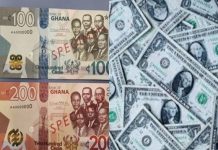

The Bank of Ghana (BoG) Governor, Dr. Johnson Pandit Asiama, has reiterated that the Ghana is the sole legal tender in Ghana, indicating the US dollar should not be accepted in the country as medium of payment for goods and services.
The Governor says the use of the US dollar for the payment of goods and services is illegal, and any person or institution found to be doing so will face the full rigours of the law.
Speaking at the ABSA-UPSA Quarterly Banking Roundtable on Thursday, July 17, 2025, Dr. Asiama stressed that both businesses and consumers are fully within their rights to refuse dollar payments, reinforcing the exclusive legal status of the Ghana cedi.
“Let me say that the dollar is not legal tender. It cannot go everywhere the cedi goes. The dollar is not a legal tender in Ghana. What it means is if you pay me in dollars for service or something I sell to you, I have every right to say no, I will not accept it,” he said.
Governor Asiama reemphasised the need to protect the cedi as Ghana’s legal tender at the expense of other currencies, to protect its stability and performance on the forex market.
He added that protecting the cedi is not only a legal obligation but also a civic duty.
“Consciously, we must be able to protect the cedi. We must be able to ensure that it’s the only form for transaction in this country. Legal tender in its simplest form refers to money that must be accepted if offered in payment of a debt,” he explained.
Dr. Asiama also cautioned that some market actors may attempt to exploit currency fluctuations for personal gain—a practice that undermines economic stability.
“Any attempt to displace the cedi in ordinary commercial transactions, whether through mandatory dollar invoicing, preferential pricing in foreign currency, or informal currency substitution, is not only economically distorting, but also legally impermissible,” he warned.
He intimated further that the cedi is a national asset and should be protected and respected, adding that its exclusive use supports Ghana’s economic sovereignty and strengthens macroeconomic policy implementation.
“It challenges the very fabric of monetary sovereignty. So the legal tender status of the cedi is therefore not a ceremony, but a ceremonial provision. It is the cornerstone of macroeconomic governance. It ensures monetary policy decisions, interest rates, and liquidity management,” he averred.
PLATO’S FOLDER: Beyond Sammy Gyamfi: The dollarisation of Ghana’s economy