
The World Health Organisation (WHO) estimates that 62 million tonnes of electronic waste are discarded every year, but less than a quarter of that is recycled through appropriate or formal means.
A 2024 study by the United Nations Institute for Training and Research (UNITAR) found that 77.7% of the world’s e-waste is not formally collected or recycled. This immediately raises serious public health questions.
Lying less than a kilometre from the Central Business District of Accra is a notorious e-waste hub, Agbogbloshie – a place that has been a focal point of academic, institutional and media research for decades for its contribution to air pollution.
Electronic gadgets of various types arrive here from all over the world at the end of their life cycle, or just about. But even in “death”, these obsolete gadgets are forced by scavengers searching for vital parts into a new life cycle where they become a danger to the environment and society at large.
At the heart of the electronic waste menace is the search for copper wires. This is where your phones, laptops, refrigerators and vehicle components go to die!
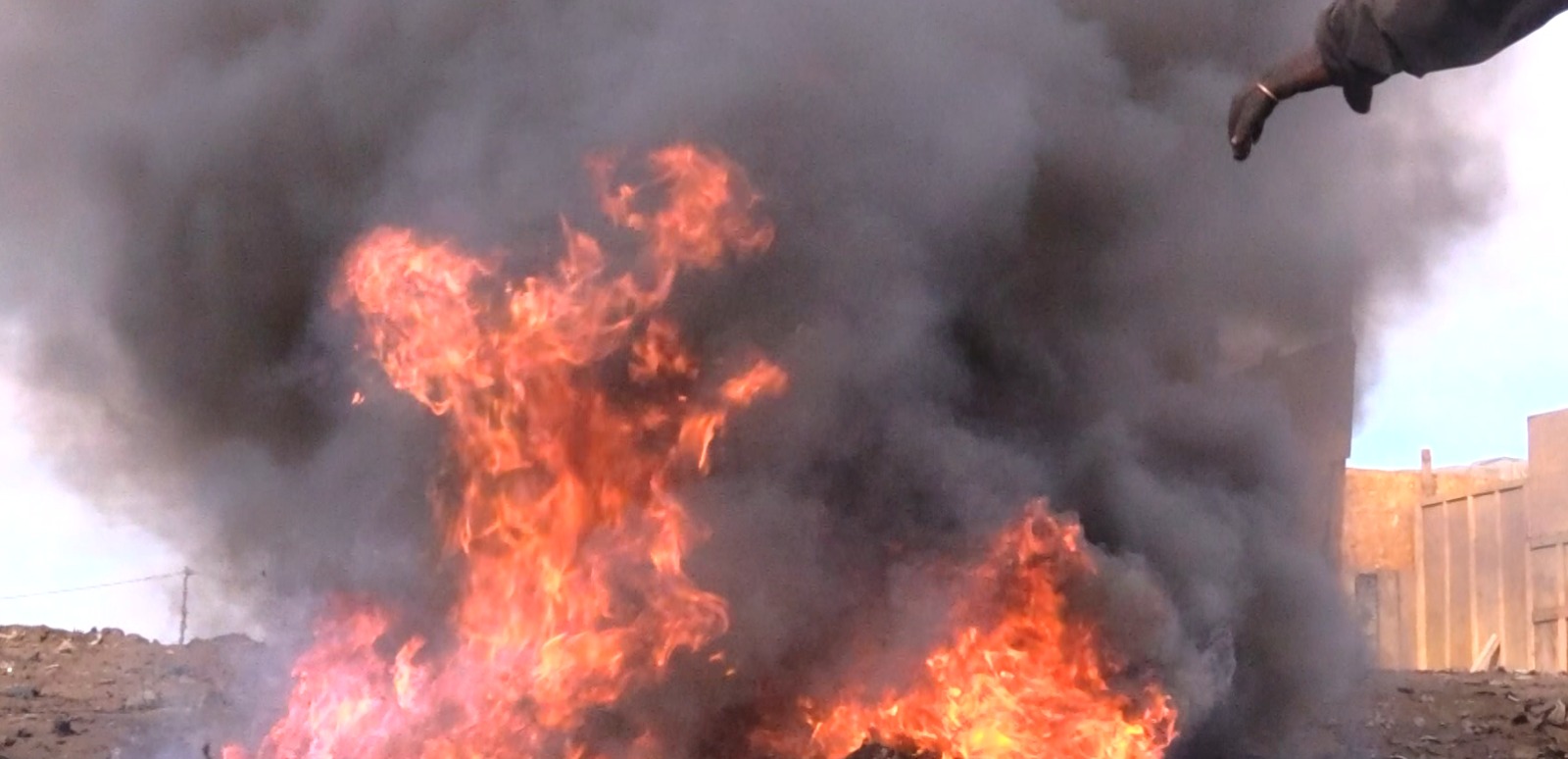
To extract copper and other useful metals from the assembled cables, a group known as the ‘Burner Boys’ openly burns the cables, releasing toxic substances such as lead and mercury into the air. Prolonged inhalation is taking a toll on residents and workers in Agbogbloshie, Old Fadama, Abbosey Okai and nearby settlements.
In a documentary titled ‘Toxic Smoke, Fragile Lives’, set to premiere on Sunday, October 4, 2026 at 5:30pm on TV3 Ghana, 3News has found high levels of pollutants in the air at Agbogbloshie, with all indicators consistently exceeding WHO standards for days, weeks and years.
The Agbogbloshie air quality situation is complex. General waste causes methane emissions, there are carbon emissions from vehicles, open burning of electronic waste, as well as household and commercial cooking and other activities – all feeding into the poor, and sometimes ‘very unhealthy’, air people breathe in the area.
Although not every pollutant was measured in this documentary, a general assessment of particulate matter (PM) 2.5 shows a serious crisis at hand that needs a critical solution.
The scrap dealer and burner boy business
The scrap dealers in Agbogbloshie collect scraps, wires and goods from places they describe as ‘bush’. Afterwards, they smash, sort, and extract useful metals from these consumer electronics.
Many of them migrated from the northern parts of Ghana to Accra in search of a better economic life, but they end up doing this work, and some have been in it for decades.
“I was an electrician working in Tamale, but business was not going well. Our masters were not paying us for work done. I decided to move to Accra, and life has been better. I have a wife and children. I have invested money into this scrap business. We use magnets to fish out the copper; that’s what we like – not aluminium and other metals because you won’t get anything after burning them.
For instance, if all these cables are copper, you can make GH¢300 or GH¢400, but you won’t get even GH¢10 from other metals. It’s a business of gains and losses; you gain today, lose tomorrow. It’s not for the faint-hearted,” said Ibrahim, one of the scrap dealers.
One of his colleagues, Issah Kwaku, shared some of the challenges they face.
“The business is lucrative but comes with huge risks. Someone can sell another person’s products to you because there won’t be any proof or receipts. Burning of the cables is also risky due to the smoke. We used to sell the cables to a company that had a formal way of extracting copper; they were exported to China, the United Arab Emirates, India, Russia and other countries,” he said.
Agbogbloshie is located on the banks of the Korle Lagoon, less than a kilometre from the central business district of Accra. The 20-acre site deals in everything, but one significant group there are the Burner Boys.
The burner boys play an important role – they burn the cables that have been stripped from electrical products.
They have different groups, and competition here can be high, with known customers. After burning, when only copper is left, they bundle it in quantities and hand it back to the scrap dealers.
At one of the burning sites, I met Rahim, one of the burner boys.
“I am the Chief burner boy here. I am 39 years old and have done this work for over 20 years. This work is risky but we don’t have any other job to feed our families. We’re exploring an alternative way to burn the cables so the smoke would ascend straight into the sky without polluting the environment,” Rahim told TV3’s Christian Yalley.
When asked whether they sometimes face health consequences from inhaling the smoke, Rahim said, “Being exposed to the heat weakens our body. I only charge when the cables arrive in large quantities. For fewer ones like this, the scrap dealers decide what amount to give us.”
There are other sites where e-waste burning happens, with different groups engaging in the practice.
“We are mostly affected by malaria. Yes, we usually visit the hospital to check our health and are given medication to treat whatever condition we’re suffering from. The doctors tell us we shouldn’t inhale the smoke because it affects us; they advise us to wear nose masks. The doctors tell us the smoke can affect our heart; we will experience chest pains and coughs,” another burner boy, Mohammed Sofo, admitted.
Across Accra, one major concern is air quality, which is compounded by heaps of waste dumped in several communities.
For the over 80,000 people living and working around Agbogbloshie, their ‘slow poison’ is immediate and, even for the burner boys, the practice can be deadly.
“We lost a boy last month or two. He was burning an airbag; there is a substance [sodium azide] inside it which exploded and cut his throat. He tried to move away but fell and died. Burning airbags is very dangerous and can kill many people.”
“When one such airbag blasted on my face, I couldn’t see anything; I thought I had died, my spirit left me. I sat for about five minutes before I regained consciousness,” scrap dealer Issah Kwaku recounted.
*The health dangers from polluted air*
You can’t refuse to sneeze or cover your nose with a mask when you walk through the streets – experts have described it as a disaster of mammoth proportions.
According to the Director of Public Health at the Accra Metropolitan Assembly, Florence Kuukyi, air pollution in Accra “is becoming so high because there has been an increase in cardiovascular diseases and upper respiratory diseases.”
She revealed: “People come to secure burial space to lay their loved ones to rest and I can say about 80% of the burial permits that are brought, when you look at the cause of death, it’s either upper respiratory disease or cardiovascular diseases. So you can see it is increasing.”
“For air pollutants, you don’t even know that you are inhaling them because they are too tiny, especially particulate matter 2.5, and that is what is killing us. We just took students to the Agbogbloshie enclave and they are complaining.”
In response to the worsening air pollution across cities in Ghana, the Ghana Urban Air Quality Project was established in May 2019, which anchors the BREATHE Accra project implemented in November 2022.
The project is funded by the Clean Air Fund, with low-cost air quality monitoring sensors across 13 districts in Greater Accra. Agbogbloshie has one.
“Among all the districts and areas we’ve been monitoring so far, we’ve realised Agbogbloshie has been the most notorious – the numbers have not changed over the last few years; 2024, 2025, the trend has been the same. We’ve had almost every single day above the WHO 15 micrograms per cubic metre; we’ve had the annual average also above the WHO average and even the Ghana EPA standard.”
“The situation hasn’t changed in Agbogbloshie; we’re still seeing high pollution levels within the area. There need to be active policies that will address this crisis we are seeing,” said Patrick Attey-Yeboah, Data Manager for the Breathe Accra project – something our own analysis of the data trend confirmed.
According to Mr Attey-Yeboah, e-waste recycling is a major contributor to pollution levels in Agbogbloshie and Old Fadama.
“However, there are other factors like idling trucks that come to offload their goods but idle around the area. At dawn, you could see very high numbers; some of the market women wait till dawn to burn because they think people are not around, but our monitors show us that these factors are all contributing to high levels of PM2.5.”
“Domestic and commercial cooking within the area – most of them use solid fuels which are very high contributors of PM2.5 in the area,” he added.
The Accra Metro Public Health Department is concerned about the situation – the elderly, children under five and pregnant women are in the complex mix and at the highest risk.
“It is one of our air pollution hotspots and because of that we are not resting; officers are there, we meet with the transport operators, the e-waste association and the market women association. We educate them and show them the real readings of the air they’re breathing. Sometimes when you ask them about what they feel, they tell you: ‘I cough a lot; I have irritation of eyes’ and so on.”
“I can tell you this year it has even reduced due to the education we are giving. Also, enforcement – we are arresting people who burn waste and they are being fined and convicted. The Assembly cannot do it alone; you need the public to come together; we need the media; we need to collaborate because we can’t do it alone,” Madam Kuukyi said.
*Policy, enforcement and urgent need for action*
Clean air is essential for health. The World Health Organisation estimates that every year, around seven million deaths are recorded globally due to exposure to outdoor and household air pollution. Nearly one million of those are in Africa.
The Environmental Protection Authority is the leading body responsible for managing air quality and controlling air pollution. It tracks ambient pollution levels, especially particulate matter 2.5.
“Air pollution, I will say, is not too good in certain areas, especially when you are looking at carbon monoxide coming from vehicular emissions. Today, if you go to Agbogbloshie, there is a collection centre that actually receives these cables from the informal sector and we pay them the money they require, and I must tell you we’ve accumulated thousands of tonnes of materials from the informal sector, thereby reducing the burning, but I must say it is not 100% because you will still find some recalcitrant individuals still burning,” said Larry Kotoe, Director of Sustainability and Circular Economy at the EPA.
The worry and dangers are real for all to see. Apart from the WHO, the EPA sets the national 24-hour ambient air quality limit for PM2.5 at 35 micrograms per cubic metre, but Agbogbloshie alone records a daily average above this figure.
I asked Larry Kotoe about existing policies and what measures are being implemented to limit or stop the importation or arrival of obsolete electronic gadgets into the country.
His response was: “In terms of transboundary shipment of e-waste into Ghana, we had those incidences like 20 years ago where you had organised crime involving people who really wanted to bring waste and dump it in Ghana. Nobody will actually say they’re bringing waste into Ghana because of the Basel Convention. That means they need to go through a different process which we call the notification process; no country will allow you to bring waste if you don’t have a recycling facility where it is coming to.”
“What we see is more personal effects. We want to discourage the burning of these cables, so if you’re a company that is receiving some of these items and you want to buy from those sources, that means you are patronising the burning of these cables. The law will deal with you; so we’re putting in some of those measures.”
At Agbogbloshie, one man’s waste is another man’s treasure. The air pollution crisis is not exclusive to this place but is widespread across Accra and other cities.
Having spent days filming and monitoring the situation in Agbogbloshie, I have a good appreciation of what it feels like breathing that toxic air. The scrap dealers and the burner boys need this work to put food in their mouths – thousands depend on it.
The reality, however, is that they are slowly dying – and vulnerable groups in Agbogbloshie and Old Fadama will bear the brunt, too.
Don’t forget that many airborne pollutants act as climate forcers, with gases and small particles that directly trap heat in the atmosphere or change how the Earth reflects sunlight – the climate impact can be far-reaching.
Policy, action and real solutions against air pollution can change things.
By Christian Yalley