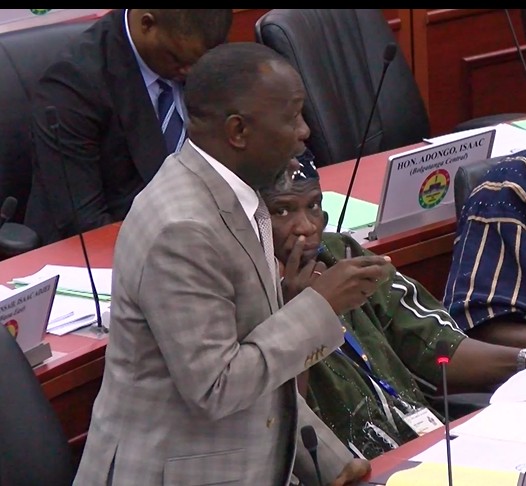

The Attorney-General and Minister for Justice, Dominic Ayine, has said the government’s decision to reintroduce the tribunal court system is intended to broaden access to justice by allowing citizens to play a greater role in the administration of justice.
Speaking in Parliament during the Second Reading of the Tribunals Bill, 2026, Dr. Ayine said the proposed tribunals would complement the existing court system while helping to reduce the growing backlog of cases.
The Tribunals Bill, 2026 seeks to establish the legal framework for the creation, jurisdiction, composition and operation of tribunals, as well as a Tribunal Oversight Committee to supervise their work.
According to the Attorney-General, the current justice system offers limited opportunities for public participation beyond the jury system, a gap the proposed tribunals are designed to address.
“As I hinted earlier, the idea of bringing back the Tribunals is first of all to allow for the participation of ordinary citizens in the administration of justice,” he told Parliament.
“Currently, but for the existence of the Jury system, ordinary citizens do not participate in the administration of justice.”
Dr. Ayine explained that the proposed structure would comprise legally qualified chairpersons supported by panel members drawn from the public.
Under the proposal, Regional Tribunals would be chaired by lawyers qualified for appointment as High Court judges, while District Tribunals would be headed by lawyers eligible for appointment as Circuit Court judges.
He said the tribunals would also include panel members representing the public, similar to the arrangement that existed under the former PNDC Law 78.
“What we are proposing to do is to allow for a panel system chaired by a Chairman of the Tribunal that would be a lawyer equivalent to someone who could be appointed to be a Justice of the High Court for the Regional Tribunals and then also lawyers that qualify to be appointed to be Justices of the Circuit Court to be the Chairpersons of the District Tribunals.
“And then we will have panel members as it used to be in the past under the PNDC Law 78 so that they will be the representatives of the people participating in the administration of justice.”
Dr. Ayine maintained that the reintroduction of the tribunal system would strengthen justice delivery by making it more accessible, participatory and efficient, while easing pressure on the conventional courts.