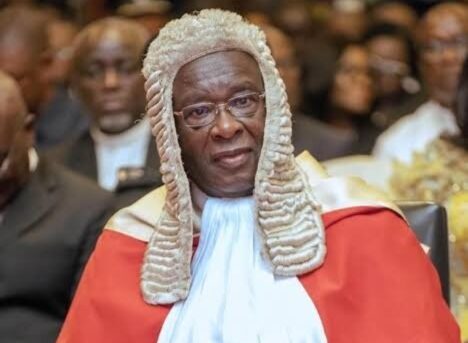

One has served on Ghana’s Supreme Court for over eleven years. Another entered the judicial system nearly four decades ago.
Two spent approximately 26 years in private legal practice before reaching the country’s highest court, while others have built careers in judicial administration, legal education and international courts.
These contrasting professional records are emerging as Ghana prepares for the expected retirement of Chief Justice Paul Kwadwo Baffoe-Bonnie on December 26, 2026, when he turns 70.
Baffoe-Bonnie was sworn into office on November 17, 2025, meaning his substantive tenure is expected to end after barely thirteen months.
Under Article 144(1) of the 1992 Constitution, the Chief Justice is appointed by the President in consultation with the Council of State and with Parliament’s approval. The Constitution does not require the President to appoint the longest-serving Supreme Court justice.
Six names have featured in public discussions: Gabriel Scott Pwamang, Avril Lovelace-Johnson, Emmanuel Yonny Kulendi, Samuel Kwame Adibu-Asiedu, Senyo Dzamefe and Sir Dennis Dominic Adjei.
This is not an officially announced presidential shortlist, and their inclusion does not establish their chances of appointment.
The central finding from their career records is that Supreme Court seniority, total judicial experience and institutional leadership experience are three different measures.
Understanding those differences provides a more useful basis for examining the six judges.
Gabriel Scott Pwamang: The argument of Supreme Court seniority
Justice Gabriel Scott Pwamang entered the Supreme Court in June 2015 after approximately 26 years in private legal practice.
His career includes constitutional litigation, participation in Ghana’s Constitution Review Commission and an earlier role as General Secretary of the People’s National Convention.
With more than eleven years on the apex court, Pwamang has accumulated substantial experience in the Supreme Court’s constitutional and appellate work.
His judicial independence and reasoning can be examined through identifiable opinions, including his dissent in the January 2026 Kpandai parliamentary election dispute.
While the majority quashed a High Court judgment invalidating the election of Matthew Nyindam, Pwamang questioned whether the Supreme Court should exercise its discretionary powers in the circumstances.
He also chaired the Article 146 committee that investigated petitions concerning the removal of former Chief Justice Gertrude Torkornoo.
His record therefore raises two important issues: the value of long Supreme Court experience and the scrutiny that accompanies participation in highly consequential judicial proceedings.
The forensic question is whether seniority, judgment quality and institutional responsibilities can be independently assessed rather than treated as interchangeable qualifications.
Senyo Dzamefe: The argument of judicial administration and institutional experience
Justice Senyo Dzamefe’s judicial career began in 1988 when he joined Ghana’s public tribunal system, four years after being called to the Bar.
He subsequently became a High Court judge in 2000 and a Court of Appeal justice in 2010, before his elevation to the Supreme Court in July 2025.
At the time of his appointment, the Judicial Service described him as the longest-serving justice of the Court of Appeal.
His professional record extends beyond adjudication.
Dzamefe has served as President of the Association of Magistrates and Judges of Ghana, a member of the Judicial Council and chairman of the Judiciary’s Disciplinary Committee.
He has also participated in committees concerned with judicial appointments and court rules.
These are responsibilities closely connected to the administrative functions of the Chief Justice’s office.
Outside the Judiciary, Dzamefe chaired the commission investigating Ghana’s participation in the 2014 FIFA World Cup in Brazil.
The commission examined financial and administrative controversies and produced a report that government subsequently addressed through a White Paper in 2015.
His judicial decisions also provide material for assessing his reasoning.
In a May 2021 Court of Appeal case involving a disputed gold transaction, Dzamefe overturned criminal convictions after examining whether the prosecution had established the necessary elements of fraud and money laundering beyond reasonable doubt.
During his Supreme Court vetting in June 2025, he proposed improvements involving virtual hearings, technology-assisted transcription, additional court facilities, judicial ethics and staff welfare.
These proposals speak directly to documented concerns about court delays and institutional capacity.
However, the distinction between proposing reforms and implementing successful reforms remains important.
Another consideration is retirement. Supplied birth information places Dzamefe’s birth in November 1957. If independently authenticated, he would reach the constitutional retirement age in November 2027.
That would create a relatively short implementation period for any programme requiring several years.
The central issue raised by his record is how extensive judicial and administrative experience could be translated into practical reforms within the available time.
Avril Lovelace-Johnson: The argument of experience across the courts
Justice Avril Lovelace-Johnson represents the career-judiciary route.
She began judicial service around 1990, progressing through the magistracy, Circuit Court, High Court and Court of Appeal before joining the Supreme Court in December 2019.
Her experience spans approximately 36 years.
That background is relevant because the Chief Justice’s administrative responsibilities extend beyond the Supreme Court to a judicial system where most citizens encounter justice through lower courts.
Her February 2024 judgment in Electroland Ghana Limited v Paulina Adomako examined a dispute involving property ownership and the attempted recovery of a commercial debt.
The decision addressed the evidence required before property could be attached to satisfy another person’s financial obligation.
Lovelace-Johnson also represents Supreme Court justices on the Judicial Council, providing a documented role in judicial governance.
Her career raises an institutional question: how can decades of experience across different court levels contribute to addressing delays, court administration and access to justice?
The next stage of assessment would require measurable evidence of reforms undertaken through her administrative responsibilities.
Emmanuel Yonny Kulendi: The argument of extensive legal practice
Justice Emmanuel Yonny Kulendi joined the Supreme Court in May 2020 after approximately 25 years and seven months in private legal practice.
His professional background includes commercial litigation, investment disputes and arbitration.
Unlike judges who progressed through the lower courts, Kulendi entered the Supreme Court directly from private practice.
This offers a different professional perspective, shaped by years of representing clients and challenging evidence in court.
His judicial reasoning featured prominently in the January 2026 Kpandai election dispute.
Writing the majority opinion, Kulendi held that the election petition had been presented outside the statutory deadline and that the High Court lacked jurisdiction to determine it.
On the same day, he dissented in a separate Supreme Court review case involving criminal disclosure and fair-trial procedures.
The two decisions provide examples of his approach to jurisdiction, court procedure and the exercise of judicial power.
His professional record raises the question of how extensive courtroom advocacy translates into judicial reasoning and the administration of the wider court system.
Samuel Kwame Adibu-Asiedu: The argument of a career built from the magistracy
Justice Samuel Kwame Adibu-Asiedu began judicial service as a magistrate in 1996 after earlier work in legal aid and at the Commission on Human Rights and Administrative Justice.
He subsequently served in the Circuit Court, High Court and Court of Appeal before his Supreme Court appointment in December 2022.
His approximately thirty years on the bench provide experience of proceedings across several levels of the judicial system.
In June 2024, he authored the lead judgment in the Supreme Court case challenging the Food and Drugs Authority’s restrictions on celebrity alcohol advertising.
The court upheld the restriction by a 5–2 majority, with his reasoning examining the relationship between constitutional protections and public health regulation.
Adibu-Asiedu also wrote a separate concurring opinion in the Kpandai election dispute.
His institutional experience includes membership of the committee investigating petitions concerning former Chief Justice Torkornoo.
His career highlights the relevance of long-term adjudication and knowledge of the practical challenges experienced by trial courts.
The question is how that experience can be connected to demonstrable improvements in the management and delivery of justice.
Sir Dennis Dominic Adjei: The argument of judicial training, scholarship and international experience
Justice Sir Dennis Dominic Adjei brings a professional history that combines private legal practice, appellate judging, judicial education and international judicial service.
Called to the Bar in 1993, he spent approximately seventeen years in legal practice before joining the Court of Appeal in July 2010.
He was elevated to Ghana’s Supreme Court in July 2025.
But his judicial career extends beyond hearing cases.
Dennis Adjei has held leadership responsibilities at the Judicial Training Institute and worked in court oversight and legal education.
His official biographies also document several legal textbooks covering criminal law, statutory interpretation, land law, constitutional law and human rights.
In December 2021, he was elected to the International Criminal Court’s Advisory Committee on Nominations of Judges.
The following year, he was elected a judge of the African Court on Human and Peoples’ Rights.
These appointments provide documented experience of international judicial institutions and human-rights adjudication.
His Ghanaian Supreme Court decisions offer another measure of his legal approach.
In January 2026, Dennis Adjei authored the majority opinion rejecting an application by the Attorney-General to review an earlier decision concerning criminal disclosure procedures.
The judgment examined the exceptional nature of the Supreme Court’s review jurisdiction and procedural safeguards in criminal proceedings.
He also authored an April 2026 Supreme Court judgment examining restrictions on voting rights following convictions for electoral offences.
An unusual connection emerges from the judicial records: in his 2021 gold-transaction judgment, Dzamefe cited Dennis Adjei’s textbook on criminal law when examining the legal ingredients of money laundering.
This demonstrates how their professional work had intersected through legal scholarship before they both joined the Supreme Court in 2025. It does not, by itself, establish agreement between them on broader legal or institutional questions.
Dennis Adjei’s record raises a distinct issue: how can judicial training, scholarship, institutional oversight and international experience inform the management of Ghana’s courts?
Measuring the results of his previous administrative programmes would be essential to answering that question.
What the forensic comparison reveals: Experience versus seniority
The six justices have followed different routes to the Supreme Court, but the numbers reveal a distinction often overlooked in the succession debate: years in legal practice, years on the bench and years on the Supreme Court are not the same measure of experience.
Justice Gabriel Pwamang has spent more than eleven years on the Supreme Court after approximately 26 years in private practice. Justices Avril Lovelace-Johnson and Samuel Adibu-Asiedu, meanwhile, have spent much longer within the judicial system, having entered the bench in 1990 and 1996 respectively.
Justice Emmanuel Yonny Kulendi brings approximately 26 years of private legal practice, while Justices Senyo Dzamefe and Sir Dennis Dominic Adjei have additional records involving judicial administration, professional leadership and legal institutions beyond Ghana’s Supreme Court.
The comparison exposes an important feature of Dzamefe’s and Dennis Adjei’s careers. Although both joined the Supreme Court in July 2025, their relatively short apex-court tenure sits alongside substantial earlier judicial and institutional experience.
Dzamefe’s record includes about 26 years in the superior courts, following twelve years in the tribunal system. His service on judicial governance bodies and chairmanship of the 2014 World Cup inquiry provide additional evidence of experience managing institutional processes.
Dennis Adjei combines approximately seventeen years in legal practice with sixteen years of appellate service, judicial training responsibilities, legal scholarship and international judicial appointments. His African Court role also extends his adjudicative experience beyond Ghana’s domestic courts.
However, these administrative and international responsibilities must be distinguished from proven institutional results. The same standard applies to the Judicial Council roles, inquiries and other responsibilities of the remaining justices.
What previous appointments reveal
Ghana’s history also demonstrates that there has been no single professional pathway to the office.
Georgina Wood became Chief Justice in 2007 after more than three decades in judicial service. Sophia Akuffo was appointed in 2017 after approximately 22 years on the Supreme Court. Gertrude Torkornoo assumed office in 2023 with approximately nineteen years on the bench, including four years on the Supreme Court.
These appointments illustrate the different combinations of trial-court experience, Supreme Court service and administrative responsibilities previously brought to the office.
The forensic evidence therefore establishes different professional profiles, not a definitive hierarchy of judicial ability. A fuller assessment requires comparable records of personally authored judgments, administrative outcomes and demonstrated institutional reforms.
The way forward: Age, institutional experience and the reform clock
Beyond professional experience, the constitutional retirement age introduces another important dimension.
Under Article 145, Supreme Court justices ordinarily retire at 70. Consequently, the six judges would have markedly different potential periods in office if appointed following Baffoe-Bonnie’s expected retirement on December 26, 2026.
The contrast between Dzamefe and Dennis Adjei illustrates the difference between accumulated experience and the potential time available for implementing reforms.
If Dzamefe’s reported date of birth is confirmed, he would have less than a year before normal retirement following a December 2026 appointment. Dennis Adjei would have approximately seven years and three months.
But longer potential tenure is not evidence of greater competence. Similarly, a shorter tenure does not rule out meaningful institutional improvements.
Past reform efforts demonstrate why the quality and continuity of implementation matter.
In June 2023, then Chief Justice Gertrude Torkornoo reported that only 12 percent of Ghana’s courts had reached full digitalisation, despite years of computerisation and automation initiatives. The figure provides a historical baseline, not an independently verified measure of the situation in October 2026.
The same institutional challenges underpin Dzamefe’s 2025 proposals for technology-assisted transcription, virtual hearings, improved judicial working conditions and faster proceedings. Dennis Adjei’s previous responsibilities in judicial training and court oversight also offer a documented connection to the institutional management questions facing the next Chief Justice.
The need for measurable reform is reinforced by Afrobarometer’s findings published in December 2025. Only 35 percent of Ghanaians surveyed expressed trust in the courts, 37 percent believed they could afford court proceedings, and 38 percent believed cases would be resolved within a reasonable time.
These are public perceptions rather than findings of misconduct by individual judges. Nevertheless, they point to the practical questions the appointment process should confront.
The next Chief Justice’s record should therefore be examined against three tests: experience already accumulated, demonstrable results from previous responsibilities, and a credible programme for addressing the Judiciary’s challenges within the available tenure.
Ultimately, Ghana’s next Chief Justice will inherit more than the gavel. The officeholder will assume responsibility for a justice system where access, affordability, delays and public confidence remain serious concerns.
The six careers reveal different qualifications and potential leadership horizons. What matters for the country’s judicial future is whether that experience can translate into measurable improvements in the delivery of justice.
So who gets the nod? You, be the judge.
By Wisdom Sarfo