
Government in the last few days, announced plans to rename the Kotoka International Airport following a petition by some group of Ghanaians who are demanding the removal of Kotoka’s name from the airport.
This announcement has since led the conversation into a full-blown national debate.
But the question is who was Gen. Emmanuel Kwasi Kotoka?
Lieutenant-General Emmanuel Kwasi Kotoka was a Ghanaian military officer who played a pivotal role in the 1966 coup that overthrew President Kwame Nkrumah’s government.

Born in September, 1926 in Alakple, a small fishing community now in the Anloga District of the Volta Region, Lieutenant-General Emmanuel Kwasi Kotoka, had his early education in Alakple and middle school in Anloga, before venturing into trade as a goldsmith.
He would later be enlisted into the Gold Coast Regiment in 1947 at the age of 20.
Kotoka’s influence in the army grew, rising through the ranks to become a prominent national figure.
In 1952, Kotoka was among some West African soldiers selected for training at Eaton Hall Officer Cadet School in the United Kingdom and was commissioned as a lieutenant and seconded to the British Army of the Rhine in 1954.
In 1963, Kotoka was awarded the Ghana Service Order, following his return from a heroic UN peacekeeping mission in Congo where he led a Ghanaian Battalion deployed to the capital, Leopoldville, now Kinshasa in the Democratic Republic of Congo.
He would later become the Commander of the Second Infantry Brigade (now the Central Command) of the Ghana Army) located at Kumasi, where he met and became friends with Major Akwasi Amankwa Afrifa, an officer in the Second Brigade of the Ghana Army.
On February 24, 1966 the two and others conspired and ousted Dr Nkrumah’s government in a coup codenamed “Operation Cold Chop” which effectively, terminated Ghana’s First Republic.
Gen. Kotoka’s role in the coup led him into becoming a member of the ruling National Liberation Council (NLC) and also the Commissioner for Ministry of Health as well as General Officer Commanding the Ghana Armed Forces.
But just a year after, he was killed in a failed counter-coup codenamed “Guitar Boy,” led by Lt. Moses Yeboah and Lt Sam Arthur, who were later tried and sentenced to death by a military tribunal.
Gen Kotoka was killed at a spot in front of the then Accra International Airport, which was renamed as the Kotoka International Airport.
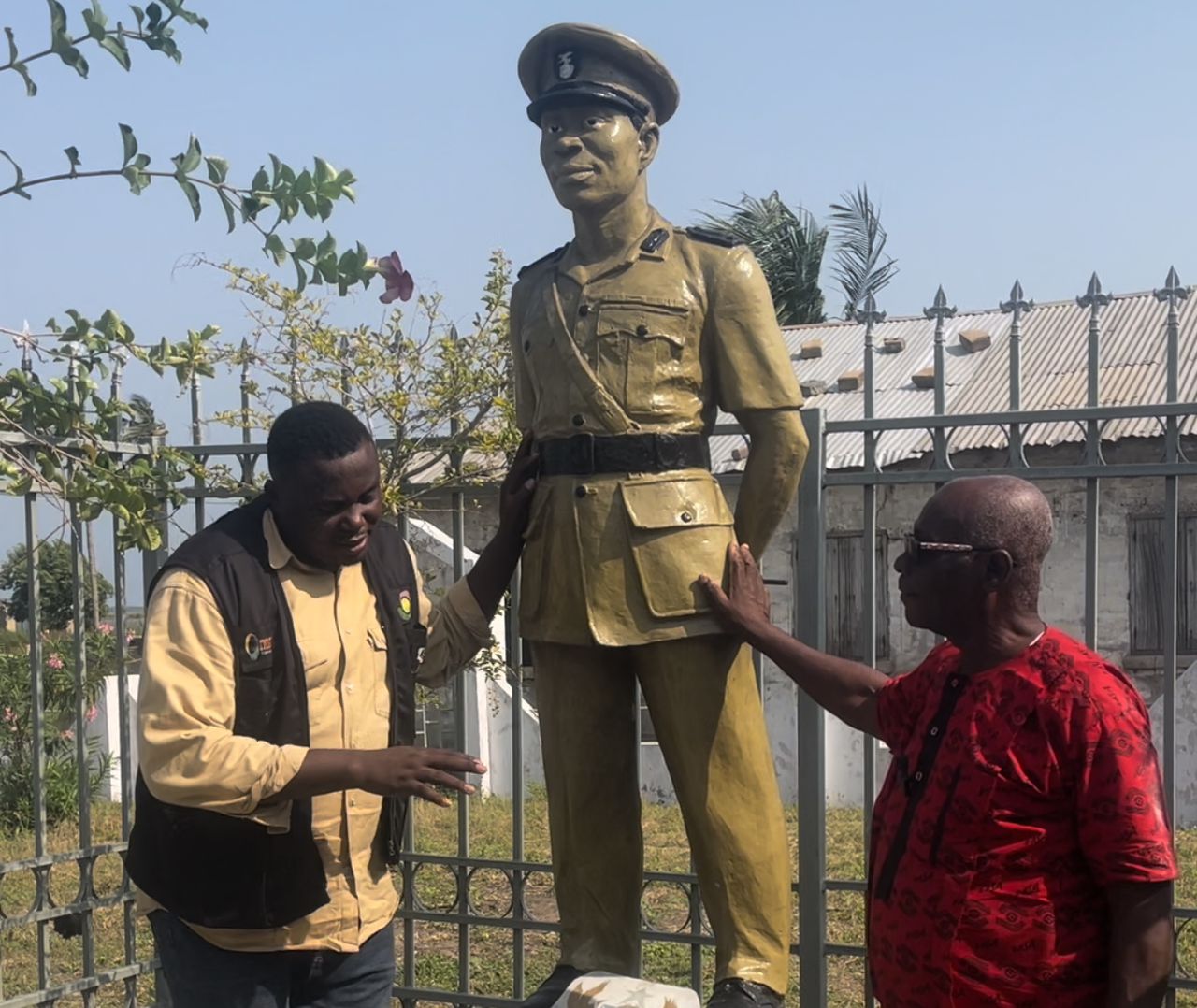
Even though he was buried in Accra, parts of remains were brought back to his paternal hometown, Fiax) for final burial.

“We brought parts of his remains back to Fiax), his paternal hometown for burial in line with Anlo tradition after the initial burial in Accra, so this is his final resting place,” Michael Djirakor, a nephew to Kotoka told 3news reporters in Fiax).
In both Fiax) and Alakple, Lieutenant-General Kotoka is regarded a national hero and immortalized.
“This statue of him, reminds us of the personality he, Kotoka was. It reminds us of his bravery and contributions to the development of Ghana,” Michael Djirakor, said.
“Had it not been his intervention, Ghana won’t be enjoying the multiparty democracy today because at the time, Nkrumah had made Ghana a one-party state,” he added.
Across the Volta Region, more than six statues in different locations have been built memory of Lieut. General Emmanuel Kwasi Kotoka.