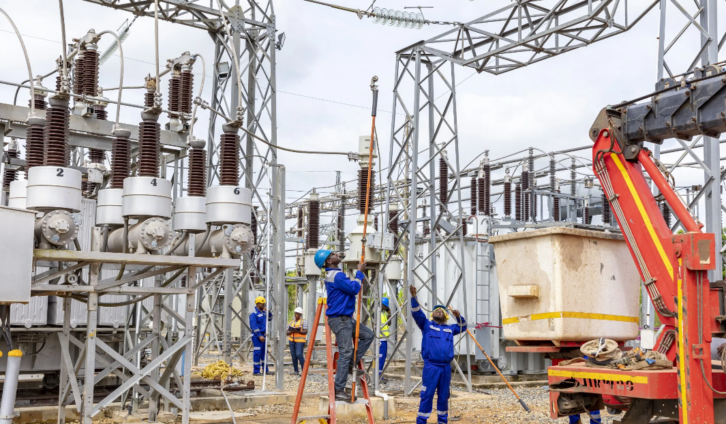

Executive Director of the Centre for Environmental Management and Sustainable Energy (CEMSE), Benjamin Nsiah has cautioned that Ghana’s planned electricity-for-gas barter deal with Nigeria may struggle due to weak infrastructure across the sub-region.
Government has announced intentions to leverage Nigeria’s abundant gas reserves by supplying electricity in exchange for natural gas.
But in an interview with 3Business on Thursday, August 28, 2025, Mr. Nsiah argued that Ghana may not have the capacity to reliably deliver power to its neighbour.
He pointed to the limitations of regional support systems, despite the existence of the West African power pool.
He said, “Yes, we believe we have West African power pool, but the infrastructure support system is too weak to supply Nigeria the needed electricity within the shortest possible time”.
Mr. Nsiah argued that the initiative may only be viable in the long term, when the cost of infrastructure across different countries has been harmonised.
“I think that some of these ideas are in the long term and in long term also means that we need to harmonise the cost of infrastructure in different countries because this infrastructure is going to pass through various countries before it gets to Nigeria.” he said.
He also suggested Ghana could learn from the West African Gas Pipeline framework, which provides a cost-sharing model among participating countries.
“We may learn from the West African gas pipeline system or framework in terms of costing each of these distribution systems within specific countries, but power also has its own infrastructure.”
The analyst added that a clear framework must be developed to cover the cost of transmitting electricity through countries such as Togo and Benin, before any meaningful progress on the barter arrangement can be achieved.
While describing the initiative as promising, Mr. Nsiah maintained that Ghana currently lacks enough generation capacity to meet Nigeria’s needs.
“On the surface I think that it looks very positive, but I think that in the short-term Ghana doesn’t have enough power available to be able to supply to Nigeria in terms of the quantum they need.”
His comments highlight the infrastructure hurdle Ghana must overcome before becoming a reliable electricity exporter within the sub-region.
Energy Minister, John Jinapor had earlier revealed at the Future Energy Conference in Accra that Ghana is in talks with Nigeria on a barter deal to exchange electricity for gas. He said the arrangement is expected to strengthen regional energy security, adding that Ghana already supplies power to Togo, Burkina Faso, Côte d’Ivoire, and Benin.
By Esinu Adza, 3BUSINESS