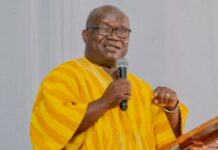

President of the Ghana Chamber of Mines, Michael Edem Akafia, has urged government to tread cautiously with proposed amendments to the Minerals and Mining Act, warning that certain changes could undermine investor confidence and threaten the long-term sustainability of Ghana’s mining industry.
His caution comes at a time when government is already in the process of taking over the Damang Gold Fields, a move that some analysts say could send worrying signals about the stability of the country’s investment climate.
Speaking to journalists on the margins of a tour of mining operations by Parliament’s Select Committee on Mines and Energy in Tarkwa, Mr. Akafia said while the Chamber appreciates that laws must be reviewed periodically to reflect changing circumstances, the current proposals by the Minerals Commission contain provisions that could weaken the very foundations that have made Ghana a leading mining destination in Africa.
“We appreciate that laws be reviewed over time, especially when circumstances change,” he noted. “We believe there are good things in there, but there are other things that are of concern to us, and those were the issues that we raised.”
At the heart of the Chamber’s concern is the Minerals Commission’s proposal to reduce the upper limit of mining leases from the current 30 years to 15 years in the first instance, renewable for another 10 years. Mr. Akafia argued that such a move would diminish the security of tenure, which remains one of the most important factors investors consider before committing capital to mining ventures.

He explained that the justification by the Minerals Commission that the payback period for mining projects is typically five years does not align with industry realities. “That’s far from the truth,” he said. “Mining is a capital-intensive, long-term, highly risky business. Evidence and research point to much longer payback periods. Investors, whether Ghanaian or foreign, need assurance that they can recover their investments within a secure tenure.”
According to him, Ghana’s current 30-year lease structure compares favourably with mature mining jurisdictions such as Australia, South Africa and Canada, countries that continue to attract major investments because of their predictability and stability.
“The Minerals Commission cites other jurisdictions to justify a shorter tenure, but those jurisdictions themselves learned from Ghana’s framework on security of tenure,” he pointed out. “The law as it stands already provides flexibility for the regulator to grant shorter leases where justified. In fact, we have a recent case where an applicant sought only a 10-year lease even though the law allows up to 30 years, because that’s what the feasibility supported. That flexibility is what makes the current law work.”
He warned that introducing arbitrary caps risks making Ghana less competitive, particularly at a time when the government’s decision to take over operations such as the Damang Gold Fields is already heightening perceptions of regulatory uncertainty. “When investors see a tightening of tenure alongside government takeovers, the signal is one of unpredictability,” he said. “It tells investors that the goalposts can shift mid-game. That’s how capital flees to jurisdictions that offer clarity and consistency.”
Mr. Akafia further cautioned that not all mines are the same, and uniform lease limits could harm lower-grade or complex deposits that require longer operational lifespans to become profitable. “Some rare-earth and critical minerals will require a longer tenure to make them viable. Low-grade mines, for instance, must operate over extended periods to achieve payback. The current 30-year ceiling accommodates that diversity,” he stressed.
He also took issue with the proposed clause that restricts all dispute resolutions to the High Court, arguing that such a provision overlooks modern trends in international mining arbitration. “The High Court is already burdened with many cases,” he said. “Globally, it is now common to encourage alternative dispute resolution, including arbitration. The Minerals Commission may be trying to avoid high arbitration costs, but there are better ways to manage that without removing flexibility altogether.”
Another area of concern is the proposed limitation on stability agreements — the fiscal and regulatory arrangements that provide investors with predictability over taxes, royalties and operational conditions. Mr. Akafia argued that for long-term mining projects financed through project loans, stability is not a luxury but a necessity. “Because mining is funded based on project finance, your feasibility study must prove viability over the life of the mine. Sometimes, that viability depends on a long stabilization period. That’s why the current law allows such agreements in appropriate cases,” he explained.
He said removing or severely restricting these provisions could deter large-scale capital inflows and jeopardise new exploration ventures, which are already in decline. “We are not opposed to reform,” he clarified, “but we want reforms that reinforce Ghana’s credibility, not those that shake investor confidence.”
Mr. Akafia concluded on a note of cautious optimism: “We believe that the powers that be will hear us. Our call is not to resist change but to ensure that change is thoughtful, inclusive, and preserves the integrity of Ghana’s mining industry.”