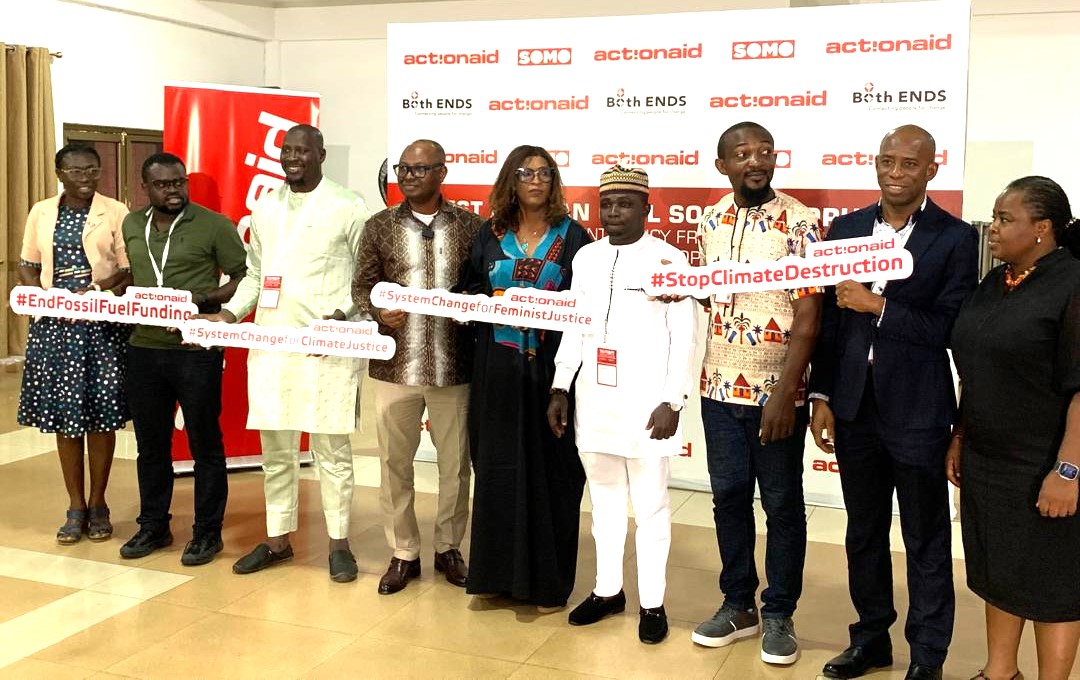

The West African Civil Society Forum has called for reforms in Investment Treaties to promote development and Climate Justice.
The forum identified that International Investment treaties with West African states are often rooted in “historical power imbalances” restricting African nations’ sovereignty over their natural resources and limiting their ability to protect the public interest.
The forum called on West African governments, policymakers, and regional bodies to terminate obsolete Bilateral Investment Treaties (BITs) that undermine national interests, sovereignty, and the ability of governments to regulate in areas that fall to protect community and environmental rights.
The call was made at a gathering of Civil Society Organisations from 13 countries including Nigeria, Senegal and Gambia.
It was hosted by ActionAid Ghana, in collaboration with the Centre for Research on Multinationals Corporations (SOMO), Both ENDS and Donor Initiative for Sustainable Development.
Key Discussions and Findings
Over the past three days, experts and researchers examined critical issues surrounding Bilateral Investment Treaties (BITs) and Investor-State Dispute Settlement (ISDS) systems, assessing their implications for development, human rights, climate action, and public health across Africa.
Participants systematically reviewed more than 132 BITs in West Africa, exploring alternative frameworks and regional models that better promote development justice, human rights protection, and climate resilience.
Discussions also addressed the persistent challenge of judgment debts, known in Ghana as a major public finance burden often resulting from poorly structured investment agreements that expose states to costly international arbitration.
Findings revealed that Ghana currently leads in West Africa with 26 active investor-state dispute cases, followed by Nigeria with 16 cases, representing a significant drain on public resources intended for development projects.
Key Observations
- Investment Treaties Are Not Neutral:
International investment treaties with West African states are often rooted in *historical power imbalances*, restricting African nations’ sovereignty over their natural resources and limiting their ability to protect the public interest.
- 2. No Proven Link Between BITs and FDI:
Evidence shows no correlation between the existence of BITs and increased Foreign Direct Investment (FDI). Instead, these treaties heighten risks of *revenue loss* through costly dispute settlements, with compensation awards often ranging between *US$100 million and US$1 billion.
- Climate Injustice Persists:
While the global green transition is commendable, it remains unjust to Africa, as the continent continues to bear the brunt of climate change despite being the lowest global emitter. Participants called for urgent action to correct these imbalances and promote climate justice.
Resolutions and Calls to Action
The forum calls on West African governments, policymakers, and regional bodies* to undertake the following actions:
Terminate obsolete Bilateral Investment Treaties (BITs) that undermine national interests, sovereignty, and the public good. Governments should renegotiate or withdraw from treaties that fail to protect community and environmental rights.
End intra-African BITs and instead leverage the African Continental Free Trade Area (AfCFTA) Investment Protocol, which offers a balanced, transparent framework for managing investments within and beyond Africa.
Prioritise industrialisation and value addition in the extractive and manufacturing sectors to ensure African states capture greater benefits from their natural resources.
Develop public-interest investment contract models aligned with the AfCFTA Investment Protocol recognised as one of the most progressive globally.
Strengthen domestic legal systems to enhance due diligence, curb corruption, and reduce illicit financial flows. All major investment contracts should be reviewed and approved by the Attorney General’s office for its equivalent before ratification.
Foster regional collaboration among policymakers, civil society organisations, and intergovernmental bodies to reform the investment landscape and ensure that treaties advance development, gender, and climate justice.
Conclusion
The forum reaffirmed the collective commitment of West African civil society to advocate for investment frameworks that put people and the planet before profit. Participants underscored that achieving sustainable and inclusive development requires bold action to reform outdated treaties and empower African states to pursue *sovereign, just, and climate-resilient economies.