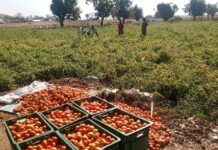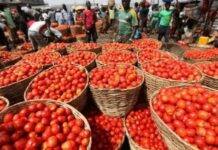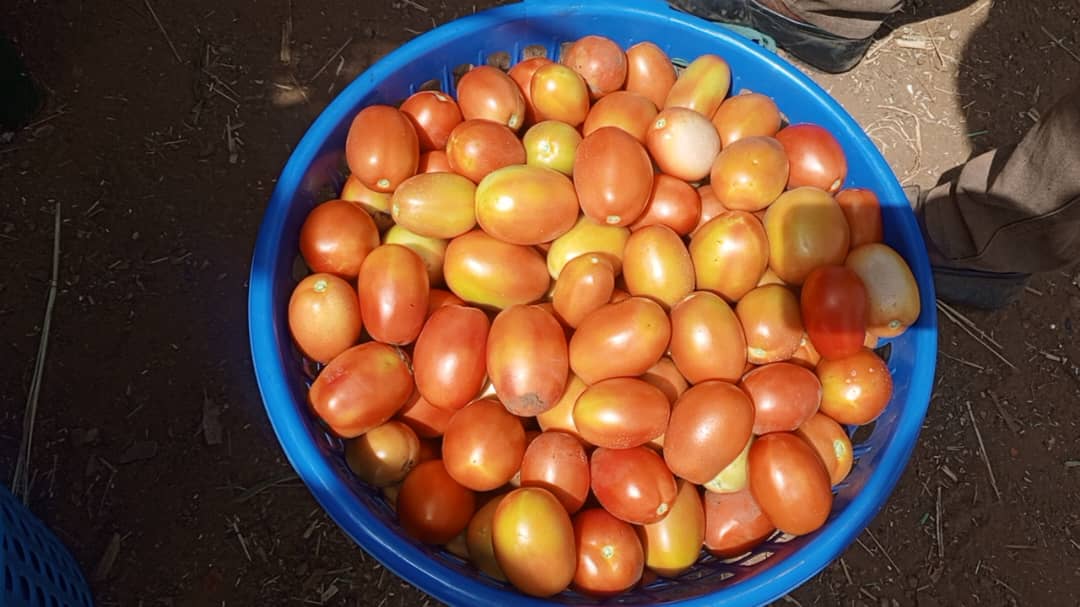

A tomato production collaboration between the West Africa Food System Resilience Programme (FSRP) and FarmMate Ltd aimed at intensifying local tomato production in Ghana has resulted in an estimated yield of 240 tonnes in its first round in the Upper East Region.
This intervention is reducing the importation of tomato from Burkina Faso by the Ghanaian market ‘queens’ and marketers which has direct economic effects in Ghana.
This forms part of interventions by the West Africa Food System Resilience Programme (FSRP) – under the Ministry of Food & Agriculture, to address the yearly incidence of tomato shortages and fluctuating prices around the country especially during the dry season.
The scheme is being carried out through financial support from the Government of Norway and coordinated by the World Bank, to revamp the Ghanaian tomato industry for year-round availability of the produce by way of dry season production.

The FSRP-FarmMate Ltd collaboration is geared at leveraging productive private sector linkages with farmers to optimise the production and facilitate timely off-take and marketing of tomatoes for the fresh and value addition (tomato puree) markets.
The FSRP-FarmMate collaboration covers 200 acres across the country, 110 of which are in the Upper East Region with about 100 farmers in the Zebilla (in the Bawku West District), Pwalugu (in the Talensi District) and Navrongo (in the Kasena Nankana District).
A visit to the tomato farms in Bawku West, Talensi and Kassena Nankana Municipality depicts the positive impact of the intervention by FSRP and FarmMate program where farmers are very excited with the quality of the yields they are producing out of the program.
The other locations are: Ningo-Prampram, Okere, Kwahu East, Akumadan Irrigation Scheme and Asunafo South districts
Under the programme, farmers are receiving inputs from FSRP in the form of smart seeds, agro chemicals like enhanced blended fertilizers with micronutrients, organic manure and pesticides (organic and inorganic).

FarmMate is also giving farmers close extension support, monitoring and immediate offtake of harvests.
The head of Engagement for FarmMate who also manages the Environmental, Social and Governance, ESG, systems of FarmMate, Kwame Asante, explained the importance of the collaboration with FSRP tomato program.
“For the past year, FarmMate has been collaborating with the FSRP program. And what we are mandated to do is to offtake the tomatoes produced from the various communities because one of the main challenges for tomato producers in this country is the market. And so offtaking has become one of the major activities that we are playing.
However, as we know, you can only offtake the best produce if you can really ensure best agronomical practices, so even though we are mandated to offtake, in order to make sure that we are offtaking the right, good produce, we also provide technical support services right from the nursery stage through transplanting, farm management, crop management, etc., all the way to the harvesting, coordination, aggregation, and transport of our produce from all these tomato zones down to Accra.
And the goal for 2026 is for us to expand our production to at least 1,000 acres of tomatoes. And in fact, if you want to look at that in terms of yield, our estimation is with the variety that we are developing and cultivating with our farmers, we are estimating a minimum of 4 tons per acre. Therefore, if you multiply that by 1,000 acres, we are expecting at least 4,000 tons of tomatoes for 2026. And that is for both the fresh market and also for processing activities” He stated.

Beyond the collaborations with FarmMate, the FSRP Tomato Support Programme is being carried out in 17 Districts in four (4) regions. It involves 1,500 farmers of which 40% are women.
So far, the intervention has resulted in yields of Approximately 10 tons/Ha and at the end of 2025 dry season yields are expected to reach 15 Tons/Ha.
FSRP targets the production of 6000 Metric tonnes of tomatoes by the end of the intervention.
The FSRP schedule officer for Bawku West district, Alafia Daniel Ayawini said, tomato marketers who usually travel to Burkina Faso for tomato are now buying the new variety tomatoes produced in the Bawku West district and is a sign of reducing poverty in the area.
“This time, we don’t sell for marketing, but we sell for farm mate. Farm mate are now the marketing firm for this year’s demand. And they are very happy with the quality. They are very happy that the size are big. The chemicals we have used, they are very comfortable with the chemicals. The kind of fertilizer we use is very normal. They have supervised the application of the fertilizer, the application of the chemicals. All the chemicals that have been applied, they were here to supervise, including with the agricultures So they are much more comfortable with the quality and the size of the fruits”.
One of the hard-working female tomato farmer in Teshie in the Bawku West district, Asigma Awafo expressed joy on the introduction of the new variety and how is helping them as farmers.
“I have been a tomato farmer all my life and FSRP has come in to help us. Two years now, FSRP came and supported us. One thing that makes this year’s project unique and special to us and very important to us is that the seed variety is also good, that’s the Sika variety and we have planted the fertilizers.
The fertilizers are not the fertilizer we have been using, it’s the high quality that will help to control the blossom end roots and we have used it and it is very good”, she excitedly said.

Tomatoes are an essential part of the Ghanaian diet, accounting for 40 percent of vegetable expenditures. However, only 34 percent of the 1.4 million tons of tomatoes consumed annually in Ghana are produced locally.
This results in substantial imports (especially between Dec and May). Challenges that confront the local tomato industry include: the use of poor-quality seeds; the absence of seeds well adapted to local seasons and climate variabilities; pests & diseases control lapses; poor agronomic/farm practices; post-harvest losses (ranging from 20% to 60%); and the absence of innovative storage methods.
All these result in low average yields of 8.3 metric tons per hectare (instead of potential yields of 20 metric tons per hectare); leading to sharp fluctuations between glut/low prices (during peak season harvests) and shortages/dramatically high prices (during off-seasons).
By Tanko Mohammed Rabiu