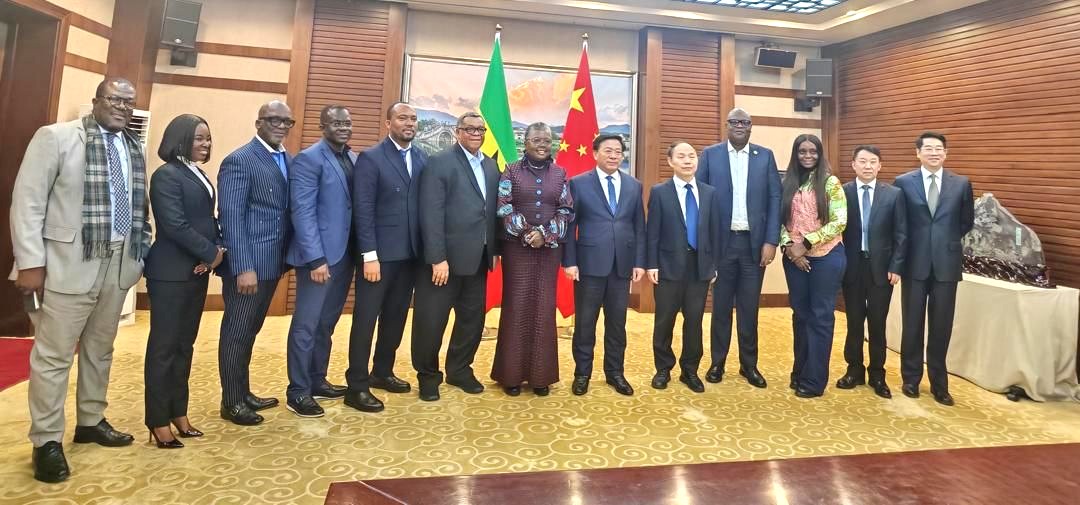

Ghana has taken a major step toward transforming its fisheries and aquaculture sector after the Minister for Fisheries and Aquaculture, Emelia Arthur, led a high-level bilateral engagement with the Government of the People’s Republic of China aimed at strengthening cooperation to enhance food security, create jobs and accelerate sustainable blue economy growth.
The engagement took place in Beijing during a strategic meeting between Hon. Arthur and Mr. Han Jun, Secretary of the Communist Party of China’s Leadership Group and Minister of the Ministry of Agriculture and Rural Affairs (MARA), under whose mandate fisheries and aquaculture fall.
The meeting provided a platform for Ghana to present a comprehensive Ghana–China Fisheries Partnership Framework, outlining the country’s vision for a resilient, sustainable and investment-ready fisheries and aquaculture sector that supports national development while safeguarding aquatic ecosystems.

Fisheries Central to Ghana’s Economic Transformation
Addressing the meeting, Hon. Emelia Arthur emphasized that fisheries and aquaculture remain critical to Ghana’s food security and economic transformation agenda. She noted that fish contributes over 60 percent of Ghana’s animal protein intake and supports millions of livelihoods across the value chain.
She highlighted government’s commitment to repositioning the sector through science-based management, aquaculture expansion, value addition and strategic international partnerships.
“The future of Ghana’s fish supply lies in responsible aquaculture development supported by technology, investment and strong institutional collaboration,” the Minister said, adding that Ghana is ready to partner with China to unlock large-scale growth across the fisheries value chain.
Ghana Positioned as China’s Gateway to African Fisheries Markets
Officials from the Ministry of Fisheries and Aquaculture (MoFA) presented Ghana as a strategic gateway to African fisheries markets, citing the country’s stable democracy, strong rule of law, investor-friendly environment and allowance for full foreign ownership.
With the African Continental Free Trade Area (AfCFTA) Secretariat headquartered in Accra, Ghana offers access to a 1.3 billion-consumer African market valued at US$3.4 trillion, in addition to the 370 million-consumer ECOWAS market.
The Ministry also highlighted Ghana’s natural endowments, including Lake Volta the world’s largest artificial lake, covering 8,502 km² and currently utilized at less than five percent. The lake presents significant opportunities for aquaculture expansion, particularly tilapia production, supported by favourable year-round water temperatures.
Closing a US$800 Million Fish Supply Gap
Data presented by MoFA revealed that Ghana’s annual fish demand stands at 1.28 million metric tonnes, while domestic production is approximately 684,000 metric tonnes, leaving a supply deficit of about 590,000 metric tonnes, valued between US$600 million and US$800 million annually.
The Ministry warned that key marine stocks, including sardinella, have declined to 13.8 percent of sustainable levels, reinforcing the need for aquaculture led growth. Ghana has set a national aquaculture production target of 177,000 metric tonnes by 2027.
Investment Opportunities Across the Fisheries Value Chain
The Ministry identified several high-impact investment opportunities for Chinese enterprises, including:
- Fish feed manufacturing
- Specific Pathogen Free (SPF) hatcheries
- Cold chain and storage infrastructure
- Modern fish processing facilities
Post-harvest losses currently range between 25–50 percent in inland fisheries and 10–20 percent in marine fisheries, while deep processing remains below 10 percent, with no large-scale fillet or surimi processing capacity in the country.
Potential investors were assured of flexible investment models including wholly owned ventures, joint ventures, public-private partnerships (PPPs) and technology licensing supported by Free Zones incentives such as tax holidays, duty exemptions and unrestricted profit repatriation.
Strategic Fishing Ports and Flagship Projects
MoFA also presented completed feasibility studies for six priority fishing ports nationwide, with Shama in the Western Region identified as a flagship project requiring an estimated US$25–40 million investment and capable of creating over 10,000 jobs.
Additionally, Ghana proposed an immediate partnership opportunity for the US$12 million Ghana National Aquaculture Centre, a fully developed facility seeking a Chinese partner to support operations, research, training and technology demonstration for Ghana and the wider West African sub-region.
Biosecurity and Human Capital Development
Hon. Emelia Arthur underscored the urgent need to strengthen aquatic animal health systems, particularly to address Infectious Spleen and Kidney Necrosis Virus (ISKNV), which has affected nearly 80 percent of aquaculture farms nationwide.
Ghana is seeking collaboration with China in vaccine development, laboratory twinning, disease surveillance systems and SPF hatchery technology, leveraging China’s global leadership in aquaculture biosecurity.
To ensure long-term sustainability, the Ministry also proposed a structured human capital development programme, including scholarships and technical training in biosecurity, disease control, processing technology and fisheries policy, targeting up to 1,200 professionals over five years.
Strong Chinese Leadership Supporting Cooperation
The engagement benefited from the leadership of Mr. Han Jun, a distinguished agricultural economist and public administrator with more than 30 years of experience in China’s “Three Rural Issues” sector.

Mr. Han Jun holds a doctoral degree in agricultural economic management from Northwest A&F University and has served in key national institutions, including the Chinese Academy of Social Sciences and the Development Research Center of the State Council.
Since assuming office as Minister of Agriculture and Rural Affairs in 2024, he has championed international agricultural and fisheries cooperation grounded in mutual benefit, technology transfer and sustainable resource management.
Hon. Emelia Arthur called for the establishment of a formal Ghana–China Fisheries Cooperation Memorandum of Understanding (MoU), supported by joint investment roadmaps, technology transfer mechanisms and scholarship programmes.
She described the partnership as one designed to serve both nations for generations, combining China’s advanced aquaculture expertise with Ghana’s natural resources, strategic location and access to African markets.
The Ministry of Fisheries and Aquaculture reaffirmed its commitment to leading a science-driven, investment-ready and inclusive transformation of Ghana’s fisheries and aquaculture sector in close collaboration with strategic international partners.
By Joseph Armstrong Gold-Alorgbey