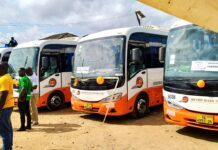
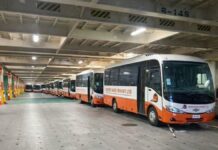
The Deputy Managing Director of Metro Mass Transit, Haroun Apaw-Wiredu, has explained that persistent bus breakdowns are largely linked to spare parts challenges.
He also mentioned procurement decisions under previous administrations, and the nature of some buses supplied to Ghana as responsible for the current state of affairs.
Speaking exclusively to Alfred Ocansey on the KeyPoints on January 24 on the condition of Metro Mass buses, Mr. Apaw-Wiredu revealed that several of the company’s buses require spare parts that cannot be sourced locally, forcing Management in some cases to send components abroad for fabrication or replacement.
According to him, spare parts for some of the buses have had to be sent to countries such as South Korea and China, where manufacturers attempt to mould or fabricate replacements.
“In many instances, when those parts are supplied back to us, they do not fit the mechanical problem identified,” he explained.
He said the mismatch in parts has often left buses grounded, as replacing one faulty component does not necessarily resolve the underlying mechanical issue.
In some cases, the only option has been to send entire components back to China for further work.
Mr. Apaw-Wiredu noted that although some of these parts have since been returned, the challenges persist, particularly for buses that were not manufactured with the Ghanaian operating environment in mind.
He contrasted these buses with others in Metro Mass’ fleet, particularly those acquired through a government-to-government agreement between Ghana and the Netherlands.
“These buses are very robust. They are strong enough,” he said, adding that the Dutch-supported agreement was extended under a previous administration.
Under that arrangement, Metro Mass received batches of buses between 2022 and 2024, with the last tranche of about 50 buses arriving in 2024.
Touching on the issue of broken-down buses, Mr. Apaw-Wiredu confirmed that out of 99 buses referenced in earlier discussions, a significant number are currently not roadworthy.
He attributed this situation to the lack of spare parts and longstanding mechanical issues.
To address the problem, he said Metro Mass has set up an internal technical committee, made up of members from the technical department and other relevant units, to assess the condition of buses nationwide.
“The moment a serious mechanical fault is detected, the bus is grounded. That is the current state of affairs,” he stated.
He stressed that procurement decisions taken in the past did not adequately factor in Ghana’s weather and environmental conditions, contributing to the frequent breakdowns being experienced today.
As part of efforts to ensure accountability, Mr. Apaw-Wiredu disclosed that Metro Mass has commissioned an external audit into the procurement and operational challenges facing the company.
He assured that the findings of the audit will be submitted to the Ministry for transport appropriate action.
“We will submit everything to the Ministry for the necessary steps to be taken,” he said.