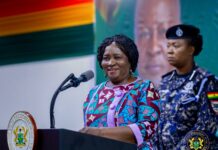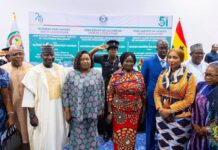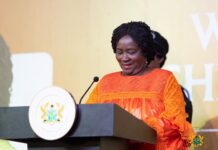

The Vice President, Prof Jane Naana Opoku-Agyemang, has stressed the need for Africa to unite.
She said failure to do so will delay the attainment of the laudable objectives of the African Continental Free Trade Area (AfCFTA) agreement.
“We must continue to interrogate the borders. Africa must unite. This is not about erasing sovereignty. It is about organizing our sovereignty in service of shared prosperity and our market,” she said.
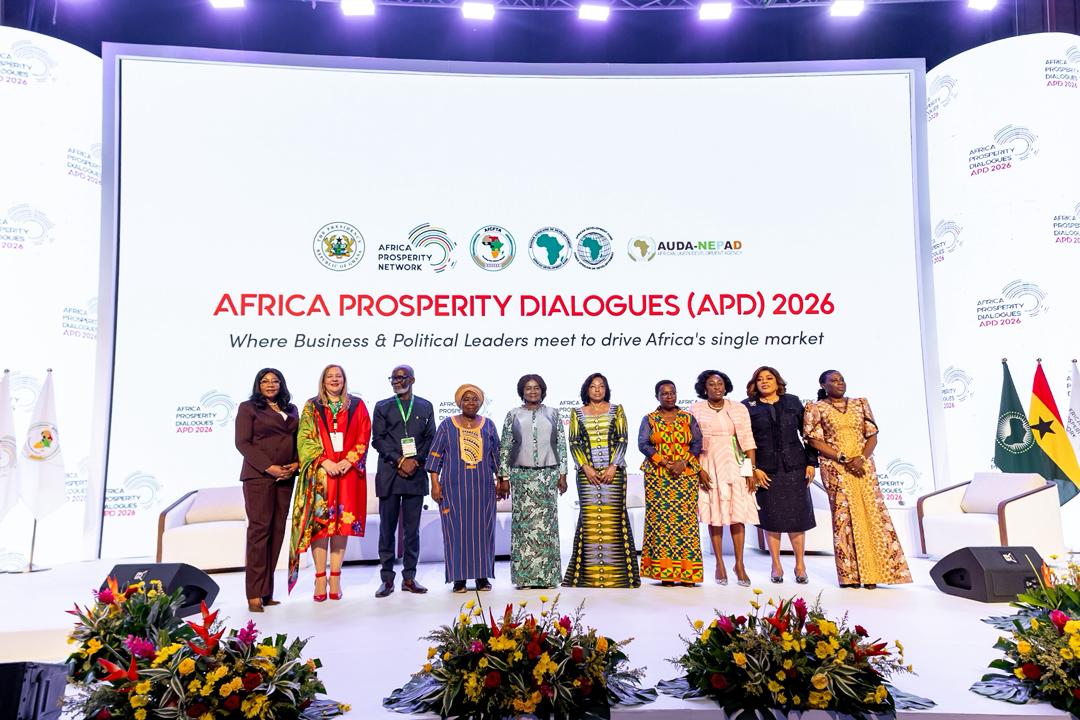
Veep Opoku-Agyemang made the call during her speech as the Special Guest of Honour at the Africa Prosperity Network Dialogue held in Accra on February 4.

According to her, Africa’s unity is about enabling an entrepreneur or manufacturer, whether in Accra, Kigali, Rwanda or elsewhere, to see Africa not as a fragmented abstraction, but as one connected market with vast opportunities.
“…our greatest asset remains our people. For that reason, this conference should be remembered for what was discussed, what was launched, what was committed to, and ultimately what was delivered,” the Vice President stressed.
Please read her full speech below:
I bring you all greetings from His Excellency. President John Dramani Mahama, who was meant to be here, but was called away for other international duties, it is a pleasure to represent His Excellency.
It is important to engage with the avenues that conceptualize change and implement it. It is in this context that such advocacy platforms have emerged to complement the work of the African continental free trade area, which is headquartered here in Accra, to champion inter African trade and deepen intra African economic cooperation, investment and mobility.
Distinguished ladies and gentlemen, this commitment is not new. Recently, at the United Nations, President Mahama stated that Africa would shape the future.
He is just as convinced of that today, and central to that conviction is a simple truth, a future that excludes young people, women and small enterprises, is not one we can afford to sleepwalk into. It is a belief that lies at a reset agenda. The idea of a reset is to move us from dependency to self-reliance, from fragmentation to integration, from exporting potential to building prosperity at home,

The vision of Africa as a single, integrated economic space remains unfinished, whether this reflects the constraints of imagination or the execution, we must remember what is at stake, and that is prosperity for Africa’s people, our borders should connect us.
From Pan African Festival of Arts and Culture through The Year of Return initiative to the Diaspora Summit, successive governments in Ghana have worked deliberately to bridge our historical and economic divides with the understanding that progress is strongest when it is collective.
This spirit of partnership was reaffirmed just last year at the second AU Summit in Addis Ababa, where African countries recommitted themselves to cooperation rooted in dignity, equity and mutual benefit.

Against this backdrop, the African Continental Free Trade Area (AfCFTA) stands out as a historic opportunity.
It is the world’s largest free trade area by number of participating countries, representing a market of 1.3 billion people within this market. SMEs are central to Africa’s development. SMEs are often cited as generating over 80% of employment and a significant share of GDP in Ghana, our SMEs continue to demonstrate resilience competitiveness, even under challenging conditions.
Equally notable is the role of people. Women make up nearly half of Africa’s workforce and are a major force in enterprise, especially in micro and small businesses.

Our youth account for more than 60% of our population across the continent, our youth are driving technology and innovation from FinTech to Creative Industries. However, ladies and gentlemen, this potential is not yet fully reflected in cross border participation.
Fewer than 20% of SMEs engage in export trade. Women continue to face unequal barriers to finance mobility and market access. Many young people still lack the capital, skills, pathways and institutional support needed to scale their ideas across borders.
Many of our economies risk remaining trapped in low productivity models, exporting raw materials, importing finished goals and watching talented young Africans seek opportunity elsewhere.
This trajectory is neither inevitable nor acceptable, and that is why the theme for this dialog is very relevant across the continent today, we are seeing sustained efforts, deeper coordination and increasingly confident leadership.
The task now is to convert this momentum into a durable economic transformation that requires clarity of focus, expanding trade within Africa and implementing the industrial strategies that strengthen priority sectors, build skills support, sustainable production.
We must continue to invest in infrastructure and connectivity, while establishing the conditions for innovation and technology. Behind all this, strong institutions and effective governance are essential to sustain progress. Ghana is actively contributing to this shared agenda.
Our 24-hour economy initiative is designed to unlock productivity by better coordinating infrastructure finance and institutions, ensuring that businesses and workers are no longer constrained by avoidable bottlenecks or lost time. Along this, the government’s big push Infrastructure Development Program is laying the foundation for trade and industrial growth while aligning Ghana’s national priorities with those of ECOWAS and the Africa union governments must generate long term and medium term policies and grow strong development finance institutions and regional projects that reflect the scale of our collective ambition, and we must continue to integrate our borders.
We must continue to interrogate the borders. Africa must unite. This is not about erasing sovereignty. It is about organizing our sovereignty in service of shared prosperity and our market.
It is about enabling an entrepreneur or manufacturer, whether in Accra, Kigali, Rwanda or elsewhere, to see Africa not as a fragmented abstraction, but as one connected market with vast opportunities. Ladies and gentlemen, our greatest asset remains our people.
For that reason, this conference should be remembered for what was discussed, what was launched, what was committed to, and ultimately what was delivered.
I thank you for your kind attention.