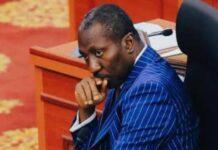

Legal practitioner and policy commentator Austin Kwabena Brako-Powers has sharply criticised the decision of the Amasaman High Court to reduce the 15-year jail sentence imposed on self-styled evangelist and priestess Patricia Asiedu, popularly known as Agradaa, to 12 months.
Speaking in reaction to the ruling on 3FM’s Midday News on Thursday, February 5, 2026, M Brako-Powers acknowledged that appellate courts possess the legal authority to vary or reduce sentences, describing the reduction as “surprising, but not new.”
However, he questioned whether the extent of the reduction was consistent with Ghana’s criminal justice framework.
“The key question people will be asking is, is this really legal. And the answer is that the imposition of jail time or years of imprisonment is discretionary,” he explained, adding that “Judges have discretion, but sometimes they must take solace from the law or act within the legal framework.”
Mr Brako-Powers was reacting to the Amasaman High Court’s decision reducing Agradaa’s 15-year jail term to 12 months.
The lawyer and artificial intelligence (AI) researcher pointed out that Agradaa was convicted on charges rooted in fraud and charlatanistic advertising, offences he described as serious crimes under Ghana’s criminal law regime. He stressed that the nature of the offences places them far above minor criminal conduct.
He noted that defrauding by false pretence, one of the offences forming the basis of Agradaa’s conviction, is classified as a second-degree felony under Section 131 of Act 29 and Section 296 of Act 30, which provides for a maximum sentence of up to 25 years’ imprisonment.
“To reduce a sentence from 15 years to just 12 months is to collapse a second-degree felony into the realm of a misdemeanour,” Mr Brako-Powers argued. “That is where the absurdity lies. Judges have discretion, but discretion must take solace in the law.”
He explained that under Ghanaian law, misdemeanours typically attract custodial sentences of up to three years, warning that a 12-month sentence sends a troubling signal about the gravity with which serious economic crimes are treated.
According to Mr Brako-Powers, the ruling risks undermining deterrence, particularly for individuals engaged in spiritual, religious, or pseudo-religious practices that exploit vulnerable members of society.
“This decision tells people in that business that even if you are convicted for a serious felony, the consequences may be minimal,” he said. “That is dangerous for the integrity of our justice system.”
He further argued that the sentence reduction weakens public confidence in the courts and erodes the deterrent purpose of criminal punishment, especially in cases involving mass deception and financial exploitation.
Mr Brako-Powers suggested that the State retains the option to escalate the matter, either through further legal processes or broader policy reforms, to ensure sentencing consistency and public accountability.
“One year is too lenient. It trivialises the offence and makes a mockery of the law,” he asserted, adding that sanctions must be sufficiently robust to discourage similar conduct.
He concluded by warning that while judicial discretion is essential, its misuse—or perceived misuse—can have long-term consequences for the credibility of Ghana’s criminal justice system.
“This was a second-degree felony, not a trivial offence,” Mr Brako-Powers stated. “Reducing the sentence to 12 months has made a mockery of the law and the justice system as a whole.”