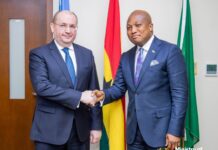

The Russian Ambassador has informed the Government that Russia is unable to confirm whether the suspect in question is a Russian.
That position should not be accepted at face value, nor should it mark the end of Ghana’s inquiry.
The Government must urgently retrieve and review all immigration records relating to the suspect, including entries and exits—particularly the period during which he is believed to have left Ghana.
These records should clarify where he resided, whether he was employed in Ghana, and under what legal authority. His work permit status must be examined, along with whether he entered the country on visa-on-arrival or under another immigration category.
It is also necessary to establish whether Kotoka International Airport has biometric or facial recognition systems capable of confirming his identity and travel movements. In a matter of this seriousness, every available technological tool should be deployed.
This issue must not be allowed to fade from public or governmental attention. Russia may, at a later stage, seek to rely on its well-known policy of not extraditing its citizens. That possibility makes it even more critical for Ghana to act decisively now, especially while the suspect’s nationality remains unverified.
Disturbingly, reports indicate that one of the suspect’s victims in Kenya died by suicide after contracting HIV. This transforms the case from a conventional criminal investigation into a matter of grave public health concern.
If multiple victims were infected, there is a real risk of further transmission. Containment measures, contact tracing, and testing are therefore not optional—they are essential.
From an international law and security perspective, Ghana must also consider its next steps if cooperation is not forthcoming. Prosecution should proceed, and if necessary, a conviction in absentia should be pursued. Once the suspect’s nationality is conclusively established, Ghana may petition Interpol on the basis that he poses a serious, tangible, and ongoing threat to public safety.
The documented harm in Kenya and Ghana, combined with a conviction in Ghana, would demonstrate that—wherever he has fled—the suspect remains a significant public health and security risk. International mechanisms exist for precisely such circumstances, and Ghana should not hesitate to invoke them.