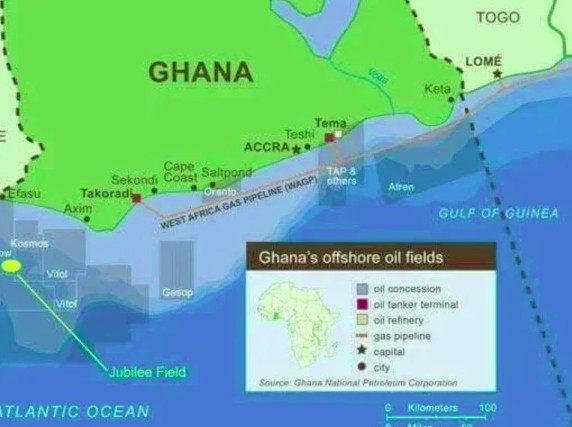

The Government of Ghana has formally notified the Government of Togo of its decision to submit the maritime boundary dispute between the two countries to international arbitration under the United Nations Convention on the Law of the Sea (UNCLOS).
In a press statement issued on Friday, February 20, 2026 by Felix Kwakye Ofosu, Spokesperson to the President and Minister for Government Communications, the Office of the Presidency indicated that the move follows eight years of negotiations that have failed to produce an agreed outcome.
According to the statement, Ghana has taken the step to avoid further escalation of incidents that have created tensions between institutions in both countries.
The government said it aims to promote an amicable resolution to the dispute while safeguarding the longstanding cordial relations between Accra and Lomé.
Ghana’s decision marks a significant development in efforts to resolve the long maritime boundary issue between the two West African neighbours through internationally recognised legal mechanisms.

This is the second time Ghana has referred a maritime boundary dispute to the United Nations Convention on the Laws of the Sea (UNCLOS).
In September 2014, Ghana referred a maritime boundary dispute with Côte d’Ivoire to the International Tribunal for the Law of the Sea (ITLOS).
Cote d’Ivoire staked a claim to parts of Ghana’s offshore a year after Ghana discovered oil in commercial quantities in June 2007.
Following 10 failed bilateral talks between the two countries in the 2014, Ghana decided to turn to Special Chamber of the International Tribunal for the Law of the Sea (ITLOS) under the rules set out by the United Nations Convention on the Laws of the Sea (UNCLOS) to protect the country’s interest and that of oil companies who have invested millions of dollars in the exploration of oil at some of the disputed areas.
In September 2014, Ghana emerged victorious in the case which has positive implications for the country’s oil and gas industry and development.
In that case, the Special Chamber of the International Tribunal for the Law of the Sea (ITLOS) constituted to hear the dispute unanimously declared that Ghana had not violated Cote d’Ivoire’s sovereign rights with Ghana’s oil exploration activities.
It also held that Ghana was not financially obligated to Cote d’Ivoire with respect to those activities to give rise to the issue of reparation (compensation).
The tribunal further rejected Cote d’Ivoire’s claim that Ghana disobeyed the tribunal’s April 25, 2015 preliminary orders which directed that new wells should not be drilled in the disputed area.
It also rejected Cote d’Ivoire’s claim that Ghana violated Article 83 of the United Nations Convention on the Law of the Sea (UNCLOS) and Cote d’Ivoire’s sovereign rights.
Article 83 of the UNCLOS, 1982, borders on agreement between states with opposite or adjacent coasts on the delimitation of customary boundary lines based on agreement on the basis of international law to achieve an equitable solution.
The Special Chamber held that it had jurisdiction to delimit the maritime boundary between the parties in the territorial sea, in the exclusive economic zone and on the continental shelf, both within and beyond 200 nautical miles (NM).
It, accordingly, found that there was no tacit agreement between the parties to delimit their territorial sea, exclusive economic zone and continental shelf, both within and beyond 200NM, and, therefore, rejected Ghana’s claim that Côte d’Ivoire was estopped from objecting to the customary equidistance boundary.
It, however, adopted Ghana’s argument for the equidistance boundary.
For that reason, it unanimously rejected Ghana’s position that there had been a tacit agreement between it and Cote d’Ivoire for more than four decades and, accordingly, proceeded to draw a new and binding boundary for the two countries.